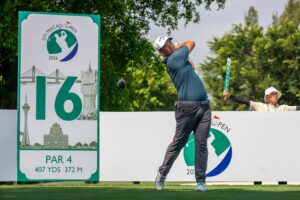
Imagine a golf course consisting of the most iconic and challenging holes on the Asian Tour.
A fictional hybrid-layout that features one of the region’s standout opening holes, one of the finest second holes and goes all the way through to an epic 18th.
A layout that would be the ultimate challenge – where breaking par is a monumental achievement.
Well, just such a virtual course now exists, as an Asian Tour panel of experts has selected the appropriate holes to make up what is the golf course of all golf courses in Asia.
With a par of 70 and length of 7,430 yards, we have appropriately named it The Asian Tour Monster.
To navigate us through The Asian Tour Monster, we asked players and experts to describe each hole – all of which have played key roles in many of the biggest tournaments on the Asian Tour.
Let us know what your think on our social media channels – Facebook, Instagram, Twitter.
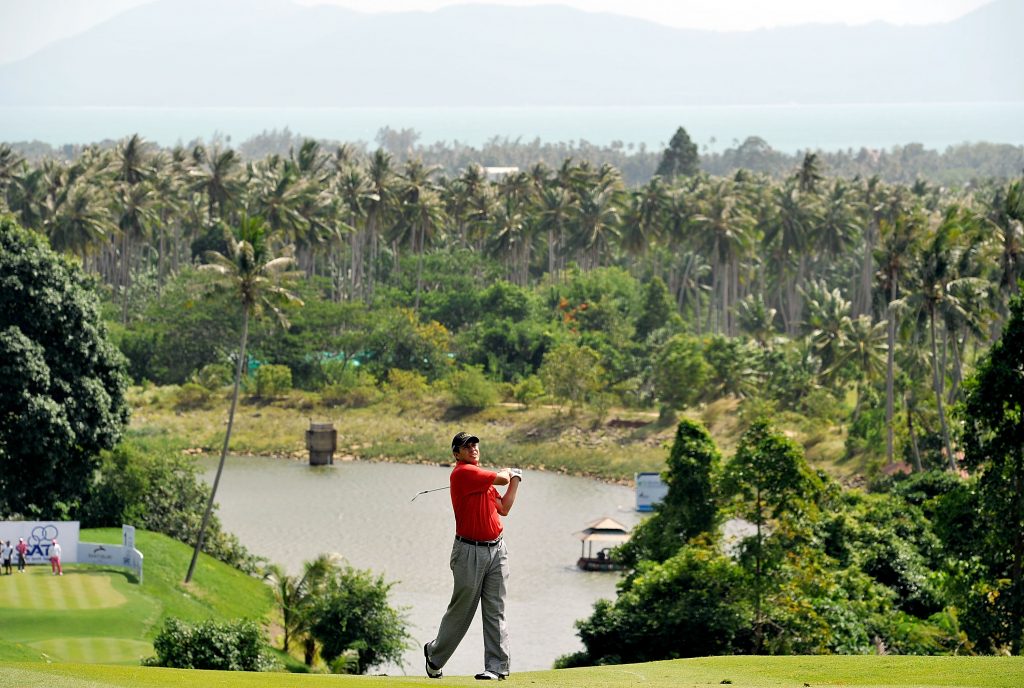
KOH SAMUI, THAILAND – JUNE 17: Adlison Da Silva of Brazil in action at Santiburi Samui Country Club on June 17, 2012 in Koh Samui, Thailand. (Photo by Paul Lakatos/Asian Tour/Asian Tour via Getty Images)
Par: Four
Yardage: 339 yards
Hole scoring average: 4.34
Asian Tour event hosted: Queen’s Cup
Where better to start this iconic course than the holiday island of Koh Samui in Thailand.
But, as with all the holes on The Asian Tour Monster, it is not a hole where you can take a vacation.
Contrary to the name of the hole – which is ‘The Flat Land’ – it is a steep uphill and treacherous opening par four, also widely known as the “Beast of Samui”.
Although it only requires a long-iron or a hybrid off the tee, the precarious elevated fairway is fringed with penalty areas and rocky outcrops. Provided you manage to find the fairway, a mid-iron will then be required for your approach shot. The severe two-tier green which is also elevated will require all your attention as it will most likely yield three putts or more if you are on the wrong level with your approach shot.
The hole is normally played as the 10th by the club members.
“A tall tree is planted just right of the buggy path about 180 yards off the tee which overhangs the fairway. I have seen balls hit that tree and bounce right into the jungle; drop straight down onto the buggy path and basically roll back down to the tee (because of the massive upslope); or hit the tree and disappear altogether.
The second shot – if the fairway is successfully found – will be anywhere from 160 to 180 yards to a green 15 yards higher than the fairway. The green is two tiered – with the tier itself close to four feet.
Hit the ball on the top tier when the pin is on the lower level and players will putt the ball off the green, without a doubt. Hit the ball on the lower tier when the pin is set on the top level … well then players will feel a flex in the putter shaft because of the unusually big swing they have to make.
The placement of this hole, as the opening hole, is perfect to ruin a good round of golf.”
Anthony Kang: a three-time Asian Tour winner and now part of the Asian Tour’s television commentary team.
Par: Four
Yardage: 493 yards
Hole scoring average: 4.27
Asian Tour events hosted: Maybank Championship, Malaysian Open
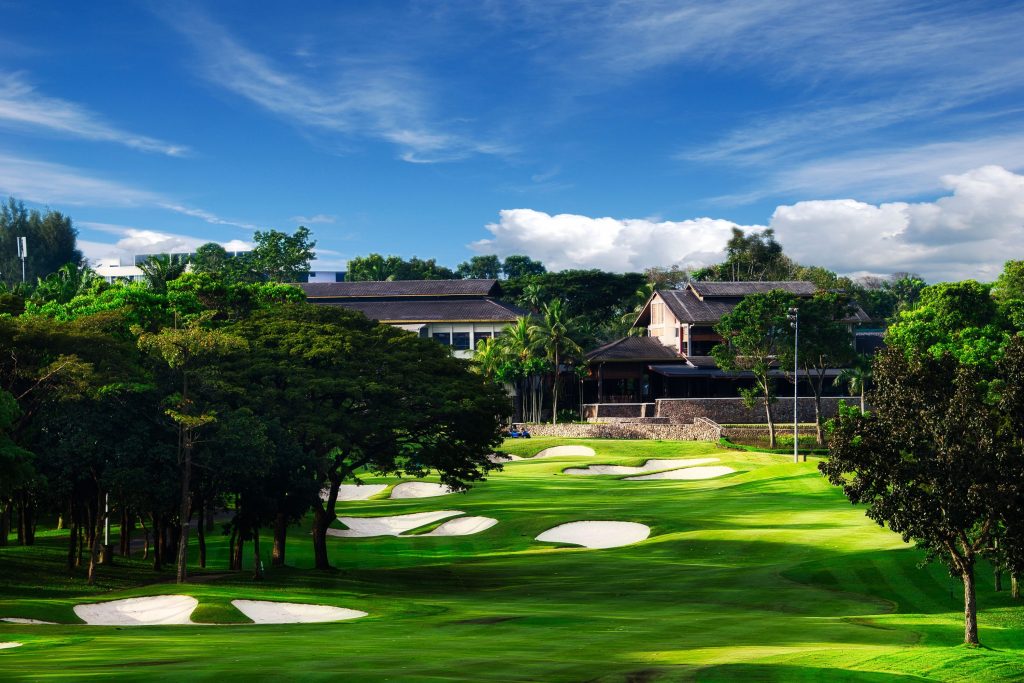
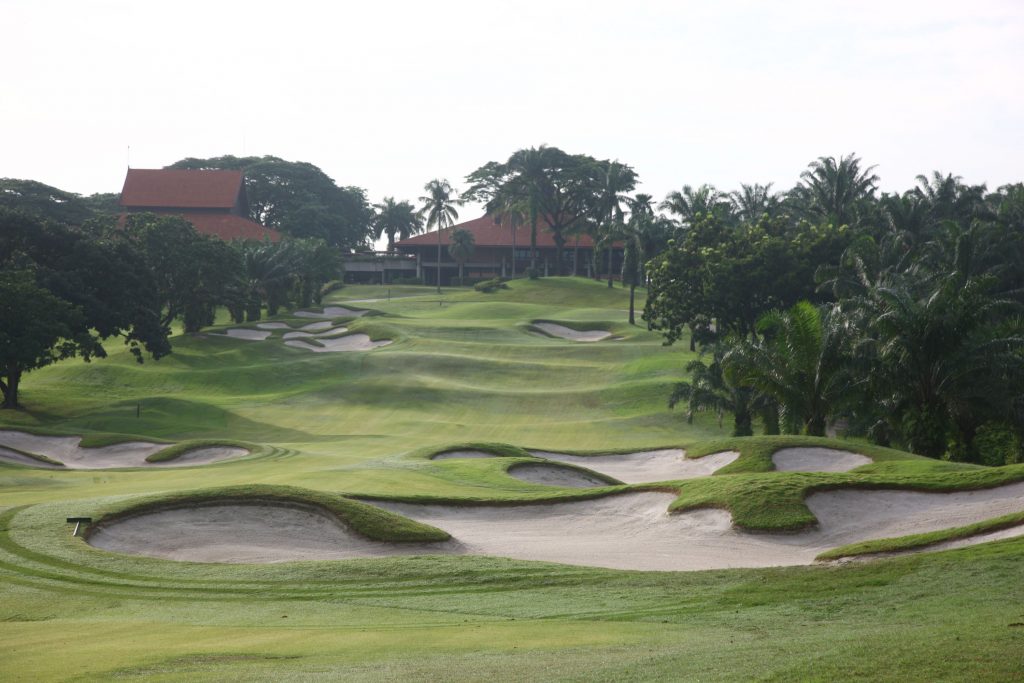
The second hole of the Palm Course at Saujana Golf & Country Club is a true test. Its length alone is enough to make you gasp at what awaits. A very narrow fairway flanked by several bunkers, palm trees and dense jungle on the right waits to punish any wayward drive. The second shot requires a mid to long iron to a green where the surface is not visible due to the steep elevation change. Multiple bunkers encompass the large two-tiered green – so making sure your approach shot is on the correct level is imperative.
“The second hole at Saujana is a bit of a difficult one because it is quite long. Much depends on which way the wind is blowing, if it is a little into the wind I will aim down the left with a driver with a little fade – to get past the fairway bunker on the right. But if there is no wind, and conditions are favourable, I will hit a three wood down there.
For the second it can anything from a six to a nine iron into the green – depending on where the pin and wind is. Normally I just try and get my shot to the middle tier if the pin is at the back or if the pin is at the front I always try to get it to the front edge – because if you don’t get up on the green it rolls back down. Definitely stay away from the right hand front bunker because it is just dead in there, because it is so deep. It is just one of those holes where you have to respect making a four and get out of there and you are happy with it.”
Scott Hend: a 10-time winner on the Asian Tour, the 2016 Asian Tour Order of Merit champion and winner of the 2019 Maybank Championship – played on the Palm Course at Saujana.
Par: Four
Yardage: 448 yards
Hole scoring average: 4.5
Asian Tour event hosted: Bangabandhu Cup Golf Open
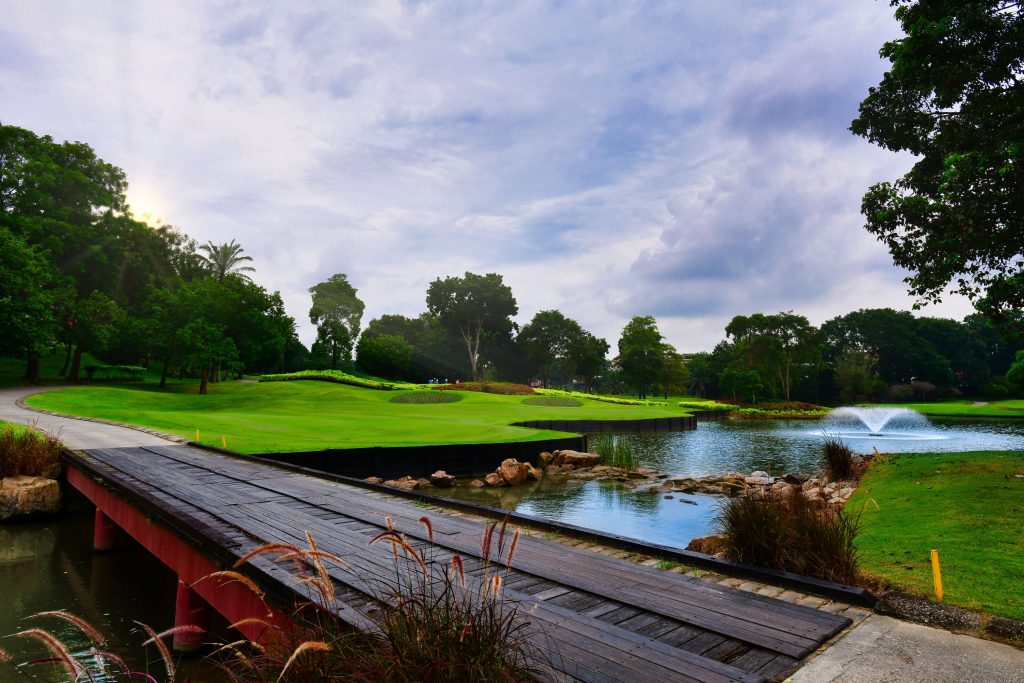
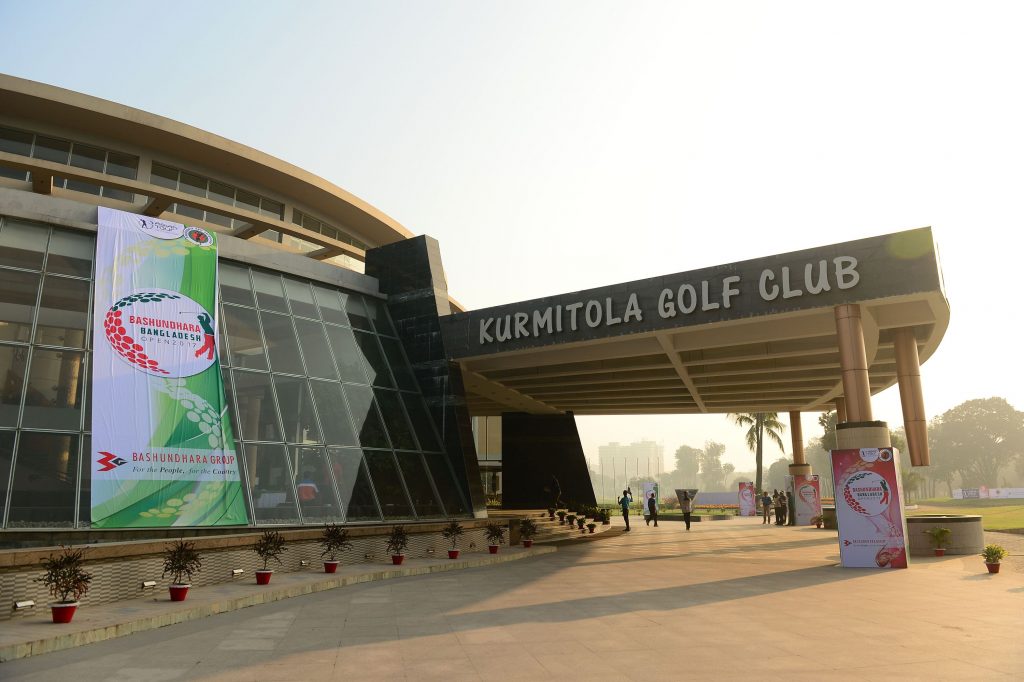
With its tree-lined fairways and intimidating water features, the third hole at Kurmitola Golf Club can challenge every aspect of your game. Off the tee you need a well-struck drive to the corner of a narrow fairway, which doglegs to the left. Bunkers await on either side to swallow any stray drive and any attempt at cutting the corner can result in disaster – as an OB looms nearby. There is also the possibility of losing your ball due to the dense treeline. Even if you manage to negotiate the tee shot, you are still left with a long-iron to a shallow undulating green which yields very few birdies.
“I grew up on this course and we always play it as a par five. For me this hole is a standard par five and as one of the shorter hitters on Tour I can handle it. But when the Asian Tour are here in Bangladesh we play it as a par four and it is a really hard hole for all of us!
But now days I am hitting it a little bit longer and I can make birdies more often here. I had a chat with myself and said I have played many par fours on Tour that are more difficult than this hole, so I am now mentally stronger playing the hole.
Before, I would play driver, then lay up 100 yards to the pin because I am very strong anywhere from 100 yards. Nowadays, I play driver and then a 22-degree hybrid.”
Siddikur Rahman: a two-time winner on the Asian Tour, two-time champion on the Asian Development Tour, and the first golfer from Bangladesh to win on the Asian Tour – at the Brunei Open in 2010.
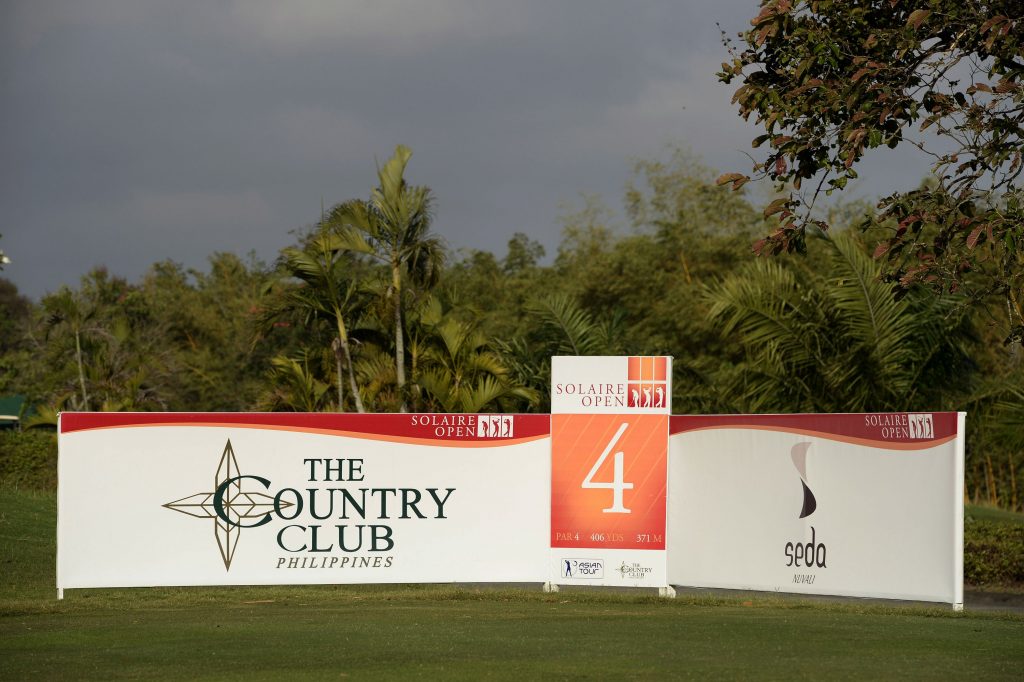
MANILA-PHILIPPINES-The Solaire Open at The Country Club, Manila, Philippines, March 13-16, 2014. a US$ 300.000 Asian Tour event. Picture by Paul Lakatos/Asian Tour.
Par: Four
Yardage: 406 yards
Hole scoring average: 4.52
Asian Tour event hosted: Solaire Open
On this slight dogleg right par-four, a driver is usually required as the further you hit, the wider the landing area is going to be. The purpose-built gap in the fairway to intentionally stop players from laying up is just merciless! Your thought process is tested even more with the OB to the left and water all the way down the right. Once you have recovered from the stress of the tee shot, a small elevated green awaits – which, if you miss the green with your approach, is very difficult to get up and down from.
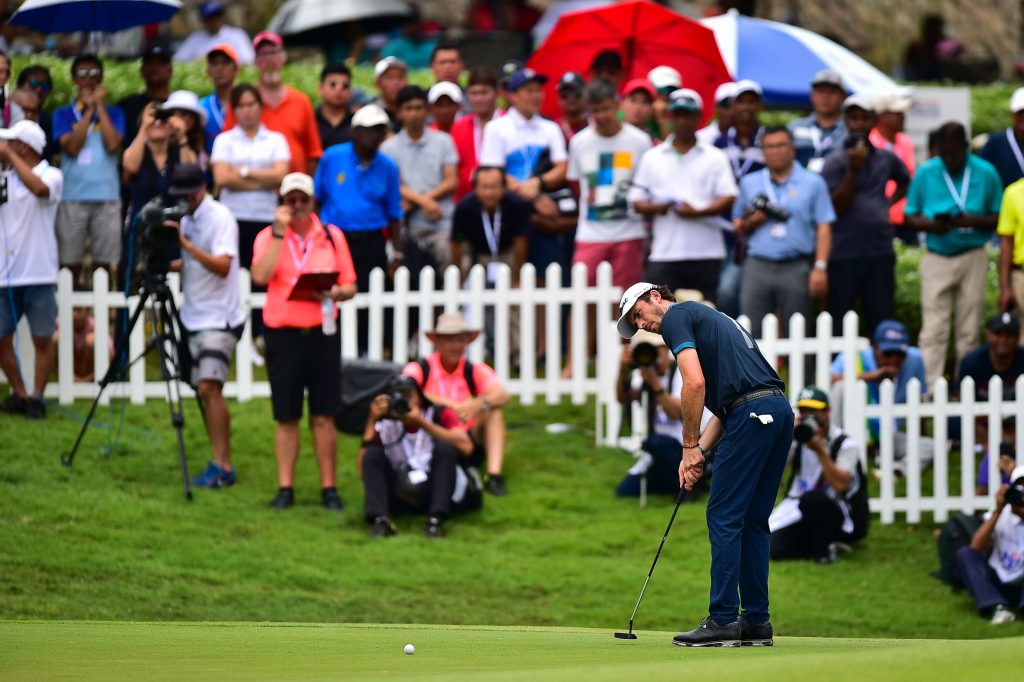
The Country Club hosted the Solaire Open in 2014 which saw Canada’s Richard T. Lee triumph. Lee double bogeyed the fourth hole on the final day, but recovered brilliantly to claim his first Asian Tour title. That week there were two quintuple bogeys and five quadruple bogeys on the fourth.
“It is a narrow hole with a wind blowing normally, making it a real test. As the wind always blows right to left you have to start the ball at the ravine on the right otherwise you are in danger of going OB left. The fairway is only about 25 metres wide and with the wind and distance it plays quite long, so you need a driver and a mid to long iron to get to the putting surface.”
Koh Dengshan: a former Singapore national player, now Asian Tour regular and touring professional with Sentosa Golf Club.
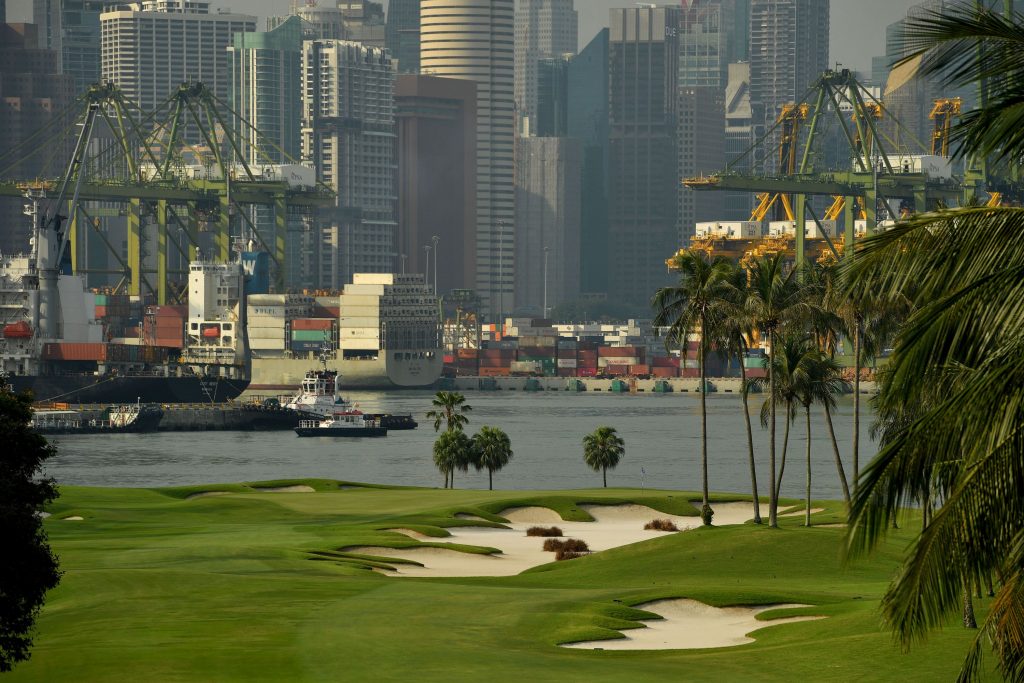
SINGAPORE – Serapong course at Sentosa Golf Club, Singapore, September 10-15, 2017. Picture by Paul Lakatos/Sentosa Golf Club.
Par: Four
Yardage: 486 yards
Hole scoring average: 4.23
Asian Tour event hosted: SMBC Singapore Open
The signature hole on the Serapong Course at Sentosa Golf Club boasts wonderful views of the Singapore skyline that look out onto one of the busiest ports in the world. However, do not allow these views to distract you. This demanding par four, especially when played into the wind, requires your best drive of the day to give yourself the shortest possible approach shot into this shallow and firm green. For shorter hitters this may still require a wood.
The landing area off the tee is fairly generous with large bunkers on either side of the fairway. However, club selection for your approach shot needs to be spot on. A yawning waste bunker stretches its way up the right side of the fairway ready to swallow any mishit shot, and any over-clubbed shot will likely end up in the sea!
“I really dreaded playing this hole during tournament play, simply due to its sheer length. Pars, let alone birdies, were hard to come by, especially when the pin was tucked on the right portion of the green where the water starts to come into play.
When this hole plays its full length, I would need to hit a solid drive and then try to figure out how to keep the ball on the firm green with a long iron in hand.
I think my greatest joy playing this hole came when, on one occasion, my drive hit a sprinkler head and gave me an extra 40 yards, making my approach shot that much shorter, but I still made a bogey!
Make a par on this hole and you will definitely gain at least half a shot on the field!”
Unho Park: an Asian Tour player for 20 years, now a Tour administrator.

Hole 6, par-3.
December 22, 2010. Thai Country Club, Bangkok, Thailand. Mandatory credit: Richard Castka/Sportpix International
Par: Three
Yardage: 227 yards
Hole scoring average: 3.17
Asian Tour events hosted: Thailand Open, Volvo Masters of Asia, Asian Honda Classic
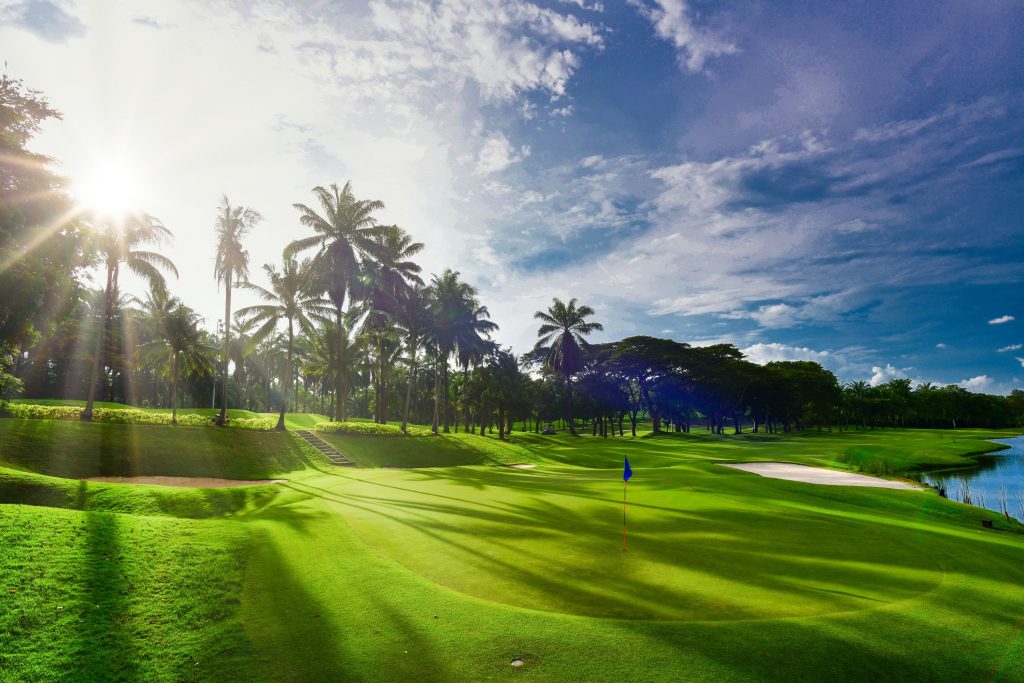
The par-three sixth hole is the signature hole at Thai Country Club. It is a long par three over water with strong head winds more often than not. The smart play is to aim for the left side of the green in order to avoid the penalty area and bunker on the right. However, if you stray too far left, the undulations will most certainly throw your ball further away from the green, leaving a tricky up and down to make par. This is just a brute of a par-three where its sheer length just makes playing this hole strenuous.
American John Catlin – who recently won the Andalucia Masters at Valderrama on the European Tour – parred the hole in his first three rounds during the 2019 Thailand Open and made birdie on Sunday, which paved the way for him to secure his fourth Asian Tour title.
“It is a long par three. Off the back it is about 220 – 230 yards to the middle of the green. The wind mostly blows in from the right, so I would have a three iron or five wood. There is a bunker and water on the right side so anything from the middle of the green to the left side is the perfect shot. I will take a three any day there. It is not a birdie hole. You have to be conservative. I had four pars during the Thailand Open in 2018 when I won there, I didn’t lose any strokes there but didn’t make any either.”
Panuphol Pittayarat: winner of the 2018 Thailand Open at Thai Country Club – which is his home club.
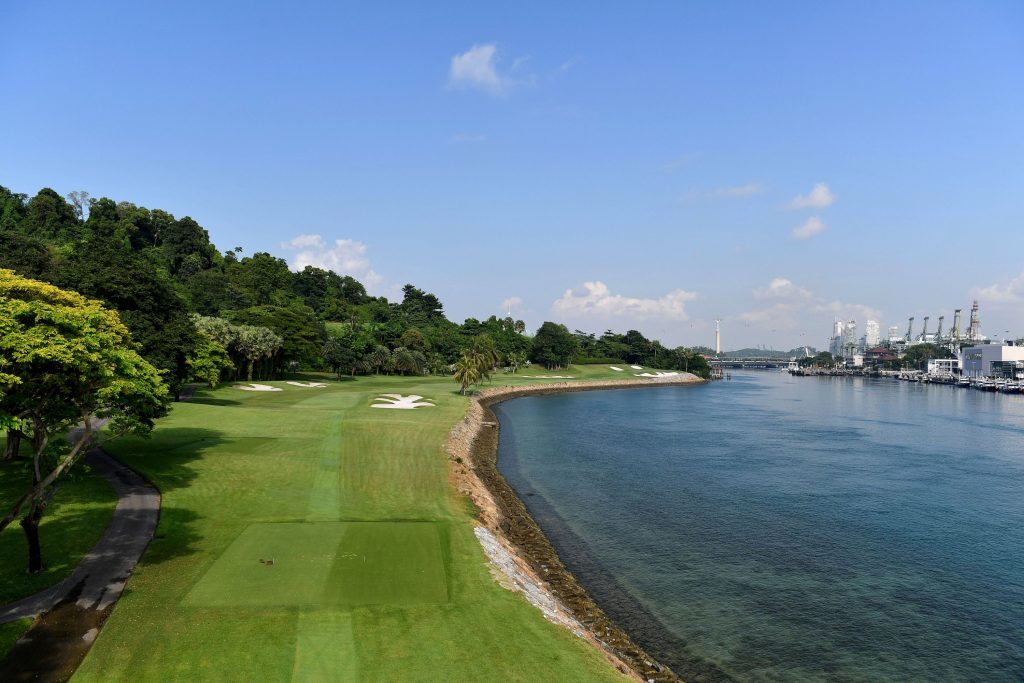
SINGAPORE – Serapong course at Sentosa Golf Club, Singapore, September 10-15, 2017. Picture by Paul Lakatos/Sentosa Golf Club.
Par: Five
Yardage: 587 yards
Hole scoring average: 5.01
Asian Tour event hosted: SMBC Singapore Open
You may think a par-five that averages near its par in tournament play is a simple enough hole but on the seventh hole on The Serapong, the devil is in the details. You are greeted on the tee with a magnificent turquoise ocean canal stretching the full length of the hole on the right.
With little to no rough on the right-hand side of the fairway, shots that veer right will almost certainly find the drink. The left side of the hole also intimidates you with dense tropical jungle. If you are skilled enough to thread your tee shot between the fairway bunkers, you are left with a very tricky lay-up that needs to be precisely planned and executed to the narrowest part of the fairway.
Any miscue can be calamitous as this year’s SMBC Singapore Open champion, Matt Kuchar, found out by carding an eight in the final round. After a poor tee shot, which went left into the trees, an unexpected air shot ensued while trying to extricate his ball from tree roots. A pulled approach shot, which ended up out of bounds, also did not help his cause. Remarkably, he did not drop a shot after, played the back nine in four under, and beat Justin Rose by three!
“It is a very good hole. It depends how you drive that hole. If you hit a bomb off the tee, 320 yards, you can reach the green in two. But then you still have to hit a quality shot to get on the green. I don’t hit the ball so long these days so I lay up with a three wood, then a four iron and a pitching wedge or nine. The hole is also one of the most scenic on the course.”
Mardan Mamat: a five-time Asian Tour champion and Singapore’s pioneering professional golfer.
MANILA, PHILIPPINES – The ICTSI Philippine Open at the Wack Wack Golf and Country Club on February 9-12, 2012 in Manila, Philippines. Photo by Paul Lakatos/Asian Tour.
Par: Three
Yardage: 191 yards
Hole scoring average: 3.55
Asian Tour event hosted: Philippine Open
The original design of this eighth hole was a lot shorter, requiring only an eight or nine iron to a postage-stamp type green, which was raised even higher than it is today. With its increased length and slightly lowered green, it is still as formidable as ever and can mentally rattle anyone’s nerves when standing on the tee box.
The view of a severely elevated narrow green sloping from back to front and guarded by multiple deep bunkers gives birth to unimaginable scenarios if you fail to hit this green. Although it may sound simple to blast out of the bunkers or chip onto the green after missing it, the nature of the green makes it almost impossible to get the ball on the green when trying to recover from the left or right.
“When I won the Philippine Open in 2008, that hole was played as the 17th hole. And it is funny because having played Wack Wack so many times, amongst friends we have always talked about what you would do if you go into that hole with a one-shot lead. And funny enough, it happened to me – I had a one shot lead in the Philippine Open in 2008. If you have played it long enough, and as much as you want to hit the green, you know you must miss it to the right.
Back then it was only an eight or nine iron but after I won they lengthened it from the back tees, it’s like a six iron now. So what I did was I made sure I aimed a bit more right and tried to hit a good shot, fortunately it landed on the green and just rolled off and ended up in the right bunker. The guy I was up against, Gavin Flint, also did the same thing, and we ended up making bogies but a par was good enough for me to win on the last.”
Angelo Que: a three-time champion on the Asian Tour and a winner on the Japan Golf Tour Organization.
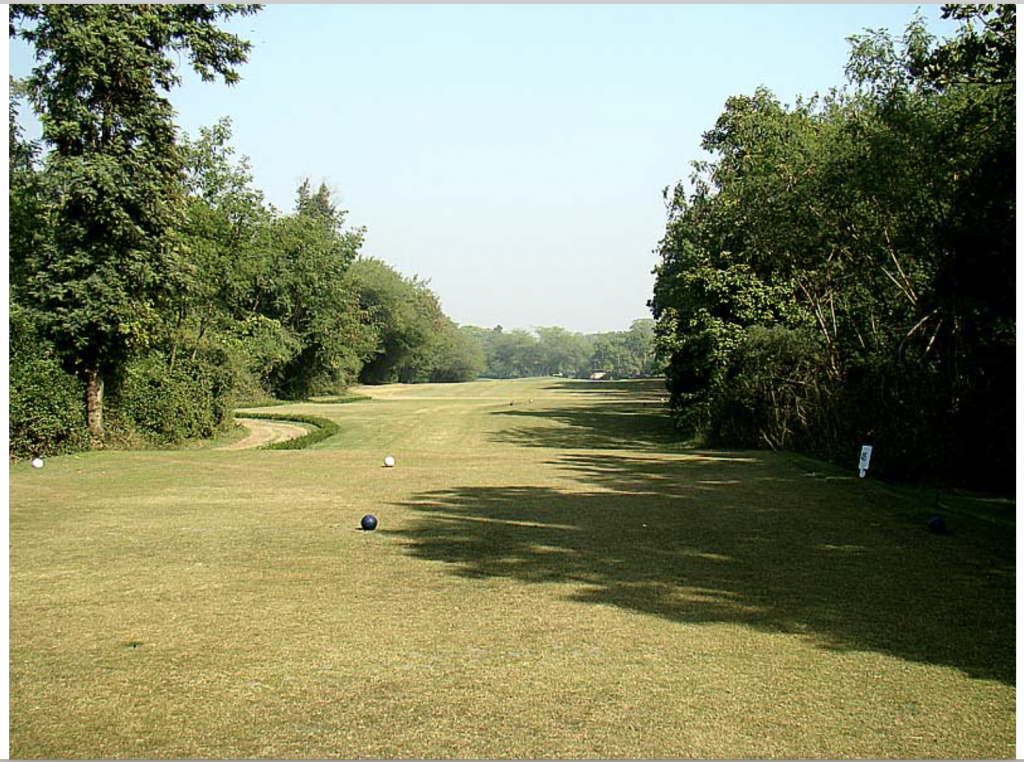
Delhi Golf Club, Hole #9
Par: Four
Yardage: 445 yards
Hole scoring average: 4.38
Asian Tour events hosted: Hero Indian Open, Panasonic Open India
The ninth hole at the Delhi Golf Club requires precision and makes even the most confident drivers of the ball tremble, especially when a tournament is on the line. This hole has a reputation for being extremely unforgiving with a narrow fairway and thorn bushes on either side. The hole does not have any significant water hazards but the bunkers, unforgiving rough and mature tree line more than make up for that.
You can choose to use either a three wood or long iron off the tee in order to find the widest part of the fairway, or in this case, the least narrow! But the challenge with this strategy means it leaves a mid to long iron approach shot to an undulating, multi-tiered L-shaped green guarded by well positioned bunkers and thorn bushes. The braver folk will opt to use a driver, however any miscue will most certainly result in playing three from the tee.
“As a member over there, it is probably regarded as the hardest hole on the course even though it is not stroke index one – simply because it gives you a few options. It is long enough to tempt you to hit a driver off the tee but it really narrows in at about the 270 to 280 yard mark – the fairway becomes half its width. It is a perfect risk reward hole if you are willing to man up and take it on with a driver, which really makes your second shot a lot shorter into a green that is quite demanding because it is a raised green that falls off to the right. The typical Sunday pin there was back right over a bunker and if you laid back too far, if you hit a three wood or a two iron off the tee, it would leave you too long a shot to be able to access that flag in anyway.
I have seen a lot of big numbers there; I have seen a lot of people lose tournaments there in the past; and I personally have made some high numbers on that hole. When we play tournaments there, the prevailing wind is normally into the wind and coming off to the left so that makes it even more demanding. It is about 440 yards, but it plays closer to 460 or 470. You also have bushes down the sides, so visually it is a very intimidating hole. I think some of the hardest holes in golf are the ones that are straight and not actually dog-legs. About five years ago there used to be a tree in the middle of the fairway, on the left half of it – it fell down in a storm. When that tree was there it made it even more challenging because if you hit anything up the left half you didn’t have a clear shot – so it was even more demanding before.”
Shiv Kapur: a four-time Asian Tour winner, and former Asian Games Gold medallist.
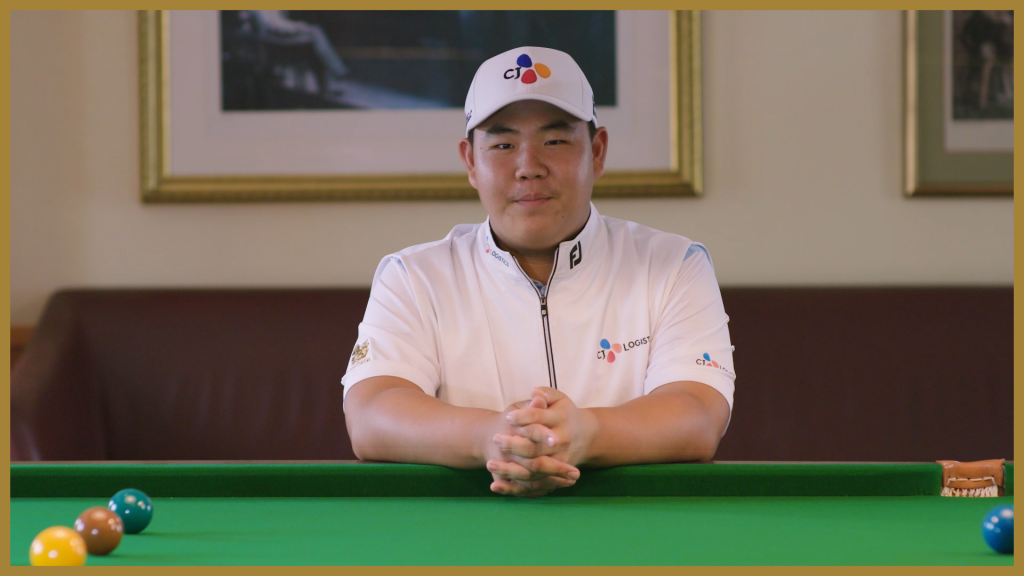
We caught up recently with Korea’s Joohyung Kim, who has been making a name for himself since joining the play-for-pay ranks in 2018. Find out more about the 18-year-old rising star in this latest feature. Kim will be making his regular PGA TOUR debut at the Safeway Open this week.
[embedyt] https://www.youtube.com/watch?v=_3wHmT2VlsM[/embedyt]
[embedyt] https://www.youtube.com/watch?v=_3wHmT2VlsM[/embedyt]
Korean wonder kid Joohyung Kim has revealed some of the keys to his early success prior to his regular PGA TOUR debut at this week’s Safeway Open – the opening event of the 2020/2021 season on the PGA TOUR.
And his father Changik Kim – a former Tour professional who played on the Buy.com Tour (now known as the Korn Ferry Tour) in the United States before becoming a teaching professional – has most definitely been the guiding force behind his meteoric rise.
“My dad didn’t teach me the basics first,” said the 18-year-old Kim.
“He made sure I just had fun. We always went to the golf club to eat, drive the cart and hit some putts. But as I started to take it really serious he always taught me to practice hard, swing mechanic wise.”
They were living in Australia when he first picked up a golf club aged five, or as he says: “a short baby club”. But it wasn’t until they moved to the Philippines, when he was aged 11, that he really started to take the game seriously.
“Basically, my parents taught me was always to practice hard and be humble. And I feel like that was the most important lesson of all. And always will be,” added the Korean.
Kim cleaned up on the amateur circuit in the Philippines – he won the 2017 Philippine Junior and the 2018 Philippine Amateur – before turning professional in 2018.
And since then he has established himself as one of the most exiting young players in the region with huge potential to be one of the dominant players in the game.

After earning a battlefield promotion from the Asian Development Tour by winning three events last season, the youngster made an instant impact by winning in just his third start on the Asian Tour at the Panasonic Open in India.
That made him the second youngest professional to win on the Asian Tour at 17 years and 149 days with countryman Seungyul Noh being the youngest when he won the 2008 Midea China Classic at the age of 17 years and 143 days.
Kim says his father, who is now 50 years old, is always on hand to offer advice.
“I ask him some stuff with golf because he is always with me and he knew my game ever since the beginning. So I feel like I can always go up to him and ask.
“My dad never plays. Doesn’t really have the time because he is always with me. But hopefully we can get a round one day. It would be fun to bring back the old memories. But he sometimes hits some chips and some putts, even hits one or two balls but nothing serious really.”
Kim also won on the Korean PGA Tour in July at the KPGA Gunsan Country Club Open – which was his first win on home soil and saw him become the youngest winner on that circuit at the age of 18.
It moved him inside top-100 on the Official World Golf Ranking (OWGR) and earned him a place in last month’s US PGA Championship – where he made his Major debut.

Despite his incredible success as a teenager, he is quick to downplay his achievements.
“I don’t think I have success at my age to be honest. I feel like I need to be better and I still lack so much,” he says.
“I’m fortunate to have some success yes, to break into the top 100 in the world, win once on the Asian Tour but I still have so many goals and feel like I need to accomplish so much more. So I don’t think I have success yet. And have so much to learn. I know I can play against the best.”
He adds: “I feel like it’s just really little by little that I need to sharpen. I’ve played against the top players in the world, so I know I deserve to be here. But I just need to be more consistent overall to get me to the top and get all aspects better.”
Travelling the world as a Tour professional will certainly not bother him after a globetrotting childhood.
He was born on the Jeju island in Korea, where they stayed for a few months. They lived in China for a few years, then Australia for seven years, followed by the Philippines for six years and Thailand for a year and a half.
“And now for the first time in my life Korea,” says Kim.
On his game plan for this week’s Safeway Open, Kim says: “This time not really focused on something. More of just feeling free. And one step at a time. And play my own game. If I can do that the rest will follow.”
Ends.
Photo credits: Sportfive
Few players have dominated one of Asia’s National Opens like Australian Adam Scott has with the Singapore Open.
He has lifted the trophy on three occasions in 2005, 2006 and 2010 – an impressive haul, surpassed only by Jumbo Ozaki’s five Japan Open victories and the four wins by Spaniard Miguel Angel Jimenez at the Hong Kong Open. Tommy Nakajima also won the Japan Open four times.
Scott has claimed the Singapore Open more times than anyone and his success was in synergy with the emergence of the prestigious event on The Serapong course at Sentosa Golf Club.
The tournament was not played from 2002 to 2004 before being relaunched in 2005 at Sentosa – where it has, so memorably, been played since.
So, Scott’s win in 2005 was the start of an exciting new chapter for the event while it was on this day 14 years ago that he successfully retained the tournament.
And what an exceptional win that was on an unprecedented Sunday.

Adam Scott of Australia
The Australian, 26 years old at the time, beat South African Ernie Els by two shots in a three-hole play-off in the US$3 million event.
He delivered the knock-out blow with a birdie at the par-five 18th to edge Els, after both players parred the first two holes – the 16th and 17th.
It was the 11th professional victory, but his first in 2006.
He coolly dropped in a five-foot putt while Els three-putted for bogey.
The rather unusual play-off format was the result of the fourth round being cancelled late on Sunday afternoon following two weather suspensions.
Organisers decided to reduce the event to 54-holes based on the scores after Saturday’s third round.
Hence, with Scott and Els tied on eight-under-par 205 after the third day the option was taken to complete the tournament with a three-hole play-off – much to the delight of the thousands of fans who had patiently remained on site waiting for a resumption.
“It’s the first time I have defended a title and it’s a great feeling and something that I will cherish. Like I said last year, it’s a great feeling to win a national Open and I’m really thrilled. It’s been a long time coming this win, since last year and hopefully I can keep going from here,” said Scott, who won US$475,500.
The fans were treated to a thrilling duel between the top two stars who matched each other blow for blow in the final round and the play-off. Els missed a birdie chance from 10 feet on the first extra hole on 16 while Scott saved par from five feet.
After both parred the 17th, Scott, the then world number six, gained the advantage on the 18th after an exquisite chip which left him five feet from the pin while Els struggled after a wayward drive put him in the shin-high rough. After finding the front of the green with his third, the South African agonizingly three putted from 25-feet.
“There wasn’t much separating Ernie and myself and whether that was over 72 or 54, or 65 holes which we played, it came down to a play-off and fortunately I won. I definitely feel I’m the winner of the tournament,” said Scott.

Ernie Els of South Africa
Els was naturally disappointed with the outcome. He said: “In the play off, I had my chances. I hit a good shot in to the 16th (to 10 feet) but did not hit the putt well. On 17 for some reason my tee shot came back – I was close to the hole but could not putt it.
“On the 18th I drove it right – just one of those things. On the third shot I was a club short, it was coming nicely on line but unfortunately it was not enough club. It is disappointing,” added the South African.
Australian Brad Kennedy took third place with his three-round total of 208 while China’s Liang Wen-chong settled for fourth position on 209.
The tournament had started with Filipino rookie Juvic Pagunsan and Scott Strange of Australia sharing the first round lead shooting four-under-par 67s.
However, on day two Els made his move surging up the leader board firing an imperious 65 – a course record at the time – to take a share of the lead with Strange.
Titleholder Scott then set up a mouth-watering showdown with Els after a 66 on Saturday. Els needed an injection to treat a bout of food poisoning during a two-hour weather disruption but he battled on gamely to finish the day tied at the top.
As expected the final round was a tight affair but a one hour and 40 minute delay in the morning due to lightning, and another torrential thunderstorm late in the afternoon, meant they could only complete eight holes before the fourth day was abandoned and the crowds eagerly gathered to watch the play off.
The tight finish was in stark contrast to Scott’s victory the year before when he sauntered to a seven stroke win over England’s Lee Westwood – that result happened this Friday, a mere 15 years ago.
Ends.
David Lipsky, the Asian Tour Order of Merit champion in 2014, hit the headlines very recently by winning the TPC San Antonio Challenge on the Korn Ferry Tour in July.
Interestingly, the American went to La Canada High School in Los Angeles – where his countryman Collin Morikawa, currently the hottest player in the game, also attended.
And Lipsky’s Korn Ferry Tour win, which was his first, came less than one hour after Morikawa earned his second success on the PGA TOUR at the Workday Charity Open.
It is evidence of the calibre of Lipsky – who also attended the prestigious Northwestern University in Chicago, where, amongst other, England’s Luke Donald enjoyed an outstanding college career.
To date, Lipsky has also claimed two titles both on the Asian Tour and on the European Tour.
And there is no doubt the biggest victory of his career so far came on this day six years ago in the Swiss Alps.

CRANS-MONTANA, SWITZERLAND – SEPTEMBER 07: David Lipsky of USA holds the winners trophy after winning in a playoff against Graeme Storm of England during the final round of the Omega European Masters at Crans-sur-Sierre Golf Club on September 7, 2014 in Crans-Montana, Switzerland. (Photo by Stuart Franklin/Getty Images)
In what was only his 18th start on the European Tour, he defeated Englishman Graeme Storm on the first hole of a sudden-death play at the Omega European Masters at Crans-sur-Sierre – an event steeped in history, with its origins dating back to the early 1920s when it was the Swiss Open.
Lipsky was 26 years old at the time and had only been a professional for three years but showed maturity beyond his years in the way he played the play-off hole.
He had started the final round two shots behind overnight leader Storm but, playing in the penultimate group, he charged through with a five-under-par 65 to set the clubhouse lead on 18 under.
That was helped by a birdie on the par-four 18th – where he hit his approach to within inches of the cup – and meant Storm needed a par there to force the tournament into overtime.
The Englishman duly made four meaning he and Lipsky finished one shot ahead of none other than emerging American star Brooks Koepka, who was tied for the lead until a bogey on the 17th, where his wayward approach plugged in a greenside bunker.
When they returned to 18 for the play-off, Lipsky played the hole very differently after his opponent hit a poor tee shot that missed the fairway and came to rest against a wall.
Storm had no option but to chip out on to the fairway.
Lipsky, who had just 86 yards to the hole from a bunker with his second shot, took no risks and laid up short of the green.
It proved to be the right decision as after he chipped close to the pin, Storm made a five, and he was left with a simple putt for victory.

CRANS-MONTANA, SWITZERLAND – SEPTEMBER 07: David Lipsky of USA celebrates winning in a playoff against Graeme Storm of England during the final round of the Omega European Masters at Crans-sur-Sierre Golf Club on September 7, 2014 in Crans-Montana, Switzerland. (Photo by Stuart Franklin/Getty Images)
Speaking about the play-off hole, Lipsky said: “It’s a tough tee shot anyway, but when there’s the title on the line it’s very tough.
“You have to draw your tee shot from right to left to hold it against the hill, and I thought I’d hit a great shot but it ended up going in the bunker.
“It was a tough shot out of the bunker and, with Graeme only going to make par at best, I decided not to risk going in the water. In the end it was the right play, and I’m so pleased to get the job done.”
Storm reflected: “It’s tough to take right now. I didn’t have much time between finishing my final round and starting the play-off, so I probably wasn’t as composed as I should’ve been.
“So it was obviously disappointing, but overall it’s been an unbelievable week. There is a lot of emotions flying round right now so I’ll have to reflect with a clear head in the morning, but there are definitely lots of positives to take from the week.”
Lipsky earned €383,330 for his triumph, putting the wheels in motion for claiming the Asian Tour Order of Merit title later in the year.

CRANS-MONTANA, SWITZERLAND – SEPTEMBER 07: David Lipsky of USA plays a shot during the final round of the Omega European Masters at Crans-sur-Sierre Golf Club on September 7, 2014 in Crans-Montana, Switzerland. (Photo by Stuart Franklin/Getty Images)
He became the first Asian Tour member to win the Omega European Masters since this event became part of the Tour in 2008.
And he was the first American to win the Omega European Masters since Craig Stadler in 1985.
Lipsky’s journey on the Asian Tour began when he won the Qualifying School in January of 2012. And, he was victorious in the Handa Faldo Cambodian Classic just two months later before a sensational 2014 thrust him into the international spotlight.
Two years ago he also claimed the Alfred Dunhill Championship in South Africa for his second win on the European Tour.
With European, Asian and Korn Ferry Tour wins to his name, he is building a mightily impressive portfolio of tournament wins across the globe.
But producing a more impressive victory than the Omega European Masters will take some doing.
Ends.
When Australian Scott Hend claimed the Pertamina Indonesia President Invitational on August 31 in 2008 he would have, understandably, been oblivious to the significance of the occasion.
A relative newcomer to the Asian Tour – the previous season he was Rookie of the Year – the victory was his maiden win on the circuit, but more importantly it was the one that opened the floodgates.
Indeed, on this day 12 years ago, the Asian Tour witnessed the arrival of a golfer who would become one of the circuit’s most dominant players.
The big-hitting Australian would go on to win nine more times and monopolise the Order of Merit.
And the signs of this success were very evident in his impressive victory at the Pertamina Indonesia President Invitational – which was played at Damai Indah Golf and Country Club in Jakarta.

PIPI08-PRIZE PRESENTATION-The Pertamina Indonesia President Invitational at the Damai Indah Golf and Country Club,’s, Pantai Indah Kapuk course, Jakarta, Indonesia. 28-31, August, 2008. Picture by Paul Lakatos/Asian Tour.
He started slowly in the US$400,000 tournament but this was merely a smoke screen for what was to come over the weekend.
His opening round of one-under-par 71 left him with much to do as the best of the day was a 64 carded by Lin Wen-tang from Chinese Taipei – an in-form golfer, who had won earlier in the year at Asian Tour International in Thailand.
Even though Hend improved with a 69 on day two, he was five behind Malaysian Iain Steel – who took the lead on nine under with a 66.
Hend’s game then found a new dimension over the weekend and although his third-round 66 left him five adrift of tournament leaders Lin and Steel, the Australian was perfectly placed to mount a challenge.
Since joining the Asian Tour in 2007 he had finished second on three occasions and was one of the hottest golfers on Tour who was more than ready for a maiden victory.
Paired in the penultimate group on the last day with Korean-American Anthony Kang, he trailed Lin by three at turn.
Quickly responding to the challenge at hand, he made an eagle on the par-five 13th – impressively for the second day in-a-row. Lin made a par there, so the gap was down to one.
But another two shot swing soon followed when the Chinese Taipei golfer found water on the par-three 15th and made double-bogey.
It was the break Hend was looking for and from there he did not look back. The victory was secured when he made another birdie on the par-five 17th, where Lin dropped another shot.
Hend’s back-nine of four-under-par 32 and second successive 66 saw him win by three shots from Lin with a tournament total of 16-under.
Kang, Thailand’s Udorn Duangdecha and Mars Pucay from the Philippines finished third.
“I had a few runner-up finishes which is nice financially but there is nothing like winning a tournament. It is truly satisfying,” said Hend, after his win.
As a result of his success, Hend walked away with the top prize of US$63,400.
“I was solid on the back nine. I was thinking that if I shot a six under, I’ll be happy no matter what the outcome, even if I had not won. There was no real pressure and my putting was average,” he added.
“The eagle was great. I struck a solid drive and then almost holed my second shot. I told myself that I had to play solid and everything came together. I got ahead of myself on a few holes but I kept a steady momentum and I’m very happy with my finish.”
Lin’s final round 74 opened the door for Hend but he was magnanimous in defeat.
He said: “My iron play was good so I thought I could be aggressive on the 15th hole but I was too fast off the tee and the ball found the water. I also bogeyed the 17th hole. But it was a good game by Scott who played well under these challenging conditions. There are still more tournaments to play this year, so I hope to follow my rhythm and stay in contention.”
Up until that point in his career, Hend had won four times in Australia and once in Canada but the Pertamina Indonesia President Invitational was the big breakthrough victory he had been looking for.
In 2004, he decided to play on the PGA Tour but after two poor seasons because of injuries and loss of form he turned his attention to Asia and the Asian Tour Qualifying School in 2006.
And he says: “I finished second to Ben Leong (at the Qualifying School). My kids where born in December 2006 and then I went straight to Pakistan and finished second and from there on it was ‘happy days’ on the Asian Tour.”
In 2016, he became the first Australian to win the Merit title and, impressively, he also finished second on three occasions – in 2013, 2015 and 2019 – and was fourth four times – in 2007, 2009, 2014 and 2017.

KUALA LUMPUR, MALAYSIA – MARCH 24: Scott Hend of Australia holds the trophy after he wins the play off match against Nacho Elvira of Spain during Day Four of the Maybank Championship at Saujana Golf & Country Club, Palm Course on March 24, 2019 in Kuala Lumpur, Malaysia. (Photo by Andrew Redington/Getty Images)
And when he claimed his 10th Asian Tour title in March 2019 – the Maybank Championship in Malaysia – he moved into second place on the Career Money List.
He is still in second place today with earnings of US$5,084,342 while Thailand’s Thongchai Jaidee – a 13-time winner on the Tour – leads the way with winnings of US$5,744,337.
Hend has been playing on the European Tour’s “UK swing” over the past few months, will compete in the US Open in September and will no doubt be looking forward to returning to Asia when the time is right.
Ends.
Cast your eye down the list of past champions of Singapore’s National Open and one of the winners who stands out – with a truly inspirational story – is Shaun Micheel.
The American triumphed, on this day, in 1998 at SAFRA Resort & Country Club, and, as is well documented, went on to record a remarkable victory in the 2003 PGA Championship – at Oak Hill Country Club in New York.

ROCHESTER, NY – AUGUST 17: Shaun Micheel of the USA holds the trophy after winning the 85th PGA Championship at Oak Hill Country Club on August 17, 2003 in Rochester, New York. (Photo by Jamie Squire/Getty Images)
That is two “Major” victories, some would say – particularly if you are a lover of the Singapore Open.
No doubt, the seeds for Micheel’s win in the PGA Championship were sown in Singapore 22 years earlier.
In 1998, he had decided to play in Asia in order to find his form.
“After I lost my PGA Tour exemption in 1997, my manager, at the time, mentioned going to Asia with Charlie Wi – who he also managed. He felt like a complete change of scenery might help me regain the confidence that I lost after a poor year on the PGA Tour,” said Micheel from his home in Tennessee last week – after having played in the Bridgestone Senior Players Championship on the Champions Tour.
He had started his professional career in 1992 on the Sunshine Tour in South Africa and because of that experience, he felt comfortable going to Malaysia to go through the Asian Tour qualifying process. The Tour at that time was called the Omega Tour.
Having negotiated the rigours of Qualifying School, he was quick to establish himself on Tour.
Early on in 1998, he pushed Thailand’s Chawalit Plaphol and Boonchu Ruangkit all the way in the Orient Masters in China. He eventually finished in a share of third, behind Chawalit – who claimed what was to be the first of many wins on Tour – and the legendary Boonchu, who finished second.
Says Micheel: “The competition was really good and I knew that if I could find some consistency, I would have a chance to get back onto the PGA Tour.”
The game plan worked and the consistency he so desperately wanted started to return; in the lead-up to the Singapore Open he was regularly in contention and on the cusp of a breakthrough win.
“You know, I don’t remember too much about the state of my game going into Singapore. One thing stands out, however, as I prepared to travel to Singapore. The week before I left, I asked my, then, girlfriend to be my wife. At the time I had known Stephanie for 16 years and we had been dating for nearly five years. I suppose that I felt quite encouraged about my engagement and that gave me the extra lift that I needed to win,” says Micheel.
He opened with a five-under-par 67 at SAFRA, to sit in a tie for fourth; and at the halfway mark, following a 69, he was two adrift of the leader, Lu Chien-soon – one of Chinese Taipei’s greatest golfing exports and a two-time winner of the Singapore Open, in 1983 and 1989.
Another 67 by Micheel on the third day saw him move into the lead, alongside South African Hendrik Buhrmann.
And on Sunday a fourth successive sub 70 (he shot 69) saw Micheel finish two ahead of Buhrmann to triumphantly claim his first Tour win and a cheque for US$80,750.
He says: “I believe that I had only two dropped shots the entire week. I don’t recall much of the competition other than my layup on the last hole, tapping in for par and then putting on the “cowboy” hat while accepting the trophy. Afterwards, I found out that a friend of my father’s had watched me win from a hotel in Japan.”
The cowboy hat was Ericsson sponsored headgear and one of many rewards that came with his win.
“The victory in Singapore validated my choice in going overseas when many others questioned my decision. Not a day goes by at home when I don’t see my Singapore Open trophy. No one will know how much that victory energised and inspired me to get back onto the PGA Tour and eventually win the PGA Championship in 2003,” said Micheel, who was 29 years old when he won in Singapore.
He is one of four past champions of the Singapore Open to have won a Major – the other three being: Australian Adam Scott, Angel Cabrera from Argentina and Spaniard Sergio Garcia.

ROCHESTER, NY – AUGUST 17: Shaun Micheel of the USA celebrates his win on the 18th green after the final round of the 85th PGA Championship at Oak Hill Country Club on August 17, 2003 in Rochester, New York. (Photo by Jamie Squire/Getty Images)
Singapore as a country also left a big impression on him, as it did for his father – who was one of the original pilots for FedEx in 1973.
“My late father travelled to Singapore quite a bit and he loved it. So, when I arrived into the country I immediately saw why he felt the way that he did. The cleanliness is what struck me initially! To be honest, I thought it was so cool to be so far away from home in a country that had so much to offer in such a small space. From the hotels to the restaurants to the natural beauty, I was enamoured with Singapore. Of course, I’ll never forget SAFRA Resort. Great memories and I would love to bring my wife over some day.”
In fact, his first year in Asia in 1998 proved to be an enormous success not just because of his victory in the Lion City.
“I absolutely loved my time in Asia. Many of the places where I competed were just faraway lands that I had read or heard about from my father who was a frequent visitor. Having a place to play was, at the time, the most important element as that was why I was there in the first place. Over time, however, I realised that it was not all about playing golf. Life in the United States was quite a bit different than many of the cities that I visited.
“Having an open mind was a bit of advice that I received and I did my best to fall in love with the new cultures, people and differences that existed. One thing that I did was to learn to a few simple words in the local language in an attempt to show respect to my new friends. Of course there was no way to become fluent in a new language overnight but I felt like it was important for me to try to fit in the best that I could. I did receive quite a bit of help from Charlie Wi and that was greatly appreciated.”
Micheel is also quick to point out the great support he received from the Tour.
He said: “In the end, my incredible experience came as the result of the incredible staff from the Asian Tour office, the players that I met and the many people who accepted me and allowed me to enjoy something new!”
After his win in Singapore he made it on to Nike Tour (now the Korn Ferry Tour) and won the NIKE Greensboro Open in 1999. And the following year he returned to the PGA Tour, so any chance of returning to play in Asia proved too difficult.

SAN FRANCISCO, CALIFORNIA – AUGUST 06: Shaun Micheel of the United States watches his tee shot on the third hole during the first round of the 2020 PGA Championship at TPC Harding Park on August 06, 2020 in San Francisco, California. (Photo by Harry How/Getty Images)
Now at 51 years old, he has been competing on the Champions Tour and the European Senior Tour, which he says: “allows me to keep my passport dust free and my experiences fresh.”
He adds: “Many journalists labelled me a journeyman pro like it was a negative. My experiences of competing in over 34 countries is a badge of honour that I share with all who will listen.
“I would never trade my time in Asia for anything. So many of my friendships began in Asia. Thinking of Darren Clarke, Lee Westwood, KJ Choi, Jeev Milkha Singh, John Senden and Thongchai Jaidee. I love catching up with these guys and reliving the old days. Maybe one day I can return!”
Ends.

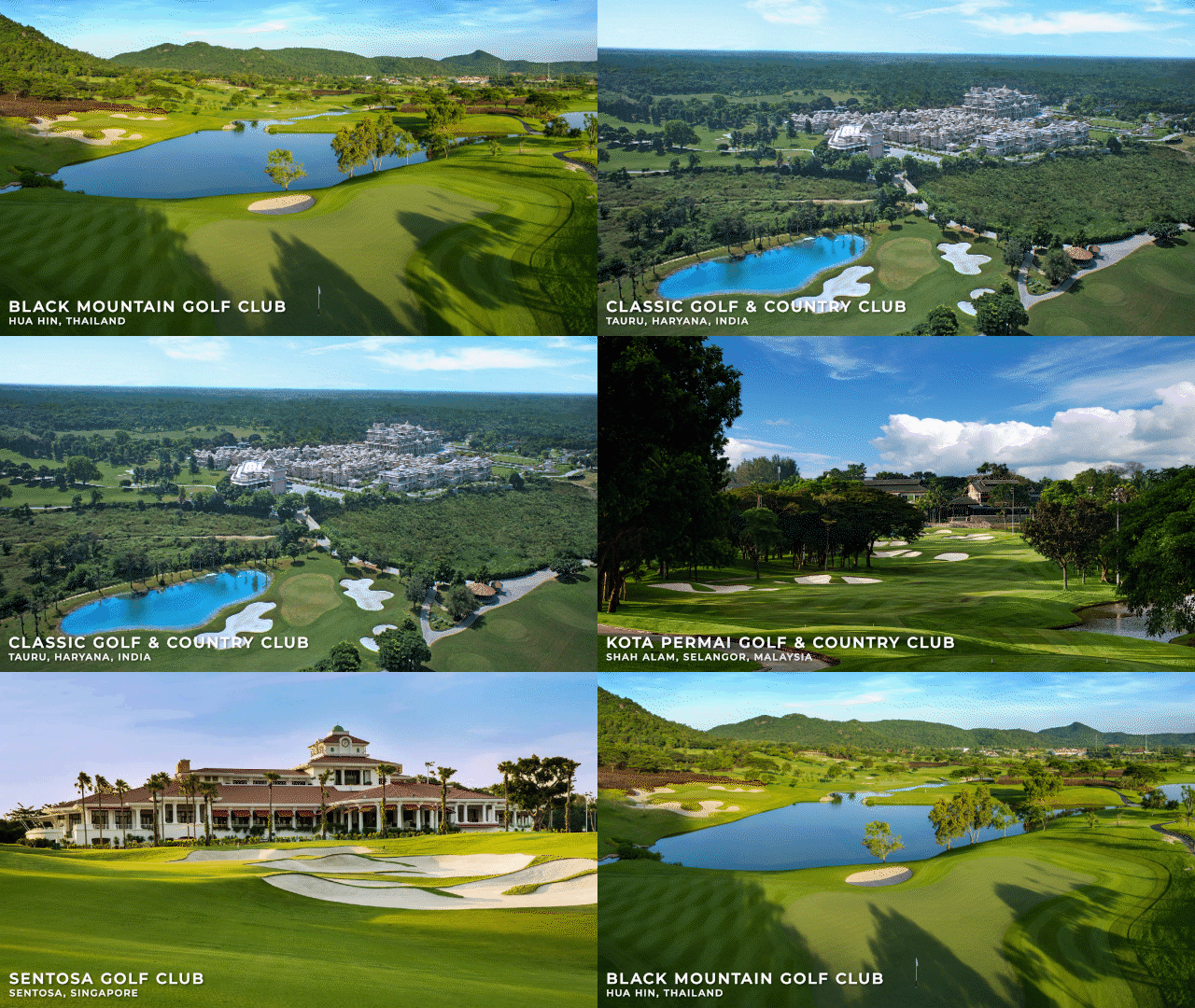
Sentosa, Singapore, August 21: Asian Tour Destinations – an exclusive network of world-class golf venues with direct ties to the Asian Tour – has significantly strengthened its presence in the region with the addition of three premier golf clubs.
Black Mountain Golf Club in Hua Hin, Thailand; Classic Golf & Country Club in New Delhi, India; and Kota Permai Golf & Country Club in Kuala Lumpur, Malaysia, have all become part of the exciting network, which will be adding prominent venues from the Asia Pacific region to its portfolio in the near future.
All with a history of hosting prestigious Asian Tour tournaments, they join Sentosa Golf Club, Singapore which was the first golf club to become part of the Asian Tour Destinations network in 2015.
In addition, Asian Tour Destinations has further enhanced its portfolio by partnering with online booking portal Tee Time Saver and the globally leading Customer Service Analysis provider 59Club Asia.
The iconic 18th hole of the New Tanjong and the clubhouse at Sentosa Golf Club.
Cho Minn Thant, Commissioner and CEO of the Asian Tour, said: “We welcome the new venues on board, and we look forward to working with them and further developing our relationships. They represent the top-tier of golfing properties in Asia and are a perfect fit for Asian Tour Destinations.
“Through our combined resources these golf clubs will benefit from the significant value that the Asian Tour and Asian Tour Destinations brand will add to their commercial and strategic goals in combination with support from Tee Time Saver and 59Club Asia.”
The primary mission of Asian Tour Destinations is to provide an affiliate membership programme between the associated venues – with a collective membership base of 7,500 golfers – and the Asian Tour which will help grow the game of golf in the region.
In particular, being a part of the Asian Tour Destinations network means that each venue is certified Tour caliber and operates a comprehensive range of facilities and services to their members and guests under tournament-ready conditions all-year round.
Among the core benefits, Asian Tour members will be able to play and practice at each venue facilitating for the members at each club to enjoy direct engagement with the region’s best golfers.
“Black Mountain is delighted be part of this new community of leading golf courses. We pride ourselves on being a desirable destination for visitors from all over the world and our association with the Asian Tour and Asian Tour destinations will truly help with this objective. Several Tour players already base themselves at our property and we look forward to welcoming more in the future as well as the members from the other Asian Tour Destination clubs around Asia,” said Harald Elisson, General Manager, Black Mountain.
The renowned Hua Hin venue has played host to a number of Asian Tour sanctioned tournaments including the Black Mountain Masters, the Thailand Classic, the King’s Cup, and the Royal Trophy.

Classic Golf & Country Club
“Classic Golf and Country Club has worked hard to build an international profile that highlights our world-class venue and so our new relationship with Asian Tour Destinations network is the perfect conduit for this, among many other benefits,” added Deepak C. Menezes, the Managing Director of Landbase India Ltd., Classic Golf & Country – venue for the Panasonic Open India, the Classic Golf and Country Club International Championship, and the Sail Open.
“Kota Permai Golf & Country Club has always embraced the spirit of providing the best golfing experience possible to all our patrons. As one of the leading golf clubs in Malaysia, we would like to ensure that we are aligned with other elite clubs in Asia plus the region’s foremost professional golf Tour. Becoming a member of Asian Tour Destinations is an honour and an exciting opportunity for Kota Permai to showcase our pristine golf course, excellent club facilities as well as warm hospitality. We look forward to welcoming both Tour players and Asian Tour Destinations members alike,” said Tang Meng Loon, Director of Club, Township & Property Management at Gamuda Land.

Kota Permai Golf and Country Club
The golf club has been hosting events on the Asian Tour for nearly 20 years such as the Volvo Masters of Asia, the Selangor Masters and more recently the 2020 Bandar Malaysia Open.
Sentosa Golf Club, home of the Asian Tour and the SMBC Singapore Open, has enjoyed its role as a founding member of Asian Tour Destinations.
“Sentosa Golf Club boasts a strong bond with the Asian Tour and our involvement with Asian Tour Destinations allows us to push ahead with one of our key roles, which is to help the golf industry in the region, as a whole, attain new levels of quality and excellence. We look forward to working with the venues who have recently joined,” said Andy Johnston – General Manager and Director of Agronomy at Sentosa Golf Club.
In addition, Asian Tour Destinations has established a partnership with the Tee Time Saver to promote its network of venues. Tee Time Saver provides an integrated search and booking engine for golfers to easily find the best tee-time and golf packages available for Asian Tour Destinations venues. They will also produce dedicated content on their website and social media platforms for golf fans to have in-depth reviews from Asian Tour professionals on the destination venues including strategies to adopt when playing signature holes.
As the leading sales & service analyst and performance training provider in Asia, 59club Asia delivers the resources to significantly improve and maintain sales & service etiquette, in turn increasing customer satisfaction, revenue and ultimately profits. 59club Asia are the only company in golf industry that rewards venues achieving improved customer service levels, recognised though mystery shopping audits, presenting Service Excellence Awards, famously known as the ‘Oscars’ of the industry.
Ends.
Indonesia’s budding young golf star Danny Masrin, like the vast majority of members on the Asian Tour, has chosen to use the current downtime – caused by the coronavirus pandemic – wisely and constructively.
“I decided to go back to school,” says Masrin.
“I have been doing an online Masters programme, which I started in May. It’s with the Thunderbird school, through Arizona State University. I thought if I am ever going to do it, now is the time.”
Keeping the mind sharp is a smart move by the 27-year-old as he is as eager as anyone to get back in action when the Asian Tour resumes.
Prior to lockdown gripping the region in March, Masrin unlocked his potential and found what it takes to play and compete with the best in the region.
He explains: “From the end of last year I was playing really good golf – since the BNI Indonesian Masters until the Bandar Malaysia Open. There were six tournaments there where I had two top-10s, three top-15s, I was playing pretty good. I was really happy.”
He had struggled to find his feet on Tour since turning professional in 2015, but last year his patience and conviction started to pay off.
In the middle of the year, his upswing in fortunes started when he made the cut in seven tournaments in a row, including finishing seventh at the Yeangder TPC in Chinese Taipei.
And then came the BNI Indonesian Masters in December at Royal Jakarta Golf Club.

“I was 55th on the Order of Merit going into the BNI Indonesian Masters – I was kind of on the edge, and I really wanted to finish higher. People were saying you are safe but the higher you are the better it is,” said the Indonesian.
Impressively, he overcame the pressure of fighting for his Tour card, and playing in front of his home support, to produce a breakthrough performance and finish in a tie for fifth – his best finish on Tour.
He says a big factor contributing to that result was having his mentor, Teddy Harmidy, caddie for him.
“To have Teddy, a good friend and mentor as my caddie was amazing. We play and practice all the time. It just gave me a level of comfort,” he says.
“Everything clicked there at the right time. We both know that course very well. So it was a matter of executing.”
https://business.facebook.com/81874786179/videos/583074252458012/
After that result he headed to the Thailand Masters – the final event of the year – brimming with confidence.
He says: “I still remember how much of a relief it was going to Thailand for the last event, as I had secured my card. I could just go out and play, there was no pressure any more. Knowing that I would get into a lot more tournaments, and that I could actually prepare. In the past it was like you might get into this tournament but you might not. Sometimes you had to be ready to leave at last minute notice.”
It was indeed a new dawn for the young Indonesian: he finished in the top-20 in Thailand, and in early 2020 he recorded a top-30 finish in the Hong Kong Open, captured equal eighth place in the SMBC Singapore Open and ended joint 13th in the Bandar Malaysia Open.
But, unfortunately, soon after Malaysia the Tour had to hit the pause button because of coronavirus.
“I have been in Jakarta since then, it’s probably the longest I have been in Jakarta,” says Masrin, who attended Bradley University, in Illinois, where he played on the golf team.
“After that solid start to the year, the schedule had been looking really good with events going two weeks on, two weeks off through to August but then we have to go through this.”
Masrin has since been playing and practicing and as he says: “keeping the body warm and in shape, and ready to play again.”
“I used to be of the mindset that if I take too many days off, I won’t be ready to play but it has been nice to know that if I take a few days off my body is still ready to play again at a high level,” he says.
“I am still playing pretty well, there have been moments during these five months when I wished there were tournaments to play in but there is nothing you can do about it.”

He practices at the Royale Jakarta, Pondok Indah and BSD courses and has been buoyed by the fact that the local Tour is aiming to stage an event each month from September until the end of the year.
“It is something to look forward to as we have not played in so long,” says Masrin, who has won seven events on local tour, with the most recent last year.
Masrin was also aiming to play in this summer’s Olympics and was bitterly disappointed it was postponed.
“For the longest time, for the last two and a half years, one of my biggest aims was to qualify for the Olympics. To have an Indonesian player represented at golf in the Olympics was the ultimate goal,” he says.
“This year we were coming down to the final stretch in the run up to Tokyo, I was on track to qualify and that’s why I was so excited I was playing well, but then obviously things changed, and now I will prepare for the tournaments I need to play in order to qualify for next year.”
There is no doubt that there is now huge cause for optimism for Masrin – thanks to his new found form and fine performances.
That has not always been the case over the past few years.
“There are a lot of struggles in golf, from the mental side, to the physical side, to the golf swing,” he says.
“There was a time in 2017 when I was playing really poorly, and I thought about quitting golf and I thought about what my options were. But when I first started playing professionally, I said I would give myself three to five years to see if professional golf was a stable career for myself and I have stayed true to that.
“Golf is a tough sport to be in as it is so uncertain. From week to week, it’s tough as you don’t know if you will have 10 weeks of missed cuts, with 10 weeks of spending money without making money, or you win one event and everything changes.”
As well as Teddy Harmidy – a former Indonesian national player, who played with American star David Duval on the Georgia Tech golf team in the United States – playing an important role in his success, a more holistic approach has also been key.
“What I have done well, the last year and a half, is I have started to focus on the statistics more. I have broken it down into more of the technical side, not of the swing, but the numbers of what needs to be focused on. I think I have a very good idea of what my strengths are and what my weaknesses are. I have been able to focus on those areas over the past 18 months.”
The analytical strategy has clearly worked and with a Masters degree imminent, he will be more applied than ever when the region once again opens up to tournament golf.
Ends.
At last weekend’s PGA Championship, there was a real possibility that a player from Asia would lift the famous Wanamaker Trophy.
The huge audience of golfers, and non-golfers, watching west of the Pacific tuned in to see if China’s Li Haotong could prevail after leading at the halfway mark.
Sadly, his challenge failed to materialize over the weekend while Asia had some consolation in the fact that the winner, America’s shining new-star Collin Morikawa, is half Japanese.
And so the quest by Asia to produce a winner of a Major to match Korean Y.E. Yang’s legendary victory in the 2009 PGA Championship continues.
That memorable win was, in fact, achieved 11 years ago on this day.

CHASKA, MN – AUGUST 16: Y.E. Yang of South Korea celebrates his birdie putt on the 18th green during the final round of the 91st PGA Championship at Hazeltine National Golf Club on August 16, 2009 in Chaska, Minnesota. (Photo by Sam Greenwood/Getty Images)
In what is another significant moment in time that feels like only yesterday, Yang became the first Asian-born player to win a Major.
He surpassed the previous best performances by Asians in Majors, which were runner-up finishes by Chinese Taipei’s Lu Liang-huan in the 1971 Open Championship; Isao Aoki, from Japan, in the 1980 U.S. Open; and Chinese Taipei’s Chen Tze-chung in the 1985 U.S. Open.
Li also came close in 2017 when he claimed third place in The Open while Korean K.J. Choi was third in the 2004 Masters – and fourth in the same event six years later.
The 91st PGA Championship was played at Hazeltine National Golf Club and Yang’s victory was one of the biggest upsets of the century and had a seismic impact on the game of golf because not only did he break Asia’s duck at Majors but he also defeated American superstar and world number one Tiger Woods.
Woods had already won 14 Majors – at that time, it would have been inconceivable to think his next one would be the Masters in 2019 – and he had never lost any tournament on American soil when leading by more than one shot.

CHASKA, MN – AUGUST 16: Y.E. Yang of South Korea (2nd L) celebrates a birdie putt on the 18th green alongside Tiger Woods (2nd R) during the final round of the 91st PGA Championship at Hazeltine National Golf Club on August 16, 2009 in Chaska, Minnesota. (Photo by David Cannon/Getty Images)
Yang, a 37-year-old who attended the PGA Tour qualifying school nine months before, was ranked 110 in the world and was barely known State side.
But that was the beauty of his moment of glory, as it was a victory sealed by stealth.
Unknown and unheralded in America, he arrived at Hazeltine already a prolific winner in Asia having claimed four titles in Japan and two on the Asian Tour.
He had also fired a warning shot early on in 2009 by winning the Honda Classic in March – becoming only the second player from the Land of Morning Calm to win on the PGA Tour. Choi was the first in 2002.
A fine victory it was but it did little to alert experts in the game about what was to happen five months later in the final Major of the year.
And as expected, Woods was dominant over the first three days at Hazeltine and appeared on course to collect his fifth PGA Championship.
He was the central character in a golden era for the game thanks to his divine brilliance.
Yang had started poorly with a one-over-par 73 but gained some confidence the next day by firing a 70 to move into the top-10 – trailing Woods by six.

CHASKA, MN – AUGUST 16: Y.E. Yang of South Korea poses with the Wanamaker Trophy after his three-stroke victory at the 91st PGA Championship at Hazeltine National Golf Club on August 16, 2009 in Chaska, Minnesota. (Photo by David Cannon/Getty Images)
But Yang used all of his powerful well built-frame – matched only by his illustrious countryman Choi – to move into contention on day three. He fired a 67 to sit two back of Woods in joint second with Ireland’s Padraig Harrington – the defending champion and already a three-time Major winner.
The Korean was in exalted company – but this was a Major – and the occasion became even more sublime when he was paired with Woods on the final day.
On the front nine, Woods was out of sorts and three-putted for bogey at number four and made bogey from the bunker on eight to make the turn in two over. That meant Yang drew level.
They were still tied with five holes to play when Yang delivered a knockout blow, much in the same way that Morikawa did when he made eagle on the par-four 16th at TPC Harding last Sunday.
Woods had appeared to have the upper hand and was in birdie range at the par-four 14th, but Yang sensationally countered by chipping in from 60 feet for eagle to take the lead by one.
And he had maintained that slim advantage by the time they reached the par-four 18th, where Yang was called upon again to conjure one final bit of magic.
For his second shot, a tree slightly blocked his view of the flag and with Woods in the fairway, Yang needed to hit the shot of his life.
He duly accepted the challenge, and with his three-iron hybrid he cleared a bunker and saw his ball come to rest 12 feet away, where he made birdie to seal a history-making victory.
He closed with a 70 for a three-stroke victory over Woods, who shot a final-round 75 after missing a short par putt on the last for his worst score ever in the final round of a Major when he was in the last group.
“It’s not like you’re in an octagon where you’re fighting against Tiger and he’s going to bite you, or swing at you with his nine-iron,” said Yang, after through an interpreter. “The worst that I could do was just lose to Tiger. So I really had nothing much at stake.”
“This might be my last win as a golfer,” added Yang. “But it sure is a great day.”
“All the other 14 major championships I’ve won, I’ve putted well for the entire week,” Woods said. “And today, that didn’t happen.”
“He [Yang] went out there and executed his game plan. He was doing exactly what you have to do, especially in these conditions. I think he played beautifully.”
Yang finished on eight-under 280 and won US$1.35 million, along with a five-year exemption on the PGA Tour and the Majors.

Y.E. Yang of South Korea after sinking his putt to win August 16 ,2009 at the 91st PGA Championship at the Hazeltine National Golf Club in Chaska, Minnesota. At right is Tiger Woods of the US . AFP PHOTO / ROBYN BECK (Photo credit should read ROBYN BECK/AFP via Getty Images)
Even Korea’s president, Lee Myung-bak, got up before sunrise to watch the tournament live. He later phoned Yang to offer his congratulations.
“I woke up at dawn today to watch the broadcast, and you played in a calm manner,” Lee told Yang, according to Lee’s office. “First of all, you enhanced our people’s morale by winning the Major title for the first time as an Asian.”
It was indeed a triumph of great magnitude on a day when Yang rode into Mayor City, made a Major name for himself and Majored in the game of life.
Ends.
Imagine a golf course consisting of the most iconic and challenging holes on the Asian Tour. A fictional hybrid-layout that features one of the region’s standout opening holes, one of the finest second holes and goes all the way through to an epic 18th.
Imagine a golf course consisting of the most iconic and challenging holes on the Asian Tour.
A fictional hybrid-layout that features one of the region’s standout opening holes, one of the finest second holes and goes all the way through to an epic 18th.
A layout that would be the ultimate challenge – where breaking par is a monumental achievement.
Well, just such a virtual course now exists, as an Asian Tour panel of experts has selected the appropriate holes to make up what is the golf course of all golf courses in Asia.
With a par of 70 and length of 7,430 yards, we have appropriately named it The Asian Tour Monster.
To navigate us through The Asian Tour Monster, we asked players and experts to describe each hole – all of which have played key roles in many of the biggest tournaments on the Asian Tour.
Let us know what your think on our social media channels – Facebook, Instagram, Twitter.

KOH SAMUI, THAILAND – JUNE 17: Adlison Da Silva of Brazil in action at Santiburi Samui Country Club on June 17, 2012 in Koh Samui, Thailand. (Photo by Paul Lakatos/Asian Tour/Asian Tour via Getty Images)
Par: Four
Yardage: 339 yards
Hole scoring average: 4.34
Asian Tour event hosted: Queen’s Cup
Where better to start this iconic course than the holiday island of Koh Samui in Thailand.
But, as with all the holes on The Asian Tour Monster, it is not a hole where you can take a vacation.
Contrary to the name of the hole – which is ‘The Flat Land’ – it is a steep uphill and treacherous opening par four, also widely known as the “Beast of Samui”.
Although it only requires a long-iron or a hybrid off the tee, the precarious elevated fairway is fringed with penalty areas and rocky outcrops. Provided you manage to find the fairway, a mid-iron will then be required for your approach shot. The severe two-tier green which is also elevated will require all your attention as it will most likely yield three putts or more if you are on the wrong level with your approach shot.
The hole is normally played as the 10th by the club members.
“A tall tree is planted just right of the buggy path about 180 yards off the tee which overhangs the fairway. I have seen balls hit that tree and bounce right into the jungle; drop straight down onto the buggy path and basically roll back down to the tee (because of the massive upslope); or hit the tree and disappear altogether.
The second shot – if the fairway is successfully found – will be anywhere from 160 to 180 yards to a green 15 yards higher than the fairway. The green is two tiered – with the tier itself close to four feet.
Hit the ball on the top tier when the pin is on the lower level and players will putt the ball off the green, without a doubt. Hit the ball on the lower tier when the pin is set on the top level … well then players will feel a flex in the putter shaft because of the unusually big swing they have to make.
The placement of this hole, as the opening hole, is perfect to ruin a good round of golf.”
Anthony Kang: a three-time Asian Tour winner and now part of the Asian Tour’s television commentary team.

Par: Four
Yardage: 493 yards
Hole scoring average: 4.27
Asian Tour events hosted: Maybank Championship, Malaysian Open
The second hole of the Palm Course at Saujana Golf & Country Club is a true test. Its length alone is enough to make you gasp at what awaits. A very narrow fairway flanked by several bunkers, palm trees and dense jungle on the right waits to punish any wayward drive. The second shot requires a mid to long iron to a green where the surface is not visible due to the steep elevation change. Multiple bunkers encompass the large two-tiered green – so making sure your approach shot is on the correct level is imperative.
“The second hole at Saujana is a bit of a difficult one because it is quite long. Much depends on which way the wind is blowing, if it is a little into the wind I will aim down the left with a driver with a little fade – to get past the fairway bunker on the right. But if there is no wind, and conditions are favourable, I will hit a three wood down there.
For the second it can anything from a six to a nine iron into the green – depending on where the pin and wind is. Normally I just try and get my shot to the middle tier if the pin is at the back or if the pin is at the front I always try to get it to the front edge – because if you don’t get up on the green it rolls back down. Definitely stay away from the right hand front bunker because it is just dead in there, because it is so deep. It is just one of those holes where you have to respect making a four and get out of there and you are happy with it.”
Scott Hend: a 10-time winner on the Asian Tour, the 2016 Asian Tour Order of Merit champion and winner of the 2019 Maybank Championship – played on the Palm Course at Saujana.

Par: Four
Yardage: 448 yards
Hole scoring average: 4.5
Asian Tour event hosted: Bangabandhu Cup Golf Open
With its tree-lined fairways and intimidating water features, the third hole at Kurmitola Golf Club can challenge every aspect of your game. Off the tee you need a well-struck drive to the corner of a narrow fairway, which doglegs to the left. Bunkers await on either side to swallow any stray drive and any attempt at cutting the corner can result in disaster – as an OB looms nearby. There is also the possibility of losing your ball due to the dense treeline. Even if you manage to negotiate the tee shot, you are still left with a long-iron to a shallow undulating green which yields very few birdies.
“I grew up on this course and we always play it as a par five. For me this hole is a standard par five and as one of the shorter hitters on Tour I can handle it. But when the Asian Tour are here in Bangladesh we play it as a par four and it is a really hard hole for all of us!
But now days I am hitting it a little bit longer and I can make birdies more often here. I had a chat with myself and said I have played many par fours on Tour that are more difficult than this hole, so I am now mentally stronger playing the hole.
Before, I would play driver, then lay up 100 yards to the pin because I am very strong anywhere from 100 yards. Nowadays, I play driver and then a 22-degree hybrid.”
Siddikur Rahman: a two-time winner on the Asian Tour, two-time champion on the Asian Development Tour, and the first golfer from Bangladesh to win on the Asian Tour – at the Brunei Open in 2010.

MANILA-PHILIPPINES-The Solaire Open at The Country Club, Manila, Philippines, March 13-16, 2014. a US$ 300.000 Asian Tour event. Picture by Paul Lakatos/Asian Tour.
Par: Four
Yardage: 406 yards
Hole scoring average: 4.52
Asian Tour event hosted: Solaire Open
On this slight dogleg right par-four, a driver is usually required as the further you hit, the wider the landing area is going to be. The purpose-built gap in the fairway to intentionally stop players from laying up is just merciless! Your thought process is tested even more with the OB to the left and water all the way down the right. Once you have recovered from the stress of the tee shot, a small elevated green awaits – which, if you miss the green with your approach, is very difficult to get up and down from.
The Country Club hosted the Solaire Open in 2014 which saw Canada’s Richard T. Lee triumph. Lee double bogeyed the fourth hole on the final day, but recovered brilliantly to claim his first Asian Tour title. That week there were two quintuple bogeys and five quadruple bogeys on the fourth.
“It is a narrow hole with a wind blowing normally, making it a real test. As the wind always blows right to left you have to start the ball at the ravine on the right otherwise you are in danger of going OB left. The fairway is only about 25 metres wide and with the wind and distance it plays quite long, so you need a driver and a mid to long iron to get to the putting surface.”
Koh Dengshan: a former Singapore national player, now Asian Tour regular and touring professional with Sentosa Golf Club.

SINGAPORE – Serapong course at Sentosa Golf Club, Singapore, September 10-15, 2017. Picture by Paul Lakatos/Sentosa Golf Club.
Par: Four
Yardage: 486 yards
Hole scoring average: 4.23
Asian Tour event hosted: SMBC Singapore Open
The signature hole on the Serapong Course at Sentosa Golf Club boasts wonderful views of the Singapore skyline that look out onto one of the busiest ports in the world. However, do not allow these views to distract you. This demanding par four, especially when played into the wind, requires your best drive of the day to give yourself the shortest possible approach shot into this shallow and firm green. For shorter hitters this may still require a wood.
The landing area off the tee is fairly generous with large bunkers on either side of the fairway. However, club selection for your approach shot needs to be spot on. A yawning waste bunker stretches its way up the right side of the fairway ready to swallow any mishit shot, and any over-clubbed shot will likely end up in the sea!
“I really dreaded playing this hole during tournament play, simply due to its sheer length. Pars, let alone birdies, were hard to come by, especially when the pin was tucked on the right portion of the green where the water starts to come into play.
When this hole plays its full length, I would need to hit a solid drive and then try to figure out how to keep the ball on the firm green with a long iron in hand.
I think my greatest joy playing this hole came when, on one occasion, my drive hit a sprinkler head and gave me an extra 40 yards, making my approach shot that much shorter, but I still made a bogey!
Make a par on this hole and you will definitely gain at least half a shot on the field!”
Unho Park: an Asian Tour player for 20 years, now a Tour administrator.

Hole 6, par-3.
December 22, 2010. Thai Country Club, Bangkok, Thailand. Mandatory credit: Richard Castka/Sportpix International
Par: Three
Yardage: 227 yards
Hole scoring average: 3.17
Asian Tour events hosted: Thailand Open, Volvo Masters of Asia, Asian Honda Classic
The par-three sixth hole is the signature hole at Thai Country Club. It is a long par three over water with strong head winds more often than not. The smart play is to aim for the left side of the green in order to avoid the penalty area and bunker on the right. However, if you stray too far left, the undulations will most certainly throw your ball further away from the green, leaving a tricky up and down to make par. This is just a brute of a par-three where its sheer length just makes playing this hole strenuous.
American John Catlin – who recently won the Andalucia Masters at Valderrama on the European Tour – parred the hole in his first three rounds during the 2019 Thailand Open and made birdie on Sunday, which paved the way for him to secure his fourth Asian Tour title.
“It is a long par three. Off the back it is about 220 – 230 yards to the middle of the green. The wind mostly blows in from the right, so I would have a three iron or five wood. There is a bunker and water on the right side so anything from the middle of the green to the left side is the perfect shot. I will take a three any day there. It is not a birdie hole. You have to be conservative. I had four pars during the Thailand Open in 2018 when I won there, I didn’t lose any strokes there but didn’t make any either.”
Panuphol Pittayarat: winner of the 2018 Thailand Open at Thai Country Club – which is his home club.

SINGAPORE – Serapong course at Sentosa Golf Club, Singapore, September 10-15, 2017. Picture by Paul Lakatos/Sentosa Golf Club.
Par: Five
Yardage: 587 yards
Hole scoring average: 5.01
Asian Tour event hosted: SMBC Singapore Open
You may think a par-five that averages near its par in tournament play is a simple enough hole but on the seventh hole on The Serapong, the devil is in the details. You are greeted on the tee with a magnificent turquoise ocean canal stretching the full length of the hole on the right.
With little to no rough on the right-hand side of the fairway, shots that veer right will almost certainly find the drink. The left side of the hole also intimidates you with dense tropical jungle. If you are skilled enough to thread your tee shot between the fairway bunkers, you are left with a very tricky lay-up that needs to be precisely planned and executed to the narrowest part of the fairway.
Any miscue can be calamitous as this year’s SMBC Singapore Open champion, Matt Kuchar, found out by carding an eight in the final round. After a poor tee shot, which went left into the trees, an unexpected air shot ensued while trying to extricate his ball from tree roots. A pulled approach shot, which ended up out of bounds, also did not help his cause. Remarkably, he did not drop a shot after, played the back nine in four under, and beat Justin Rose by three!
“It is a very good hole. It depends how you drive that hole. If you hit a bomb off the tee, 320 yards, you can reach the green in two. But then you still have to hit a quality shot to get on the green. I don’t hit the ball so long these days so I lay up with a three wood, then a four iron and a pitching wedge or nine. The hole is also one of the most scenic on the course.”
Mardan Mamat: a five-time Asian Tour champion and Singapore’s pioneering professional golfer.

MANILA, PHILIPPINES – The ICTSI Philippine Open at the Wack Wack Golf and Country Club on February 9-12, 2012 in Manila, Philippines. Photo by Paul Lakatos/Asian Tour.
Par: Three
Yardage: 191 yards
Hole scoring average: 3.55
Asian Tour event hosted: Philippine Open
The original design of this eighth hole was a lot shorter, requiring only an eight or nine iron to a postage-stamp type green, which was raised even higher than it is today. With its increased length and slightly lowered green, it is still as formidable as ever and can mentally rattle anyone’s nerves when standing on the tee box.
The view of a severely elevated narrow green sloping from back to front and guarded by multiple deep bunkers gives birth to unimaginable scenarios if you fail to hit this green. Although it may sound simple to blast out of the bunkers or chip onto the green after missing it, the nature of the green makes it almost impossible to get the ball on the green when trying to recover from the left or right.
“When I won the Philippine Open in 2008, that hole was played as the 17th hole. And it is funny because having played Wack Wack so many times, amongst friends we have always talked about what you would do if you go into that hole with a one-shot lead. And funny enough, it happened to me – I had a one shot lead in the Philippine Open in 2008. If you have played it long enough, and as much as you want to hit the green, you know you must miss it to the right.
Back then it was only an eight or nine iron but after I won they lengthened it from the back tees, it’s like a six iron now. So what I did was I made sure I aimed a bit more right and tried to hit a good shot, fortunately it landed on the green and just rolled off and ended up in the right bunker. The guy I was up against, Gavin Flint, also did the same thing, and we ended up making bogies but a par was good enough for me to win on the last.”
Angelo Que: a three-time champion on the Asian Tour and a winner on the Japan Golf Tour Organization.

Delhi Golf Club, Hole #9
Par: Four
Yardage: 445 yards
Hole scoring average: 4.38
Asian Tour events hosted: Hero Indian Open, Panasonic Open India
The ninth hole at the Delhi Golf Club requires precision and makes even the most confident drivers of the ball tremble, especially when a tournament is on the line. This hole has a reputation for being extremely unforgiving with a narrow fairway and thorn bushes on either side. The hole does not have any significant water hazards but the bunkers, unforgiving rough and mature tree line more than make up for that.
You can choose to use either a three wood or long iron off the tee in order to find the widest part of the fairway, or in this case, the least narrow! But the challenge with this strategy means it leaves a mid to long iron approach shot to an undulating, multi-tiered L-shaped green guarded by well positioned bunkers and thorn bushes. The braver folk will opt to use a driver, however any miscue will most certainly result in playing three from the tee.
“As a member over there, it is probably regarded as the hardest hole on the course even though it is not stroke index one – simply because it gives you a few options. It is long enough to tempt you to hit a driver off the tee but it really narrows in at about the 270 to 280 yard mark – the fairway becomes half its width. It is a perfect risk reward hole if you are willing to man up and take it on with a driver, which really makes your second shot a lot shorter into a green that is quite demanding because it is a raised green that falls off to the right. The typical Sunday pin there was back right over a bunker and if you laid back too far, if you hit a three wood or a two iron off the tee, it would leave you too long a shot to be able to access that flag in anyway.
I have seen a lot of big numbers there; I have seen a lot of people lose tournaments there in the past; and I personally have made some high numbers on that hole. When we play tournaments there, the prevailing wind is normally into the wind and coming off to the left so that makes it even more demanding. It is about 440 yards, but it plays closer to 460 or 470. You also have bushes down the sides, so visually it is a very intimidating hole. I think some of the hardest holes in golf are the ones that are straight and not actually dog-legs. About five years ago there used to be a tree in the middle of the fairway, on the left half of it – it fell down in a storm. When that tree was there it made it even more challenging because if you hit anything up the left half you didn’t have a clear shot – so it was even more demanding before.”
Shiv Kapur: a four-time Asian Tour winner, and former Asian Games Gold medallist.
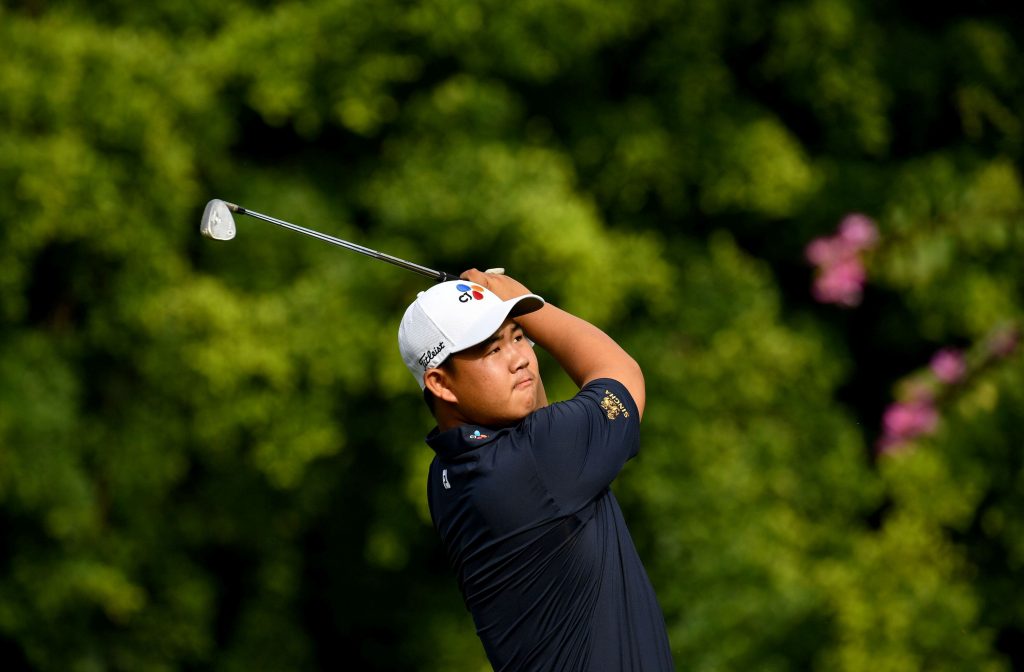
We caught up recently with Korea’s Joohyung Kim, who has been making a name for himself since joining the play-for-pay ranks in 2018. Kim will be making his regular PGA TOUR debut at the Safeway Open this week.
We caught up recently with Korea’s Joohyung Kim, who has been making a name for himself since joining the play-for-pay ranks in 2018. Find out more about the 18-year-old rising star in this latest feature. Kim will be making his regular PGA TOUR debut at the Safeway Open this week.
[embedyt] https://www.youtube.com/watch?v=_3wHmT2VlsM[/embedyt]
Korean wonder kid Joohyung Kim has revealed some of the keys to his early success, on the eve of his regular PGA TOUR debut in this week’s Safeway Open.
[embedyt] https://www.youtube.com/watch?v=_3wHmT2VlsM[/embedyt]
Korean wonder kid Joohyung Kim has revealed some of the keys to his early success prior to his regular PGA TOUR debut at this week’s Safeway Open – the opening event of the 2020/2021 season on the PGA TOUR.
And his father Changik Kim – a former Tour professional who played on the Buy.com Tour (now known as the Korn Ferry Tour) in the United States before becoming a teaching professional – has most definitely been the guiding force behind his meteoric rise.
“My dad didn’t teach me the basics first,” said the 18-year-old Kim.
“He made sure I just had fun. We always went to the golf club to eat, drive the cart and hit some putts. But as I started to take it really serious he always taught me to practice hard, swing mechanic wise.”
They were living in Australia when he first picked up a golf club aged five, or as he says: “a short baby club”. But it wasn’t until they moved to the Philippines, when he was aged 11, that he really started to take the game seriously.
“Basically, my parents taught me was always to practice hard and be humble. And I feel like that was the most important lesson of all. And always will be,” added the Korean.
Kim cleaned up on the amateur circuit in the Philippines – he won the 2017 Philippine Junior and the 2018 Philippine Amateur – before turning professional in 2018.
And since then he has established himself as one of the most exiting young players in the region with huge potential to be one of the dominant players in the game.
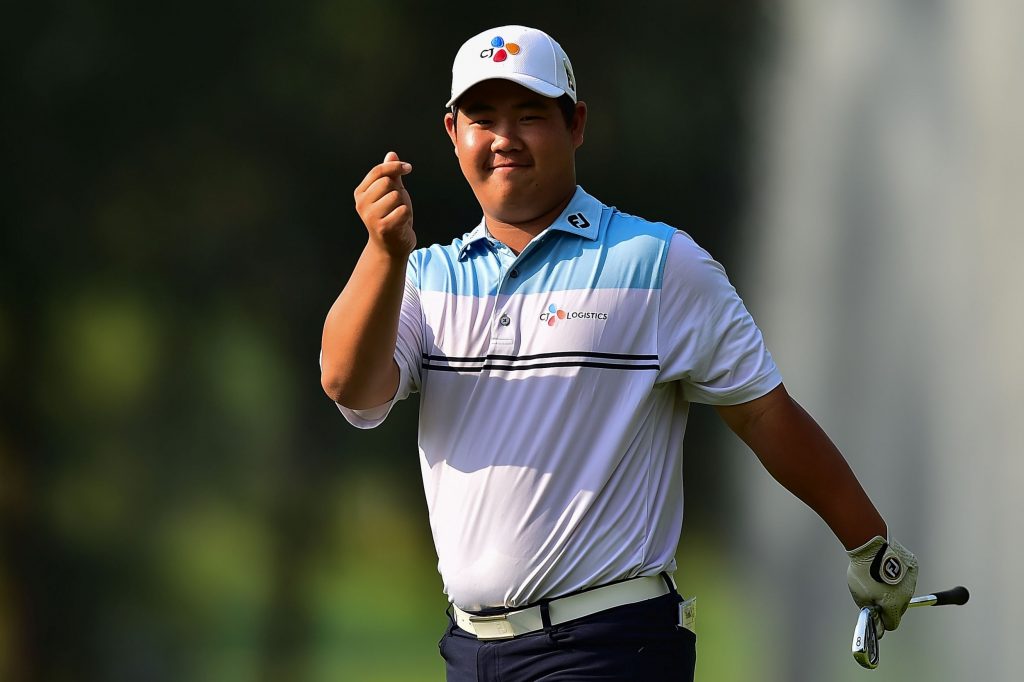
After earning a battlefield promotion from the Asian Development Tour by winning three events last season, the youngster made an instant impact by winning in just his third start on the Asian Tour at the Panasonic Open in India.
That made him the second youngest professional to win on the Asian Tour at 17 years and 149 days with countryman Seungyul Noh being the youngest when he won the 2008 Midea China Classic at the age of 17 years and 143 days.
Kim says his father, who is now 50 years old, is always on hand to offer advice.
“I ask him some stuff with golf because he is always with me and he knew my game ever since the beginning. So I feel like I can always go up to him and ask.
“My dad never plays. Doesn’t really have the time because he is always with me. But hopefully we can get a round one day. It would be fun to bring back the old memories. But he sometimes hits some chips and some putts, even hits one or two balls but nothing serious really.”
Kim also won on the Korean PGA Tour in July at the KPGA Gunsan Country Club Open – which was his first win on home soil and saw him become the youngest winner on that circuit at the age of 18.
It moved him inside top-100 on the Official World Golf Ranking (OWGR) and earned him a place in last month’s US PGA Championship – where he made his Major debut.
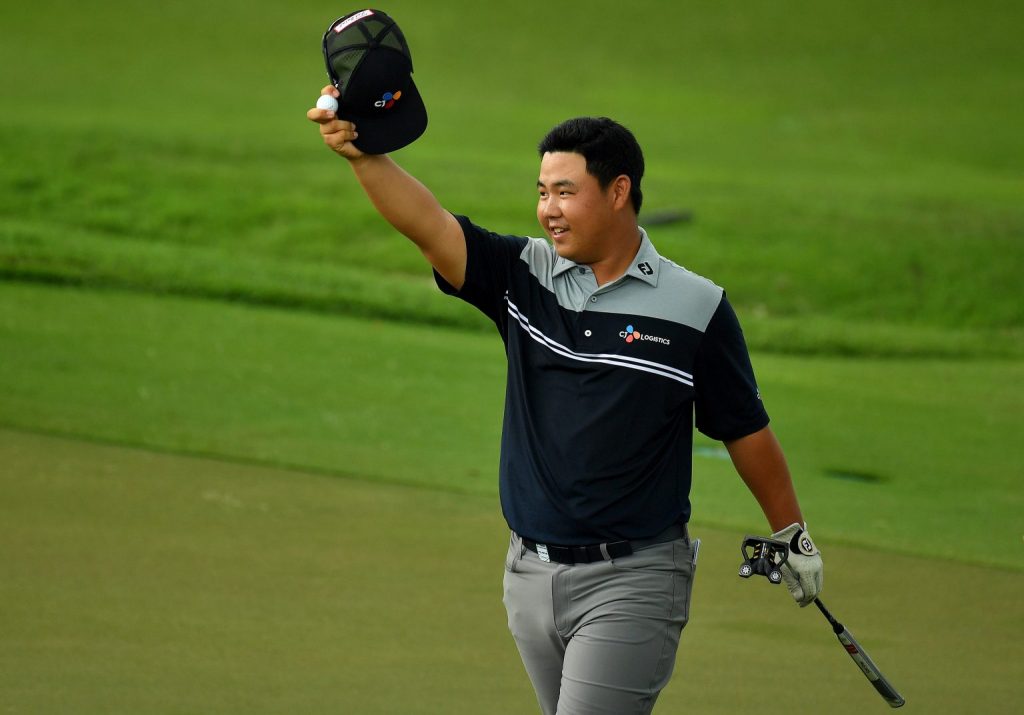
Despite his incredible success as a teenager, he is quick to downplay his achievements.
“I don’t think I have success at my age to be honest. I feel like I need to be better and I still lack so much,” he says.
“I’m fortunate to have some success yes, to break into the top 100 in the world, win once on the Asian Tour but I still have so many goals and feel like I need to accomplish so much more. So I don’t think I have success yet. And have so much to learn. I know I can play against the best.”
He adds: “I feel like it’s just really little by little that I need to sharpen. I’ve played against the top players in the world, so I know I deserve to be here. But I just need to be more consistent overall to get me to the top and get all aspects better.”
Travelling the world as a Tour professional will certainly not bother him after a globetrotting childhood.
He was born on the Jeju island in Korea, where they stayed for a few months. They lived in China for a few years, then Australia for seven years, followed by the Philippines for six years and Thailand for a year and a half.
“And now for the first time in my life Korea,” says Kim.
On his game plan for this week’s Safeway Open, Kim says: “This time not really focused on something. More of just feeling free. And one step at a time. And play my own game. If I can do that the rest will follow.”
Ends.
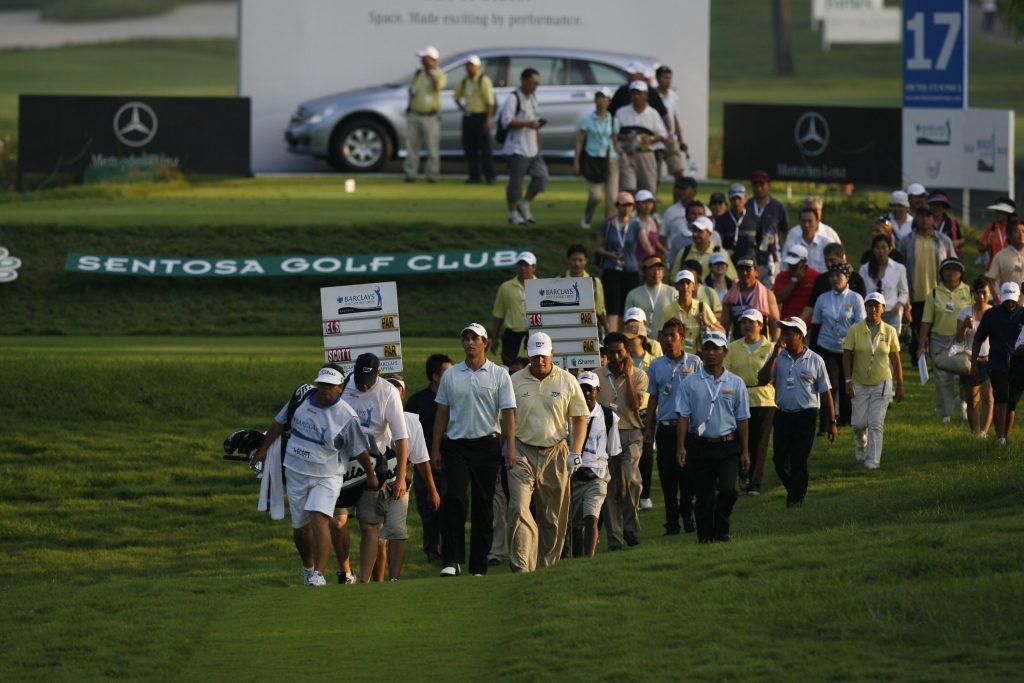
Few players have dominated one of Asia’s national Opens like Australian Adam Scott has with the Singapore Open.
Photo credits: Sportfive
Few players have dominated one of Asia’s National Opens like Australian Adam Scott has with the Singapore Open.
He has lifted the trophy on three occasions in 2005, 2006 and 2010 – an impressive haul, surpassed only by Jumbo Ozaki’s five Japan Open victories and the four wins by Spaniard Miguel Angel Jimenez at the Hong Kong Open. Tommy Nakajima also won the Japan Open four times.
Scott has claimed the Singapore Open more times than anyone and his success was in synergy with the emergence of the prestigious event on The Serapong course at Sentosa Golf Club.
The tournament was not played from 2002 to 2004 before being relaunched in 2005 at Sentosa – where it has, so memorably, been played since.
So, Scott’s win in 2005 was the start of an exciting new chapter for the event while it was on this day 14 years ago that he successfully retained the tournament.
And what an exceptional win that was on an unprecedented Sunday.
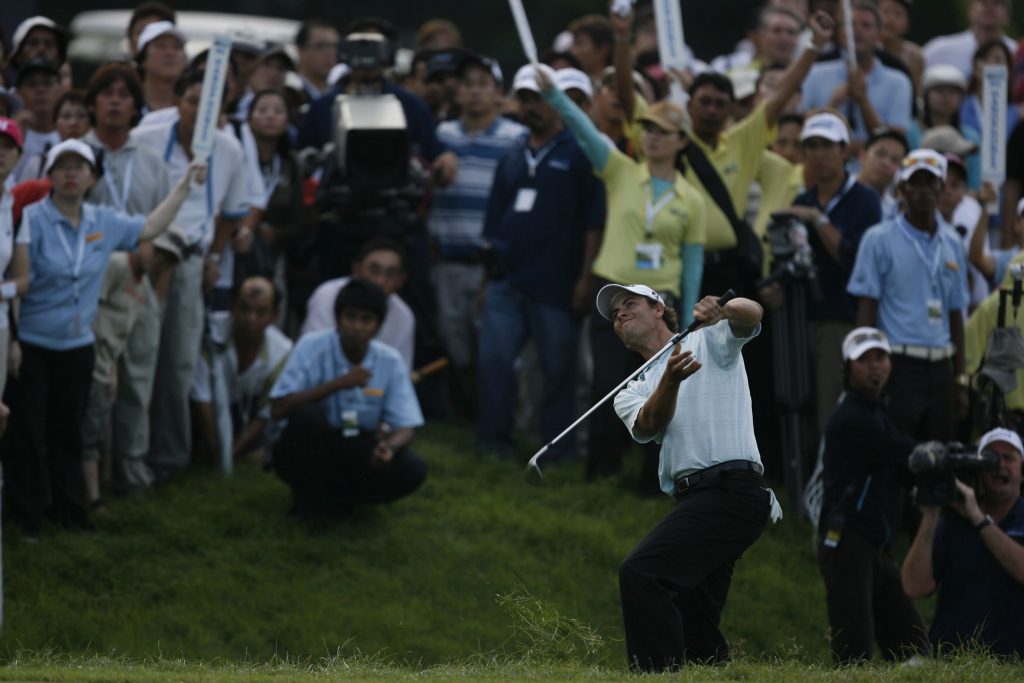
Adam Scott of Australia
The Australian, 26 years old at the time, beat South African Ernie Els by two shots in a three-hole play-off in the US$3 million event.
He delivered the knock-out blow with a birdie at the par-five 18th to edge Els, after both players parred the first two holes – the 16th and 17th.
It was the 11th professional victory, but his first in 2006.
He coolly dropped in a five-foot putt while Els three-putted for bogey.
The rather unusual play-off format was the result of the fourth round being cancelled late on Sunday afternoon following two weather suspensions.
Organisers decided to reduce the event to 54-holes based on the scores after Saturday’s third round.
Hence, with Scott and Els tied on eight-under-par 205 after the third day the option was taken to complete the tournament with a three-hole play-off – much to the delight of the thousands of fans who had patiently remained on site waiting for a resumption.
“It’s the first time I have defended a title and it’s a great feeling and something that I will cherish. Like I said last year, it’s a great feeling to win a national Open and I’m really thrilled. It’s been a long time coming this win, since last year and hopefully I can keep going from here,” said Scott, who won US$475,500.
The fans were treated to a thrilling duel between the top two stars who matched each other blow for blow in the final round and the play-off. Els missed a birdie chance from 10 feet on the first extra hole on 16 while Scott saved par from five feet.
After both parred the 17th, Scott, the then world number six, gained the advantage on the 18th after an exquisite chip which left him five feet from the pin while Els struggled after a wayward drive put him in the shin-high rough. After finding the front of the green with his third, the South African agonizingly three putted from 25-feet.
“There wasn’t much separating Ernie and myself and whether that was over 72 or 54, or 65 holes which we played, it came down to a play-off and fortunately I won. I definitely feel I’m the winner of the tournament,” said Scott.
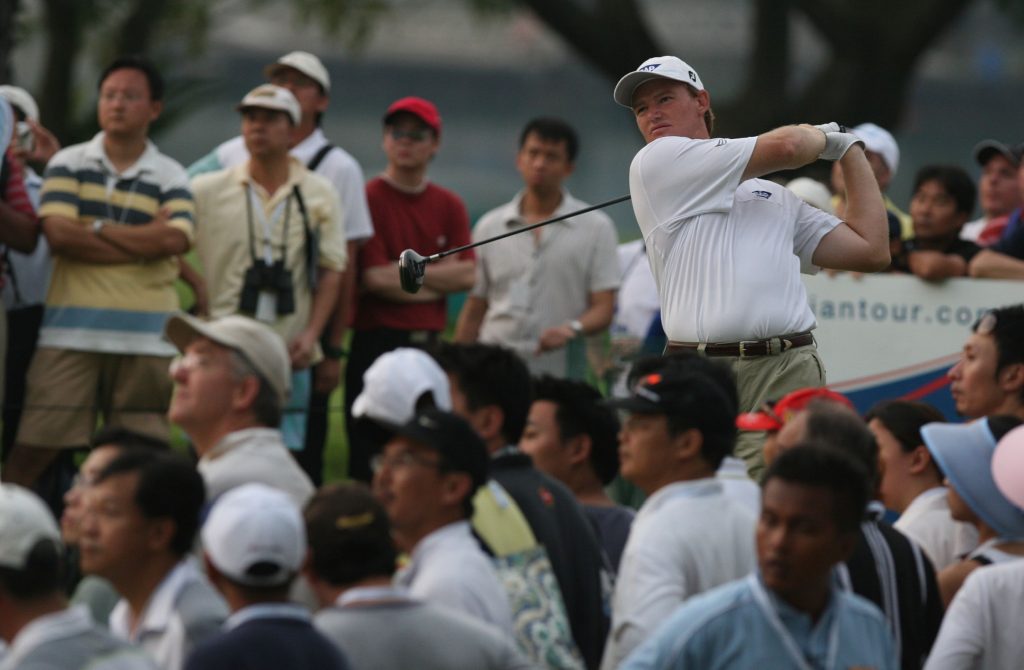
Ernie Els of South Africa
Els was naturally disappointed with the outcome. He said: “In the play off, I had my chances. I hit a good shot in to the 16th (to 10 feet) but did not hit the putt well. On 17 for some reason my tee shot came back – I was close to the hole but could not putt it.
“On the 18th I drove it right – just one of those things. On the third shot I was a club short, it was coming nicely on line but unfortunately it was not enough club. It is disappointing,” added the South African.
Australian Brad Kennedy took third place with his three-round total of 208 while China’s Liang Wen-chong settled for fourth position on 209.
The tournament had started with Filipino rookie Juvic Pagunsan and Scott Strange of Australia sharing the first round lead shooting four-under-par 67s.
However, on day two Els made his move surging up the leader board firing an imperious 65 – a course record at the time – to take a share of the lead with Strange.
Titleholder Scott then set up a mouth-watering showdown with Els after a 66 on Saturday. Els needed an injection to treat a bout of food poisoning during a two-hour weather disruption but he battled on gamely to finish the day tied at the top.
As expected the final round was a tight affair but a one hour and 40 minute delay in the morning due to lightning, and another torrential thunderstorm late in the afternoon, meant they could only complete eight holes before the fourth day was abandoned and the crowds eagerly gathered to watch the play off.
The tight finish was in stark contrast to Scott’s victory the year before when he sauntered to a seven stroke win over England’s Lee Westwood – that result happened this Friday, a mere 15 years ago.
Ends.
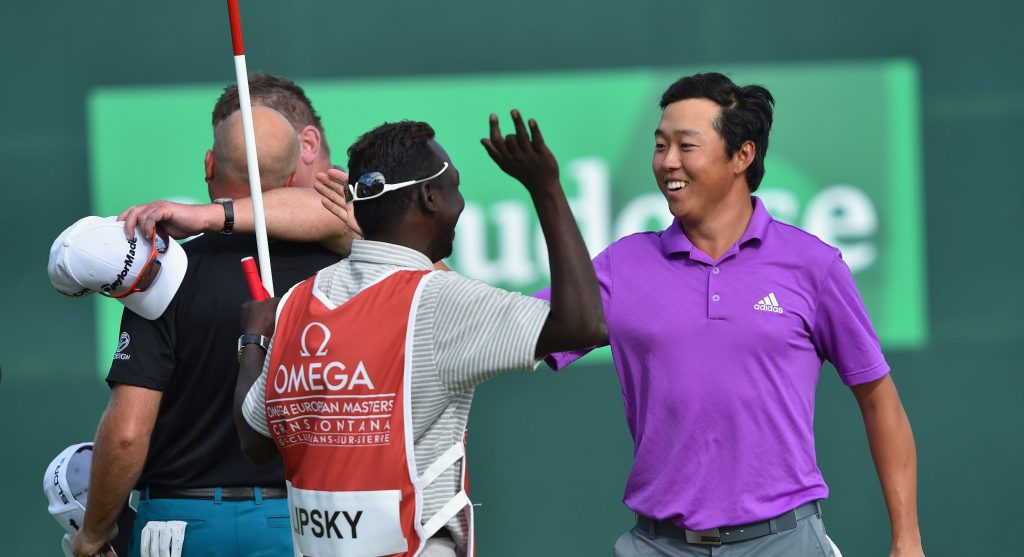
David Lipsky, the Asian Tour Order of Merit champion in 2014, hit the headlines very recently by winning the TPC San Antonio Challenge on the Korn Ferry Tour in July.
Interestingly, the American went to La Canada High School in Los Angeles – where his countryman Collin Morikawa, currently the hottest player in the game, also attended.
And Lipsky’s Korn Ferry Tour win, which was his first, came less than one hour after Morikawa earned his second success on the PGA TOUR at the Workday Charity Open.
It is evidence of the calibre of Lipsky – who also attended the prestigious Northwestern University in Chicago, where, amongst other, England’s Luke Donald enjoyed an outstanding college career.
To date, Lipsky has also claimed two titles both on the Asian Tour and on the European Tour.
And there is no doubt the biggest victory of his career so far came on this day six years ago in the Swiss Alps.
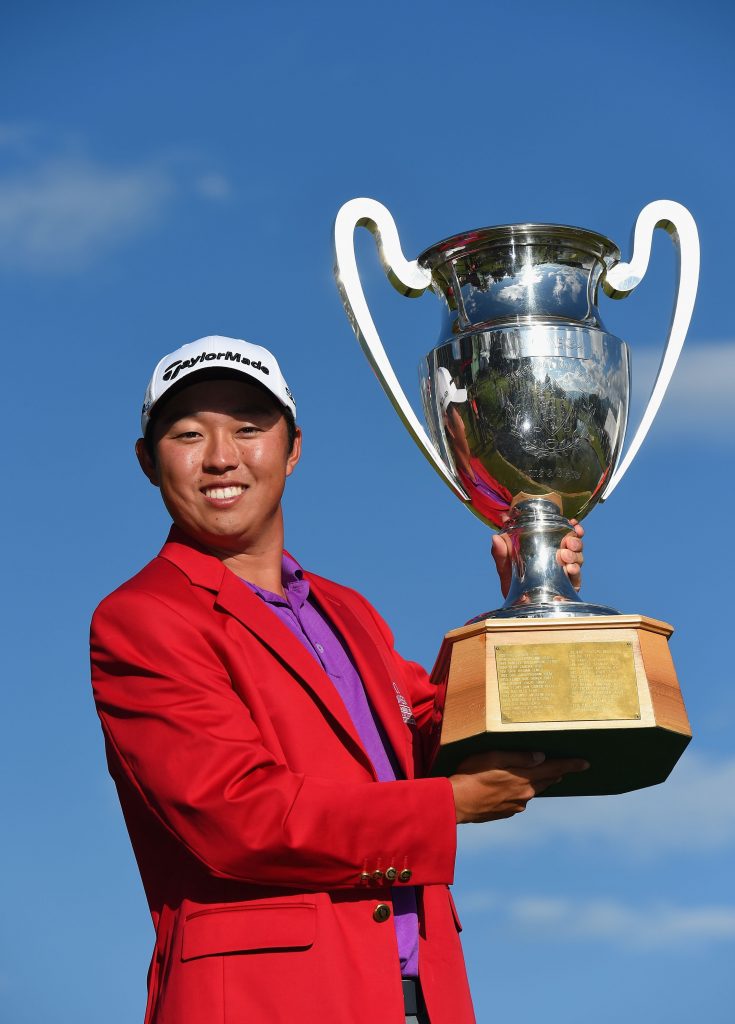
CRANS-MONTANA, SWITZERLAND – SEPTEMBER 07: David Lipsky of USA holds the winners trophy after winning in a playoff against Graeme Storm of England during the final round of the Omega European Masters at Crans-sur-Sierre Golf Club on September 7, 2014 in Crans-Montana, Switzerland. (Photo by Stuart Franklin/Getty Images)
In what was only his 18th start on the European Tour, he defeated Englishman Graeme Storm on the first hole of a sudden-death play at the Omega European Masters at Crans-sur-Sierre – an event steeped in history, with its origins dating back to the early 1920s when it was the Swiss Open.
Lipsky was 26 years old at the time and had only been a professional for three years but showed maturity beyond his years in the way he played the play-off hole.
He had started the final round two shots behind overnight leader Storm but, playing in the penultimate group, he charged through with a five-under-par 65 to set the clubhouse lead on 18 under.
That was helped by a birdie on the par-four 18th – where he hit his approach to within inches of the cup – and meant Storm needed a par there to force the tournament into overtime.
The Englishman duly made four meaning he and Lipsky finished one shot ahead of none other than emerging American star Brooks Koepka, who was tied for the lead until a bogey on the 17th, where his wayward approach plugged in a greenside bunker.
When they returned to 18 for the play-off, Lipsky played the hole very differently after his opponent hit a poor tee shot that missed the fairway and came to rest against a wall.
Storm had no option but to chip out on to the fairway.
Lipsky, who had just 86 yards to the hole from a bunker with his second shot, took no risks and laid up short of the green.
It proved to be the right decision as after he chipped close to the pin, Storm made a five, and he was left with a simple putt for victory.
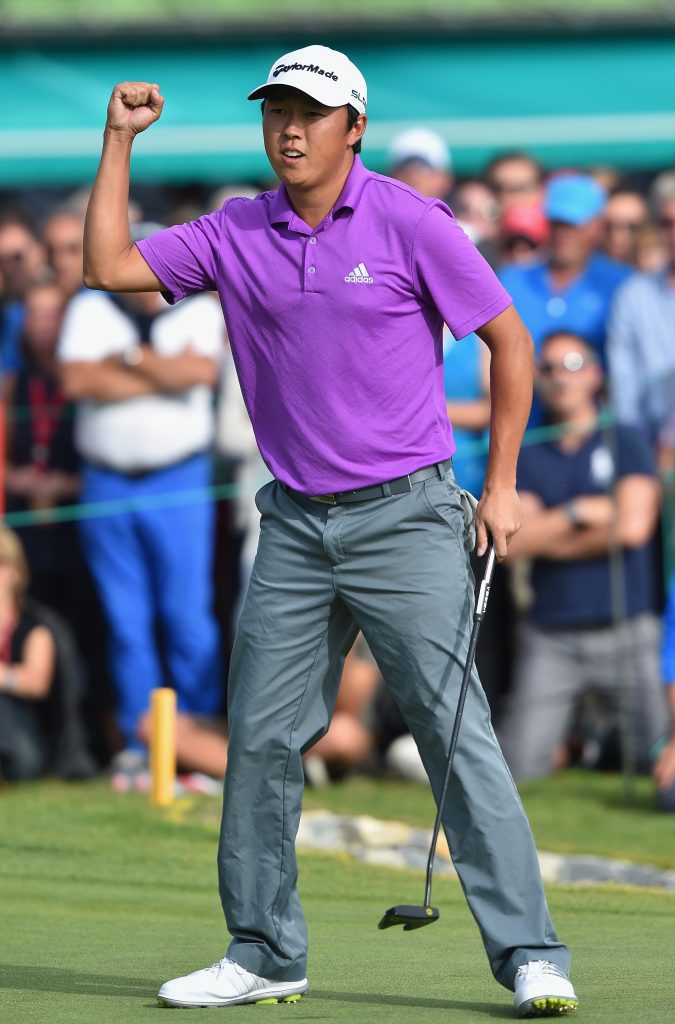
CRANS-MONTANA, SWITZERLAND – SEPTEMBER 07: David Lipsky of USA celebrates winning in a playoff against Graeme Storm of England during the final round of the Omega European Masters at Crans-sur-Sierre Golf Club on September 7, 2014 in Crans-Montana, Switzerland. (Photo by Stuart Franklin/Getty Images)
Speaking about the play-off hole, Lipsky said: “It’s a tough tee shot anyway, but when there’s the title on the line it’s very tough.
“You have to draw your tee shot from right to left to hold it against the hill, and I thought I’d hit a great shot but it ended up going in the bunker.
“It was a tough shot out of the bunker and, with Graeme only going to make par at best, I decided not to risk going in the water. In the end it was the right play, and I’m so pleased to get the job done.”
Storm reflected: “It’s tough to take right now. I didn’t have much time between finishing my final round and starting the play-off, so I probably wasn’t as composed as I should’ve been.
“So it was obviously disappointing, but overall it’s been an unbelievable week. There is a lot of emotions flying round right now so I’ll have to reflect with a clear head in the morning, but there are definitely lots of positives to take from the week.”
Lipsky earned €383,330 for his triumph, putting the wheels in motion for claiming the Asian Tour Order of Merit title later in the year.
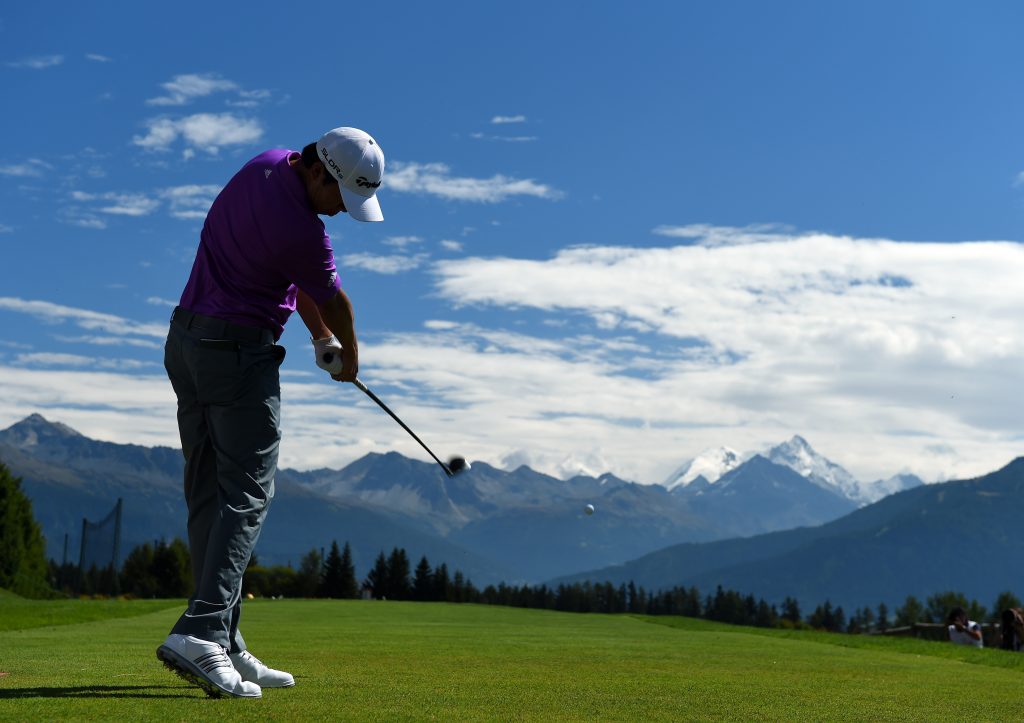
CRANS-MONTANA, SWITZERLAND – SEPTEMBER 07: David Lipsky of USA plays a shot during the final round of the Omega European Masters at Crans-sur-Sierre Golf Club on September 7, 2014 in Crans-Montana, Switzerland. (Photo by Stuart Franklin/Getty Images)
He became the first Asian Tour member to win the Omega European Masters since this event became part of the Tour in 2008.
And he was the first American to win the Omega European Masters since Craig Stadler in 1985.
Lipsky’s journey on the Asian Tour began when he won the Qualifying School in January of 2012. And, he was victorious in the Handa Faldo Cambodian Classic just two months later before a sensational 2014 thrust him into the international spotlight.
Two years ago he also claimed the Alfred Dunhill Championship in South Africa for his second win on the European Tour.
With European, Asian and Korn Ferry Tour wins to his name, he is building a mightily impressive portfolio of tournament wins across the globe.
But producing a more impressive victory than the Omega European Masters will take some doing.
Ends.
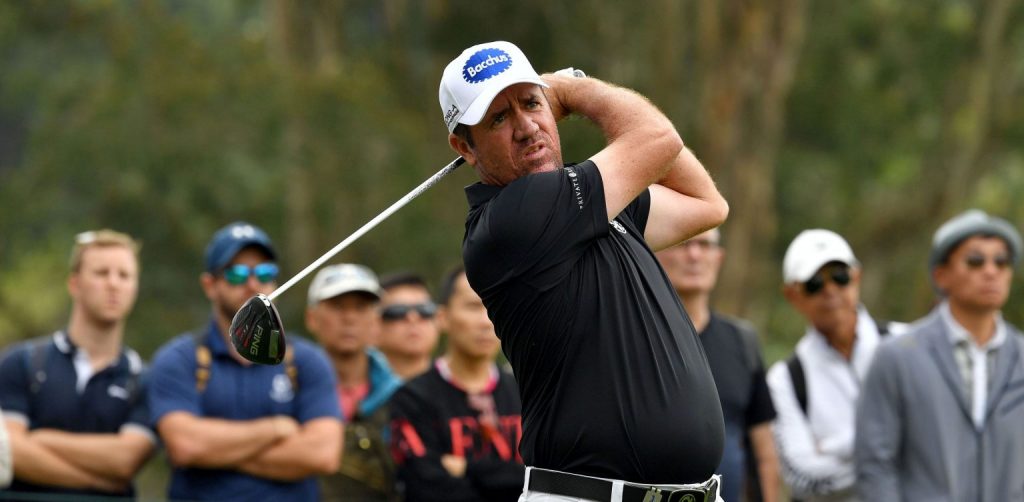
When Australian Scott Hend claimed the Pertamina Indonesia President Invitational on August 31 in 2008 he would have, understandably, been oblivious to the significance of the occasion.
A relative newcomer to the Asian Tour – the previous season he was Rookie of the Year – the victory was his maiden win on the circuit, but more importantly it was the one that opened the floodgates.
Indeed, on this day 12 years ago, the Asian Tour witnessed the arrival of a golfer who would become one of the circuit’s most dominant players.
The big-hitting Australian would go on to win nine more times and monopolise the Order of Merit.
And the signs of this success were very evident in his impressive victory at the Pertamina Indonesia President Invitational – which was played at Damai Indah Golf and Country Club in Jakarta.
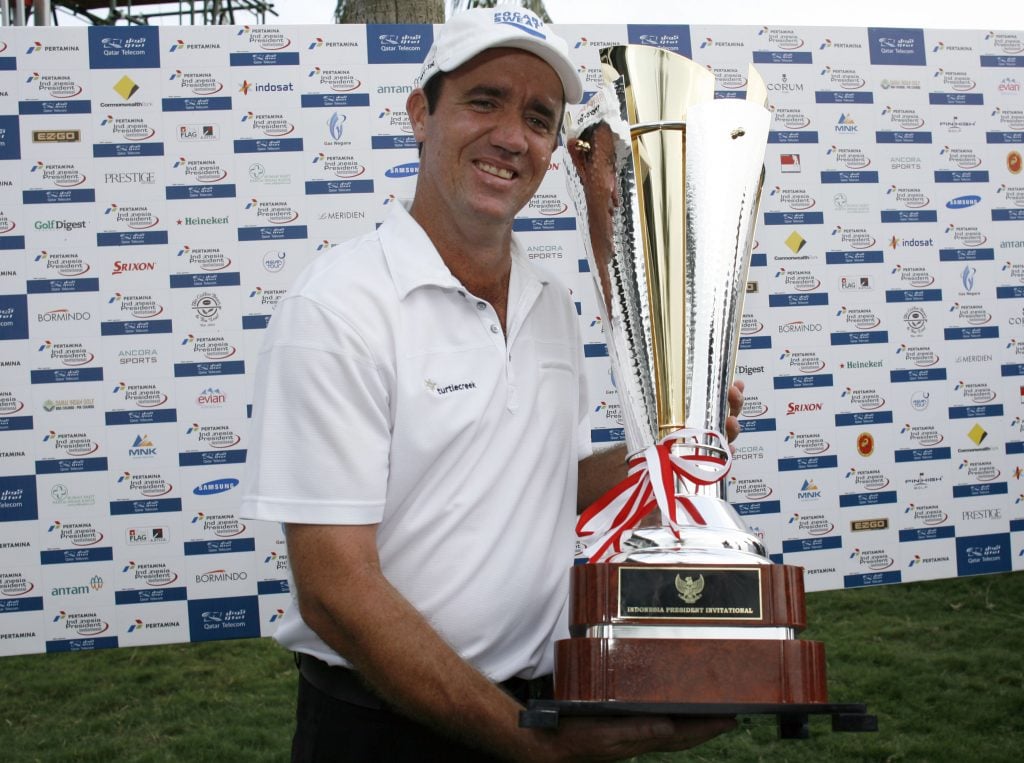
PIPI08-PRIZE PRESENTATION-The Pertamina Indonesia President Invitational at the Damai Indah Golf and Country Club,’s, Pantai Indah Kapuk course, Jakarta, Indonesia. 28-31, August, 2008. Picture by Paul Lakatos/Asian Tour.
He started slowly in the US$400,000 tournament but this was merely a smoke screen for what was to come over the weekend.
His opening round of one-under-par 71 left him with much to do as the best of the day was a 64 carded by Lin Wen-tang from Chinese Taipei – an in-form golfer, who had won earlier in the year at Asian Tour International in Thailand.
Even though Hend improved with a 69 on day two, he was five behind Malaysian Iain Steel – who took the lead on nine under with a 66.
Hend’s game then found a new dimension over the weekend and although his third-round 66 left him five adrift of tournament leaders Lin and Steel, the Australian was perfectly placed to mount a challenge.
Since joining the Asian Tour in 2007 he had finished second on three occasions and was one of the hottest golfers on Tour who was more than ready for a maiden victory.
Paired in the penultimate group on the last day with Korean-American Anthony Kang, he trailed Lin by three at turn.
Quickly responding to the challenge at hand, he made an eagle on the par-five 13th – impressively for the second day in-a-row. Lin made a par there, so the gap was down to one.
But another two shot swing soon followed when the Chinese Taipei golfer found water on the par-three 15th and made double-bogey.
It was the break Hend was looking for and from there he did not look back. The victory was secured when he made another birdie on the par-five 17th, where Lin dropped another shot.
Hend’s back-nine of four-under-par 32 and second successive 66 saw him win by three shots from Lin with a tournament total of 16-under.
Kang, Thailand’s Udorn Duangdecha and Mars Pucay from the Philippines finished third.
“I had a few runner-up finishes which is nice financially but there is nothing like winning a tournament. It is truly satisfying,” said Hend, after his win.
As a result of his success, Hend walked away with the top prize of US$63,400.
“I was solid on the back nine. I was thinking that if I shot a six under, I’ll be happy no matter what the outcome, even if I had not won. There was no real pressure and my putting was average,” he added.
“The eagle was great. I struck a solid drive and then almost holed my second shot. I told myself that I had to play solid and everything came together. I got ahead of myself on a few holes but I kept a steady momentum and I’m very happy with my finish.”
Lin’s final round 74 opened the door for Hend but he was magnanimous in defeat.
He said: “My iron play was good so I thought I could be aggressive on the 15th hole but I was too fast off the tee and the ball found the water. I also bogeyed the 17th hole. But it was a good game by Scott who played well under these challenging conditions. There are still more tournaments to play this year, so I hope to follow my rhythm and stay in contention.”
Up until that point in his career, Hend had won four times in Australia and once in Canada but the Pertamina Indonesia President Invitational was the big breakthrough victory he had been looking for.
In 2004, he decided to play on the PGA Tour but after two poor seasons because of injuries and loss of form he turned his attention to Asia and the Asian Tour Qualifying School in 2006.
And he says: “I finished second to Ben Leong (at the Qualifying School). My kids where born in December 2006 and then I went straight to Pakistan and finished second and from there on it was ‘happy days’ on the Asian Tour.”
In 2016, he became the first Australian to win the Merit title and, impressively, he also finished second on three occasions – in 2013, 2015 and 2019 – and was fourth four times – in 2007, 2009, 2014 and 2017.
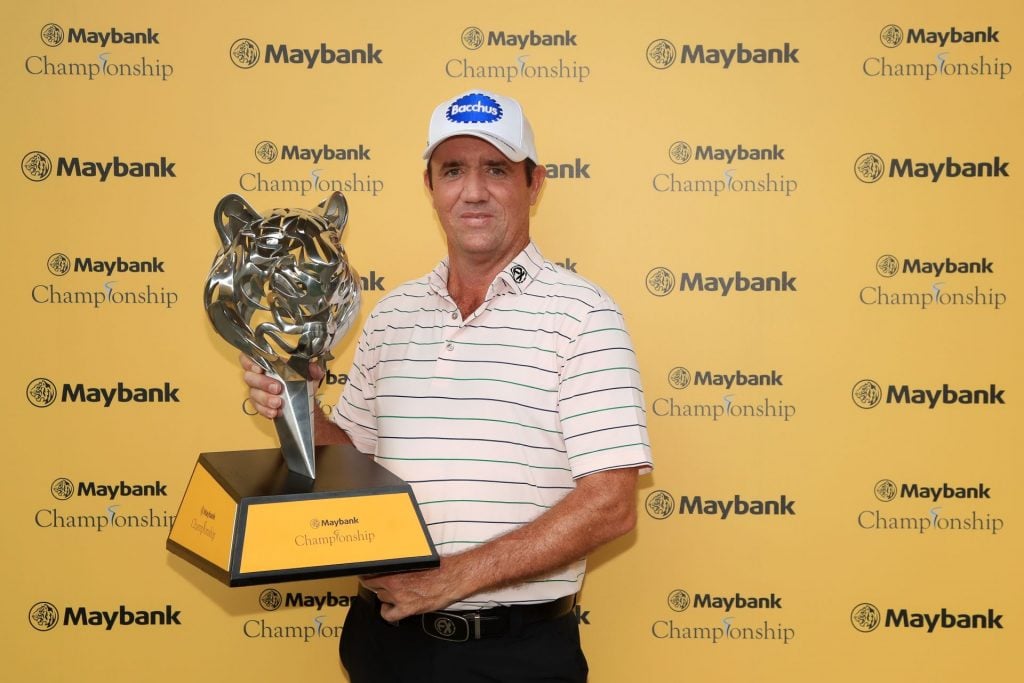
KUALA LUMPUR, MALAYSIA – MARCH 24: Scott Hend of Australia holds the trophy after he wins the play off match against Nacho Elvira of Spain during Day Four of the Maybank Championship at Saujana Golf & Country Club, Palm Course on March 24, 2019 in Kuala Lumpur, Malaysia. (Photo by Andrew Redington/Getty Images)
And when he claimed his 10th Asian Tour title in March 2019 – the Maybank Championship in Malaysia – he moved into second place on the Career Money List.
He is still in second place today with earnings of US$5,084,342 while Thailand’s Thongchai Jaidee – a 13-time winner on the Tour – leads the way with winnings of US$5,744,337.
Hend has been playing on the European Tour’s “UK swing” over the past few months, will compete in the US Open in September and will no doubt be looking forward to returning to Asia when the time is right.
Ends.
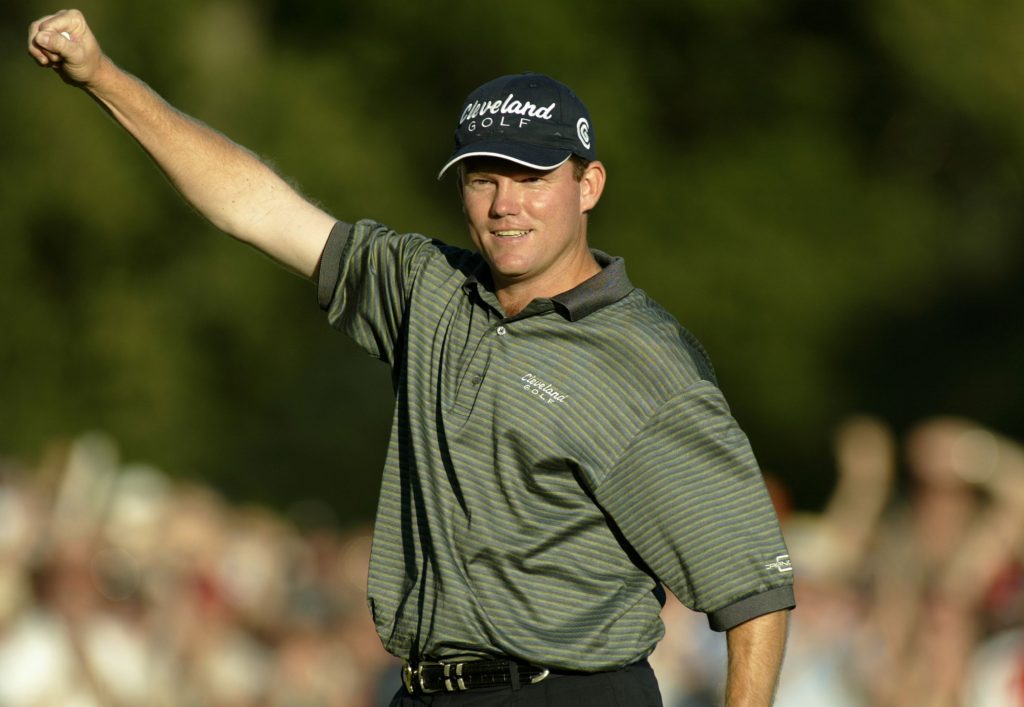
Cast your eye down the list of past champions of Singapore’s national Open and one of the winners who stands out – with a truly inspirational story – is Shaun Micheel.
Cast your eye down the list of past champions of Singapore’s National Open and one of the winners who stands out – with a truly inspirational story – is Shaun Micheel.
The American triumphed, on this day, in 1998 at SAFRA Resort & Country Club, and, as is well documented, went on to record a remarkable victory in the 2003 PGA Championship – at Oak Hill Country Club in New York.
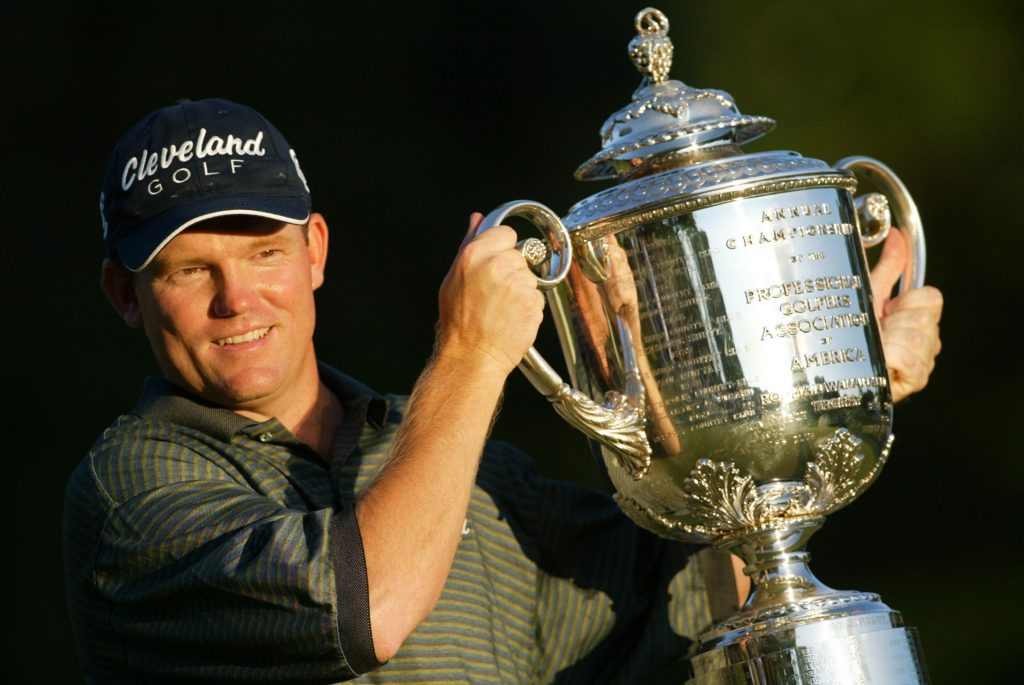
ROCHESTER, NY – AUGUST 17: Shaun Micheel of the USA holds the trophy after winning the 85th PGA Championship at Oak Hill Country Club on August 17, 2003 in Rochester, New York. (Photo by Jamie Squire/Getty Images)
That is two “Major” victories, some would say – particularly if you are a lover of the Singapore Open.
No doubt, the seeds for Micheel’s win in the PGA Championship were sown in Singapore 22 years earlier.
In 1998, he had decided to play in Asia in order to find his form.
“After I lost my PGA Tour exemption in 1997, my manager, at the time, mentioned going to Asia with Charlie Wi – who he also managed. He felt like a complete change of scenery might help me regain the confidence that I lost after a poor year on the PGA Tour,” said Micheel from his home in Tennessee last week – after having played in the Bridgestone Senior Players Championship on the Champions Tour.
He had started his professional career in 1992 on the Sunshine Tour in South Africa and because of that experience, he felt comfortable going to Malaysia to go through the Asian Tour qualifying process. The Tour at that time was called the Omega Tour.
Having negotiated the rigours of Qualifying School, he was quick to establish himself on Tour.
Early on in 1998, he pushed Thailand’s Chawalit Plaphol and Boonchu Ruangkit all the way in the Orient Masters in China. He eventually finished in a share of third, behind Chawalit – who claimed what was to be the first of many wins on Tour – and the legendary Boonchu, who finished second.
Says Micheel: “The competition was really good and I knew that if I could find some consistency, I would have a chance to get back onto the PGA Tour.”
The game plan worked and the consistency he so desperately wanted started to return; in the lead-up to the Singapore Open he was regularly in contention and on the cusp of a breakthrough win.
“You know, I don’t remember too much about the state of my game going into Singapore. One thing stands out, however, as I prepared to travel to Singapore. The week before I left, I asked my, then, girlfriend to be my wife. At the time I had known Stephanie for 16 years and we had been dating for nearly five years. I suppose that I felt quite encouraged about my engagement and that gave me the extra lift that I needed to win,” says Micheel.
He opened with a five-under-par 67 at SAFRA, to sit in a tie for fourth; and at the halfway mark, following a 69, he was two adrift of the leader, Lu Chien-soon – one of Chinese Taipei’s greatest golfing exports and a two-time winner of the Singapore Open, in 1983 and 1989.
Another 67 by Micheel on the third day saw him move into the lead, alongside South African Hendrik Buhrmann.
And on Sunday a fourth successive sub 70 (he shot 69) saw Micheel finish two ahead of Buhrmann to triumphantly claim his first Tour win and a cheque for US$80,750.
He says: “I believe that I had only two dropped shots the entire week. I don’t recall much of the competition other than my layup on the last hole, tapping in for par and then putting on the “cowboy” hat while accepting the trophy. Afterwards, I found out that a friend of my father’s had watched me win from a hotel in Japan.”
The cowboy hat was Ericsson sponsored headgear and one of many rewards that came with his win.
“The victory in Singapore validated my choice in going overseas when many others questioned my decision. Not a day goes by at home when I don’t see my Singapore Open trophy. No one will know how much that victory energised and inspired me to get back onto the PGA Tour and eventually win the PGA Championship in 2003,” said Micheel, who was 29 years old when he won in Singapore.
He is one of four past champions of the Singapore Open to have won a Major – the other three being: Australian Adam Scott, Angel Cabrera from Argentina and Spaniard Sergio Garcia.
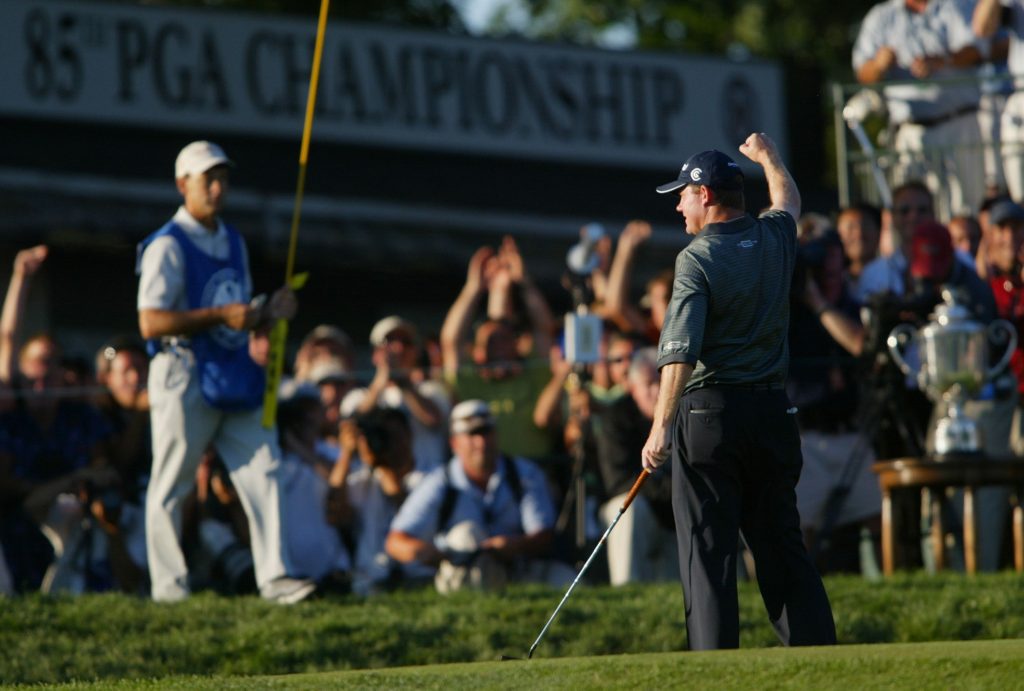
ROCHESTER, NY – AUGUST 17: Shaun Micheel of the USA celebrates his win on the 18th green after the final round of the 85th PGA Championship at Oak Hill Country Club on August 17, 2003 in Rochester, New York. (Photo by Jamie Squire/Getty Images)
Singapore as a country also left a big impression on him, as it did for his father – who was one of the original pilots for FedEx in 1973.
“My late father travelled to Singapore quite a bit and he loved it. So, when I arrived into the country I immediately saw why he felt the way that he did. The cleanliness is what struck me initially! To be honest, I thought it was so cool to be so far away from home in a country that had so much to offer in such a small space. From the hotels to the restaurants to the natural beauty, I was enamoured with Singapore. Of course, I’ll never forget SAFRA Resort. Great memories and I would love to bring my wife over some day.”
In fact, his first year in Asia in 1998 proved to be an enormous success not just because of his victory in the Lion City.
“I absolutely loved my time in Asia. Many of the places where I competed were just faraway lands that I had read or heard about from my father who was a frequent visitor. Having a place to play was, at the time, the most important element as that was why I was there in the first place. Over time, however, I realised that it was not all about playing golf. Life in the United States was quite a bit different than many of the cities that I visited.
“Having an open mind was a bit of advice that I received and I did my best to fall in love with the new cultures, people and differences that existed. One thing that I did was to learn to a few simple words in the local language in an attempt to show respect to my new friends. Of course there was no way to become fluent in a new language overnight but I felt like it was important for me to try to fit in the best that I could. I did receive quite a bit of help from Charlie Wi and that was greatly appreciated.”
Micheel is also quick to point out the great support he received from the Tour.
He said: “In the end, my incredible experience came as the result of the incredible staff from the Asian Tour office, the players that I met and the many people who accepted me and allowed me to enjoy something new!”
After his win in Singapore he made it on to Nike Tour (now the Korn Ferry Tour) and won the NIKE Greensboro Open in 1999. And the following year he returned to the PGA Tour, so any chance of returning to play in Asia proved too difficult.
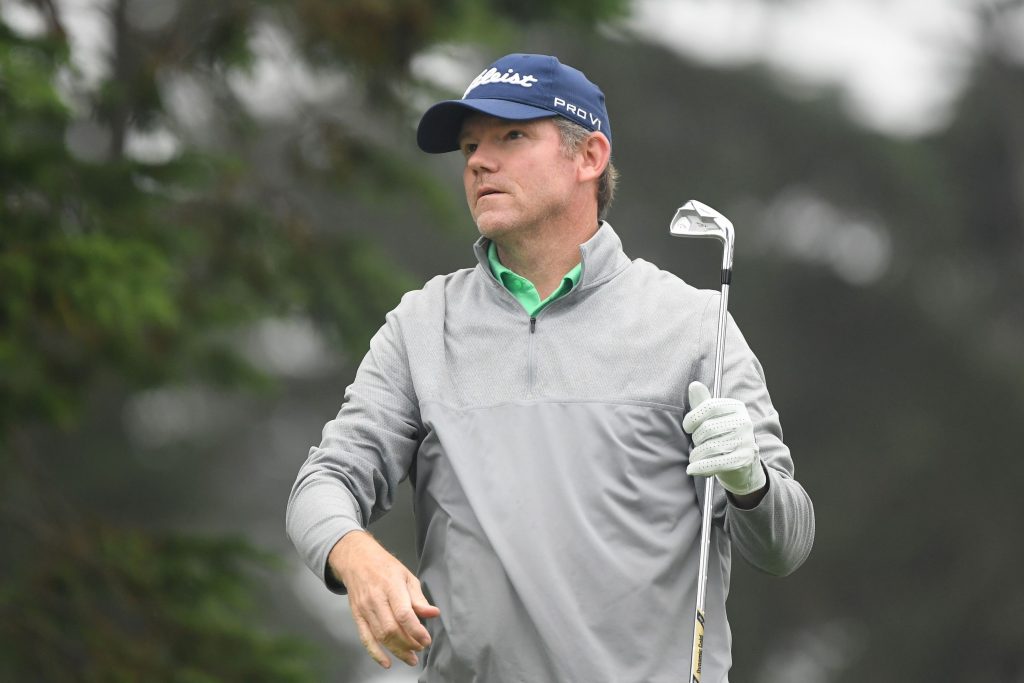
SAN FRANCISCO, CALIFORNIA – AUGUST 06: Shaun Micheel of the United States watches his tee shot on the third hole during the first round of the 2020 PGA Championship at TPC Harding Park on August 06, 2020 in San Francisco, California. (Photo by Harry How/Getty Images)
Now at 51 years old, he has been competing on the Champions Tour and the European Senior Tour, which he says: “allows me to keep my passport dust free and my experiences fresh.”
He adds: “Many journalists labelled me a journeyman pro like it was a negative. My experiences of competing in over 34 countries is a badge of honour that I share with all who will listen.
“I would never trade my time in Asia for anything. So many of my friendships began in Asia. Thinking of Darren Clarke, Lee Westwood, KJ Choi, Jeev Milkha Singh, John Senden and Thongchai Jaidee. I love catching up with these guys and reliving the old days. Maybe one day I can return!”
Ends.
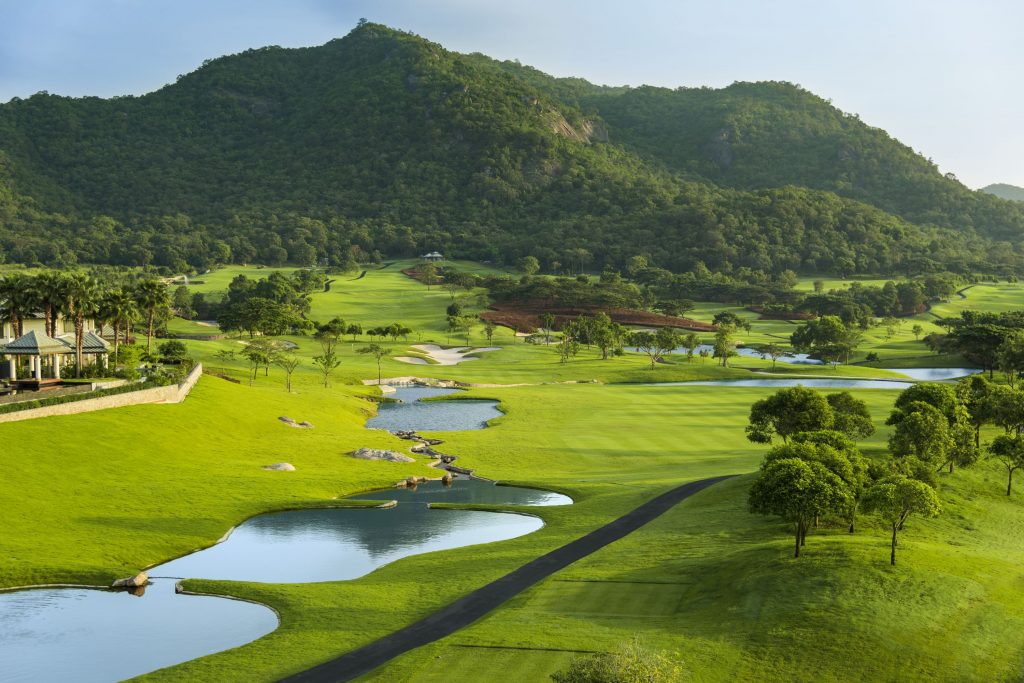
Asian Tour Destinations – an exclusive network of world-class golf venues with direct ties to the Asian Tour – has significantly strengthened its presence in the region with the addition of three premier golf clubs.

Sentosa, Singapore, August 21: Asian Tour Destinations – an exclusive network of world-class golf venues with direct ties to the Asian Tour – has significantly strengthened its presence in the region with the addition of three premier golf clubs.
Black Mountain Golf Club in Hua Hin, Thailand; Classic Golf & Country Club in New Delhi, India; and Kota Permai Golf & Country Club in Kuala Lumpur, Malaysia, have all become part of the exciting network, which will be adding prominent venues from the Asia Pacific region to its portfolio in the near future.
All with a history of hosting prestigious Asian Tour tournaments, they join Sentosa Golf Club, Singapore which was the first golf club to become part of the Asian Tour Destinations network in 2015.
In addition, Asian Tour Destinations has further enhanced its portfolio by partnering with online booking portal Tee Time Saver and the globally leading Customer Service Analysis provider 59Club Asia.
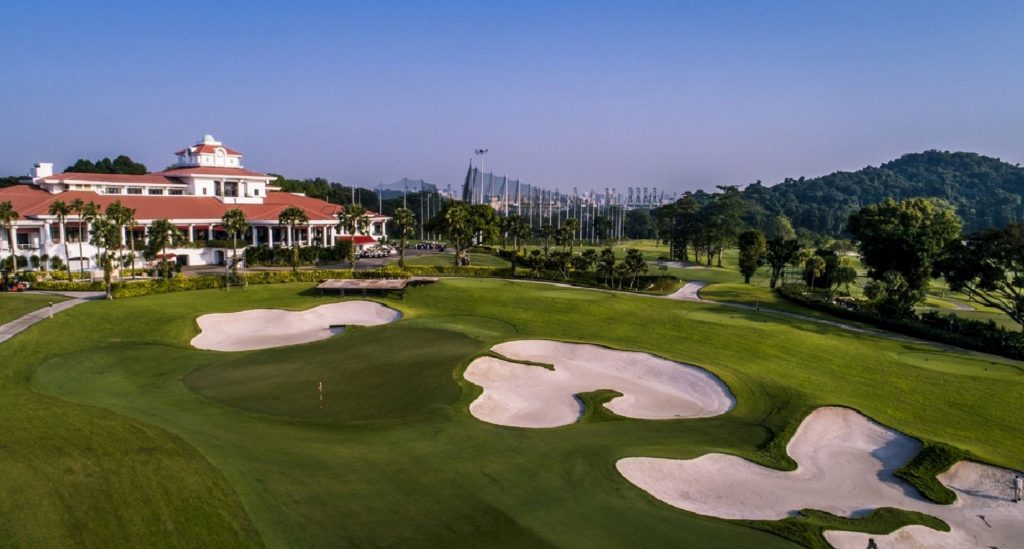
The iconic 18th hole of the New Tanjong and the clubhouse at Sentosa Golf Club.
Cho Minn Thant, Commissioner and CEO of the Asian Tour, said: “We welcome the new venues on board, and we look forward to working with them and further developing our relationships. They represent the top-tier of golfing properties in Asia and are a perfect fit for Asian Tour Destinations.
“Through our combined resources these golf clubs will benefit from the significant value that the Asian Tour and Asian Tour Destinations brand will add to their commercial and strategic goals in combination with support from Tee Time Saver and 59Club Asia.”
The primary mission of Asian Tour Destinations is to provide an affiliate membership programme between the associated venues – with a collective membership base of 7,500 golfers – and the Asian Tour which will help grow the game of golf in the region.
In particular, being a part of the Asian Tour Destinations network means that each venue is certified Tour caliber and operates a comprehensive range of facilities and services to their members and guests under tournament-ready conditions all-year round.
Among the core benefits, Asian Tour members will be able to play and practice at each venue facilitating for the members at each club to enjoy direct engagement with the region’s best golfers.
“Black Mountain is delighted be part of this new community of leading golf courses. We pride ourselves on being a desirable destination for visitors from all over the world and our association with the Asian Tour and Asian Tour destinations will truly help with this objective. Several Tour players already base themselves at our property and we look forward to welcoming more in the future as well as the members from the other Asian Tour Destination clubs around Asia,” said Harald Elisson, General Manager, Black Mountain.
The renowned Hua Hin venue has played host to a number of Asian Tour sanctioned tournaments including the Black Mountain Masters, the Thailand Classic, the King’s Cup, and the Royal Trophy.
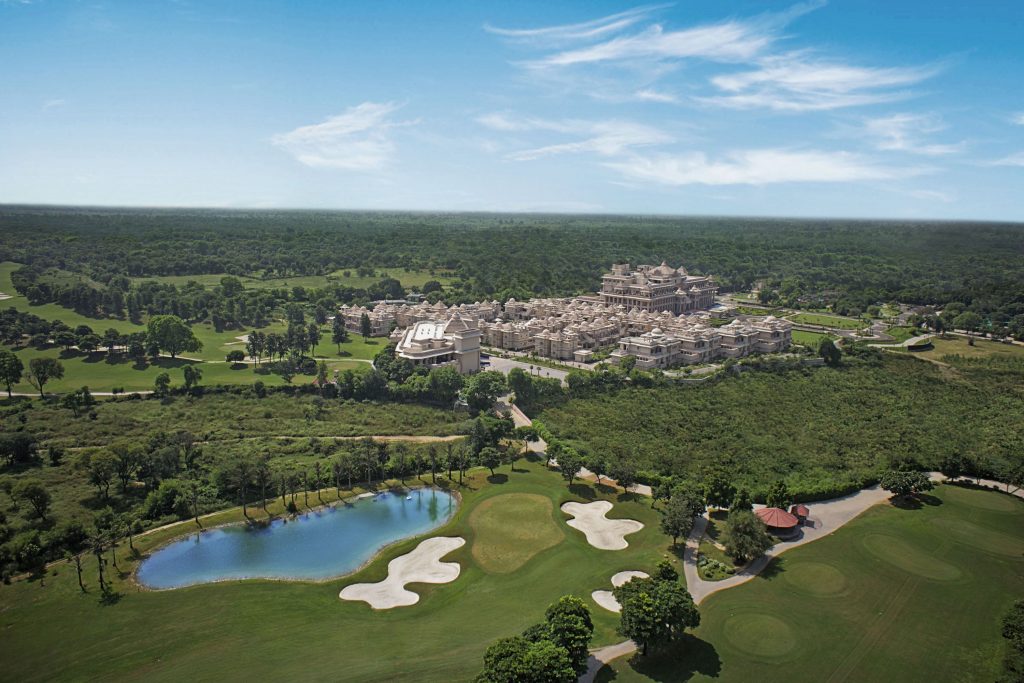
Classic Golf & Country Club
“Classic Golf and Country Club has worked hard to build an international profile that highlights our world-class venue and so our new relationship with Asian Tour Destinations network is the perfect conduit for this, among many other benefits,” added Deepak C. Menezes, the Managing Director of Landbase India Ltd., Classic Golf & Country – venue for the Panasonic Open India, the Classic Golf and Country Club International Championship, and the Sail Open.
“Kota Permai Golf & Country Club has always embraced the spirit of providing the best golfing experience possible to all our patrons. As one of the leading golf clubs in Malaysia, we would like to ensure that we are aligned with other elite clubs in Asia plus the region’s foremost professional golf Tour. Becoming a member of Asian Tour Destinations is an honour and an exciting opportunity for Kota Permai to showcase our pristine golf course, excellent club facilities as well as warm hospitality. We look forward to welcoming both Tour players and Asian Tour Destinations members alike,” said Tang Meng Loon, Director of Club, Township & Property Management at Gamuda Land.
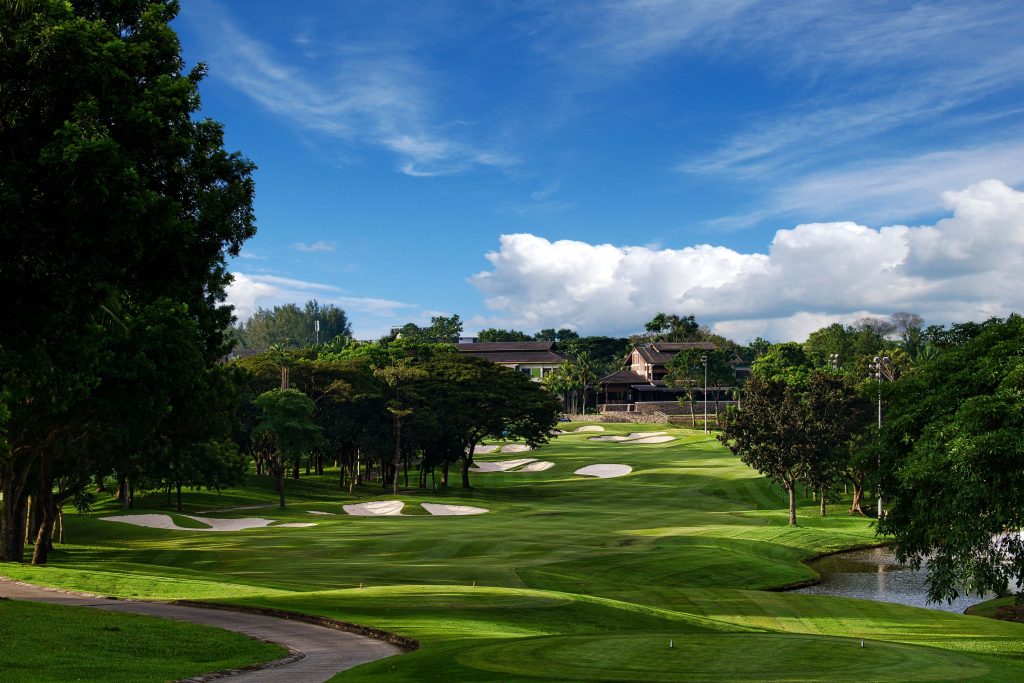
Kota Permai Golf and Country Club
The golf club has been hosting events on the Asian Tour for nearly 20 years such as the Volvo Masters of Asia, the Selangor Masters and more recently the 2020 Bandar Malaysia Open.
Sentosa Golf Club, home of the Asian Tour and the SMBC Singapore Open, has enjoyed its role as a founding member of Asian Tour Destinations.
“Sentosa Golf Club boasts a strong bond with the Asian Tour and our involvement with Asian Tour Destinations allows us to push ahead with one of our key roles, which is to help the golf industry in the region, as a whole, attain new levels of quality and excellence. We look forward to working with the venues who have recently joined,” said Andy Johnston – General Manager and Director of Agronomy at Sentosa Golf Club.
In addition, Asian Tour Destinations has established a partnership with the Tee Time Saver to promote its network of venues. Tee Time Saver provides an integrated search and booking engine for golfers to easily find the best tee-time and golf packages available for Asian Tour Destinations venues. They will also produce dedicated content on their website and social media platforms for golf fans to have in-depth reviews from Asian Tour professionals on the destination venues including strategies to adopt when playing signature holes.
As the leading sales & service analyst and performance training provider in Asia, 59club Asia delivers the resources to significantly improve and maintain sales & service etiquette, in turn increasing customer satisfaction, revenue and ultimately profits. 59club Asia are the only company in golf industry that rewards venues achieving improved customer service levels, recognised though mystery shopping audits, presenting Service Excellence Awards, famously known as the ‘Oscars’ of the industry.
Ends.

Indonesia’s budding young golf star Danny Masrin, like the vast majority of members on the Asian Tour, has chosen to use the current downtime – caused by the coronavirus pandemic – wisely and constructively.
“I decided to go back to school,” says Masrin.
“I have been doing an online Masters programme, which I started in May. It’s with the Thunderbird school, through Arizona State University. I thought if I am ever going to do it, now is the time.”
Keeping the mind sharp is a smart move by the 27-year-old as he is as eager as anyone to get back in action when the Asian Tour resumes.
Prior to lockdown gripping the region in March, Masrin unlocked his potential and found what it takes to play and compete with the best in the region.
He explains: “From the end of last year I was playing really good golf – since the BNI Indonesian Masters until the Bandar Malaysia Open. There were six tournaments there where I had two top-10s, three top-15s, I was playing pretty good. I was really happy.”
He had struggled to find his feet on Tour since turning professional in 2015, but last year his patience and conviction started to pay off.
In the middle of the year, his upswing in fortunes started when he made the cut in seven tournaments in a row, including finishing seventh at the Yeangder TPC in Chinese Taipei.
And then came the BNI Indonesian Masters in December at Royal Jakarta Golf Club.

“I was 55th on the Order of Merit going into the BNI Indonesian Masters – I was kind of on the edge, and I really wanted to finish higher. People were saying you are safe but the higher you are the better it is,” said the Indonesian.
Impressively, he overcame the pressure of fighting for his Tour card, and playing in front of his home support, to produce a breakthrough performance and finish in a tie for fifth – his best finish on Tour.
He says a big factor contributing to that result was having his mentor, Teddy Harmidy, caddie for him.
“To have Teddy, a good friend and mentor as my caddie was amazing. We play and practice all the time. It just gave me a level of comfort,” he says.
“Everything clicked there at the right time. We both know that course very well. So it was a matter of executing.”
https://business.facebook.com/81874786179/videos/583074252458012/
After that result he headed to the Thailand Masters – the final event of the year – brimming with confidence.
He says: “I still remember how much of a relief it was going to Thailand for the last event, as I had secured my card. I could just go out and play, there was no pressure any more. Knowing that I would get into a lot more tournaments, and that I could actually prepare. In the past it was like you might get into this tournament but you might not. Sometimes you had to be ready to leave at last minute notice.”
It was indeed a new dawn for the young Indonesian: he finished in the top-20 in Thailand, and in early 2020 he recorded a top-30 finish in the Hong Kong Open, captured equal eighth place in the SMBC Singapore Open and ended joint 13th in the Bandar Malaysia Open.
But, unfortunately, soon after Malaysia the Tour had to hit the pause button because of coronavirus.
“I have been in Jakarta since then, it’s probably the longest I have been in Jakarta,” says Masrin, who attended Bradley University, in Illinois, where he played on the golf team.
“After that solid start to the year, the schedule had been looking really good with events going two weeks on, two weeks off through to August but then we have to go through this.”
Masrin has since been playing and practicing and as he says: “keeping the body warm and in shape, and ready to play again.”
“I used to be of the mindset that if I take too many days off, I won’t be ready to play but it has been nice to know that if I take a few days off my body is still ready to play again at a high level,” he says.
“I am still playing pretty well, there have been moments during these five months when I wished there were tournaments to play in but there is nothing you can do about it.”

He practices at the Royale Jakarta, Pondok Indah and BSD courses and has been buoyed by the fact that the local Tour is aiming to stage an event each month from September until the end of the year.
“It is something to look forward to as we have not played in so long,” says Masrin, who has won seven events on local tour, with the most recent last year.
Masrin was also aiming to play in this summer’s Olympics and was bitterly disappointed it was postponed.
“For the longest time, for the last two and a half years, one of my biggest aims was to qualify for the Olympics. To have an Indonesian player represented at golf in the Olympics was the ultimate goal,” he says.
“This year we were coming down to the final stretch in the run up to Tokyo, I was on track to qualify and that’s why I was so excited I was playing well, but then obviously things changed, and now I will prepare for the tournaments I need to play in order to qualify for next year.”
There is no doubt that there is now huge cause for optimism for Masrin – thanks to his new found form and fine performances.
That has not always been the case over the past few years.
“There are a lot of struggles in golf, from the mental side, to the physical side, to the golf swing,” he says.
“There was a time in 2017 when I was playing really poorly, and I thought about quitting golf and I thought about what my options were. But when I first started playing professionally, I said I would give myself three to five years to see if professional golf was a stable career for myself and I have stayed true to that.
“Golf is a tough sport to be in as it is so uncertain. From week to week, it’s tough as you don’t know if you will have 10 weeks of missed cuts, with 10 weeks of spending money without making money, or you win one event and everything changes.”
As well as Teddy Harmidy – a former Indonesian national player, who played with American star David Duval on the Georgia Tech golf team in the United States – playing an important role in his success, a more holistic approach has also been key.
“What I have done well, the last year and a half, is I have started to focus on the statistics more. I have broken it down into more of the technical side, not of the swing, but the numbers of what needs to be focused on. I think I have a very good idea of what my strengths are and what my weaknesses are. I have been able to focus on those areas over the past 18 months.”
The analytical strategy has clearly worked and with a Masters degree imminent, he will be more applied than ever when the region once again opens up to tournament golf.
Ends.
11 years ago today, Korea’s Y.E. Yang became the first Asian-born player to win a Major at the PGA Championship.
At last weekend’s PGA Championship, there was a real possibility that a player from Asia would lift the famous Wanamaker Trophy.
The huge audience of golfers, and non-golfers, watching west of the Pacific tuned in to see if China’s Li Haotong could prevail after leading at the halfway mark.
Sadly, his challenge failed to materialize over the weekend while Asia had some consolation in the fact that the winner, America’s shining new-star Collin Morikawa, is half Japanese.
And so the quest by Asia to produce a winner of a Major to match Korean Y.E. Yang’s legendary victory in the 2009 PGA Championship continues.
That memorable win was, in fact, achieved 11 years ago on this day.

CHASKA, MN – AUGUST 16: Y.E. Yang of South Korea celebrates his birdie putt on the 18th green during the final round of the 91st PGA Championship at Hazeltine National Golf Club on August 16, 2009 in Chaska, Minnesota. (Photo by Sam Greenwood/Getty Images)
In what is another significant moment in time that feels like only yesterday, Yang became the first Asian-born player to win a Major.
He surpassed the previous best performances by Asians in Majors, which were runner-up finishes by Chinese Taipei’s Lu Liang-huan in the 1971 Open Championship; Isao Aoki, from Japan, in the 1980 U.S. Open; and Chinese Taipei’s Chen Tze-chung in the 1985 U.S. Open.
Li also came close in 2017 when he claimed third place in The Open while Korean K.J. Choi was third in the 2004 Masters – and fourth in the same event six years later.
The 91st PGA Championship was played at Hazeltine National Golf Club and Yang’s victory was one of the biggest upsets of the century and had a seismic impact on the game of golf because not only did he break Asia’s duck at Majors but he also defeated American superstar and world number one Tiger Woods.
Woods had already won 14 Majors – at that time, it would have been inconceivable to think his next one would be the Masters in 2019 – and he had never lost any tournament on American soil when leading by more than one shot.

CHASKA, MN – AUGUST 16: Y.E. Yang of South Korea (2nd L) celebrates a birdie putt on the 18th green alongside Tiger Woods (2nd R) during the final round of the 91st PGA Championship at Hazeltine National Golf Club on August 16, 2009 in Chaska, Minnesota. (Photo by David Cannon/Getty Images)
Yang, a 37-year-old who attended the PGA Tour qualifying school nine months before, was ranked 110 in the world and was barely known State side.
But that was the beauty of his moment of glory, as it was a victory sealed by stealth.
Unknown and unheralded in America, he arrived at Hazeltine already a prolific winner in Asia having claimed four titles in Japan and two on the Asian Tour.
He had also fired a warning shot early on in 2009 by winning the Honda Classic in March – becoming only the second player from the Land of Morning Calm to win on the PGA Tour. Choi was the first in 2002.
A fine victory it was but it did little to alert experts in the game about what was to happen five months later in the final Major of the year.
And as expected, Woods was dominant over the first three days at Hazeltine and appeared on course to collect his fifth PGA Championship.
He was the central character in a golden era for the game thanks to his divine brilliance.
Yang had started poorly with a one-over-par 73 but gained some confidence the next day by firing a 70 to move into the top-10 – trailing Woods by six.

CHASKA, MN – AUGUST 16: Y.E. Yang of South Korea poses with the Wanamaker Trophy after his three-stroke victory at the 91st PGA Championship at Hazeltine National Golf Club on August 16, 2009 in Chaska, Minnesota. (Photo by David Cannon/Getty Images)
But Yang used all of his powerful well built-frame – matched only by his illustrious countryman Choi – to move into contention on day three. He fired a 67 to sit two back of Woods in joint second with Ireland’s Padraig Harrington – the defending champion and already a three-time Major winner.
The Korean was in exalted company – but this was a Major – and the occasion became even more sublime when he was paired with Woods on the final day.
On the front nine, Woods was out of sorts and three-putted for bogey at number four and made bogey from the bunker on eight to make the turn in two over. That meant Yang drew level.
They were still tied with five holes to play when Yang delivered a knockout blow, much in the same way that Morikawa did when he made eagle on the par-four 16th at TPC Harding last Sunday.
Woods had appeared to have the upper hand and was in birdie range at the par-four 14th, but Yang sensationally countered by chipping in from 60 feet for eagle to take the lead by one.
And he had maintained that slim advantage by the time they reached the par-four 18th, where Yang was called upon again to conjure one final bit of magic.
For his second shot, a tree slightly blocked his view of the flag and with Woods in the fairway, Yang needed to hit the shot of his life.
He duly accepted the challenge, and with his three-iron hybrid he cleared a bunker and saw his ball come to rest 12 feet away, where he made birdie to seal a history-making victory.
He closed with a 70 for a three-stroke victory over Woods, who shot a final-round 75 after missing a short par putt on the last for his worst score ever in the final round of a Major when he was in the last group.
“It’s not like you’re in an octagon where you’re fighting against Tiger and he’s going to bite you, or swing at you with his nine-iron,” said Yang, after through an interpreter. “The worst that I could do was just lose to Tiger. So I really had nothing much at stake.”
“This might be my last win as a golfer,” added Yang. “But it sure is a great day.”
“All the other 14 major championships I’ve won, I’ve putted well for the entire week,” Woods said. “And today, that didn’t happen.”
“He [Yang] went out there and executed his game plan. He was doing exactly what you have to do, especially in these conditions. I think he played beautifully.”
Yang finished on eight-under 280 and won US$1.35 million, along with a five-year exemption on the PGA Tour and the Majors.

Y.E. Yang of South Korea after sinking his putt to win August 16 ,2009 at the 91st PGA Championship at the Hazeltine National Golf Club in Chaska, Minnesota. At right is Tiger Woods of the US . AFP PHOTO / ROBYN BECK (Photo credit should read ROBYN BECK/AFP via Getty Images)
Even Korea’s president, Lee Myung-bak, got up before sunrise to watch the tournament live. He later phoned Yang to offer his congratulations.
“I woke up at dawn today to watch the broadcast, and you played in a calm manner,” Lee told Yang, according to Lee’s office. “First of all, you enhanced our people’s morale by winning the Major title for the first time as an Asian.”
It was indeed a triumph of great magnitude on a day when Yang rode into Mayor City, made a Major name for himself and Majored in the game of life.
Ends.


Recent Comments