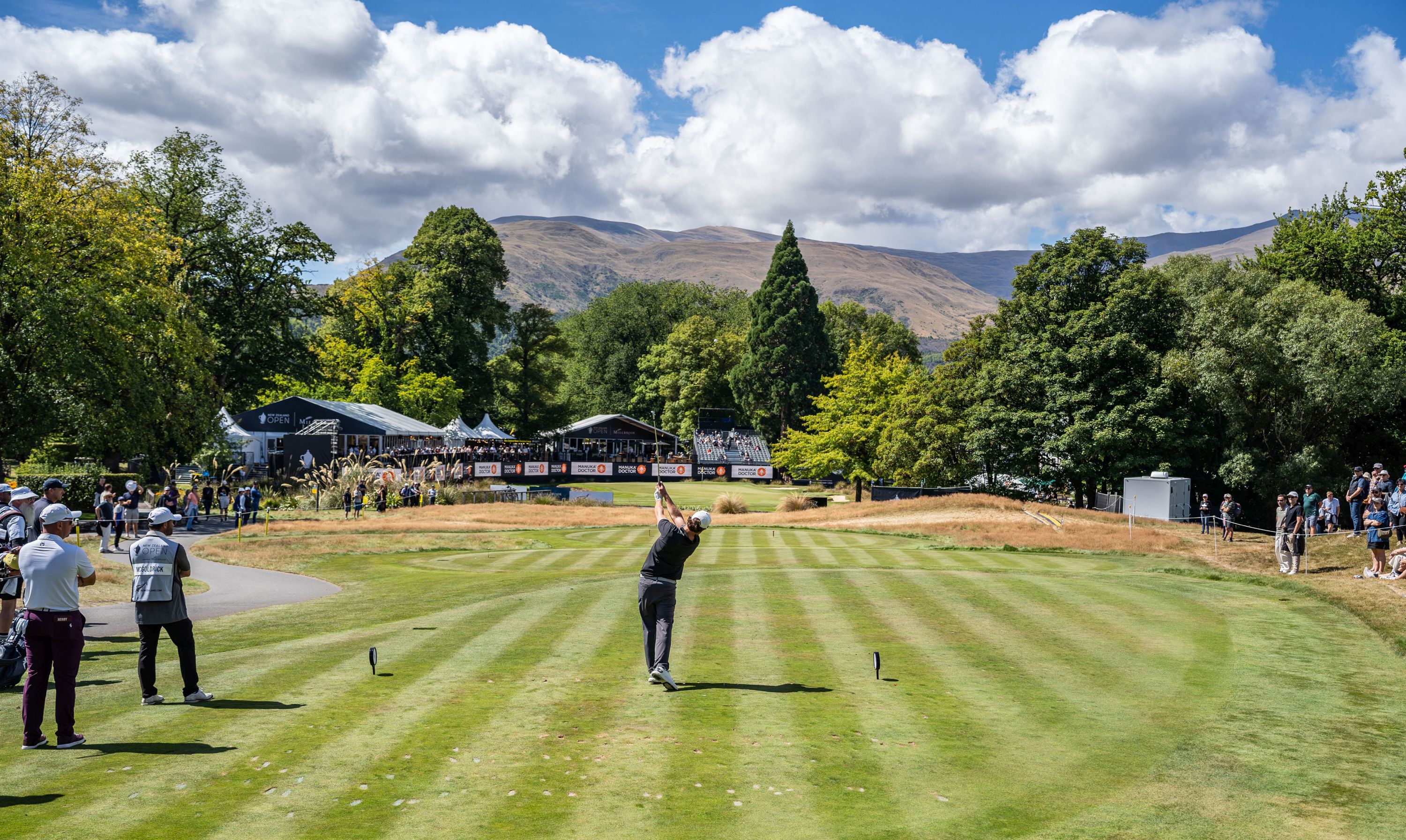
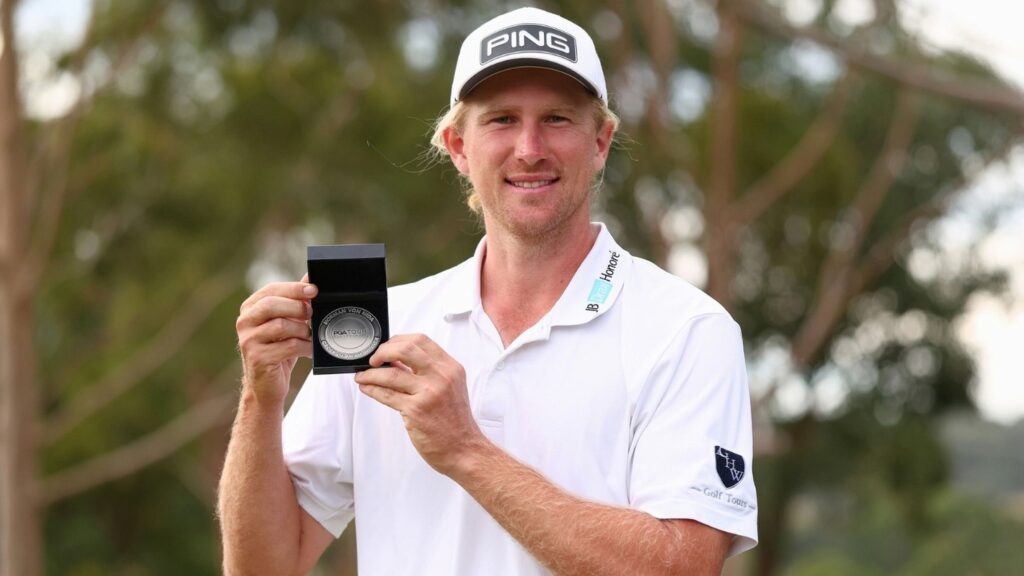
One of New Zealand’s pre-eminent sporting events, the New Zealand Golf Open, scheduled to be played at Millbrook Resort and The Hills in February 2021 has been cancelled.
The Chairman of the Organising Committee, Mr John Hart, confirmed the cancellation, due to the ongoing global Covid-19 pandemic and the related health and financial risks.
The 102nd New Zealand Open will now be played between 17th and 20th February 2022.
“We are extremely disappointed to have had to come to this decision but the effects of the pandemic, borders being closed, and the financial risk associated with a potential later cancellation due to any further Covid-19 outbreaks means we have no other alternative other than to cancel this event now.”
“With up to 300 international participants coming from offshore (including professional players, amateur players, caddies, and officials of our Tour partners (the PGA Tour of Australasia, the Asian Tour and the Japan Golf Tour), we need absolute certainty now in terms of accessibility to New Zealand and this is clearly not possible” said Hart.
“We would like to thank Millbrook Resort (the tournament underwriter), The Hills, our many commercial partners, both domestic and international, led by our presenting sponsor Sky Sport, Government and the Queenstown Lakes District Council for their support and understanding. Further thanks go to our Tour partners, New Zealand Golf, our professional players, our sold-out amateur field, and our amazing volunteer force.”
“This is not a decision we have made lightly, and we are particularly disappointed for the Queenstown region who have suffered many setbacks during this Covid-19 era.”
“We are very proud of what we have created with the New Zealand Open becoming one of New Zealand’s most recognised and applauded international sporting events.”
“We remain very committed to once again showcasing the very best of Queenstown and New Zealand in February 2022 at a time when hopefully we will all be operating in a more certain and safer environment” said Hart.
The cancellation of the New Zealand Open follows announcements in the past 10 days of the cancellation of Australia’s four major golf tournaments; the Australian Men’s Open, the Australian Women’s Open, the Australian PGA Championship, and the Victorian Open, all similarly planned for February 2021.
Ends.
Sentosa, Singapore, October 27: The Asian Tour Annual General Meeting (AGM) took place today and saw a number of established and respected players join the Tournament Players’ Committee (TPC).
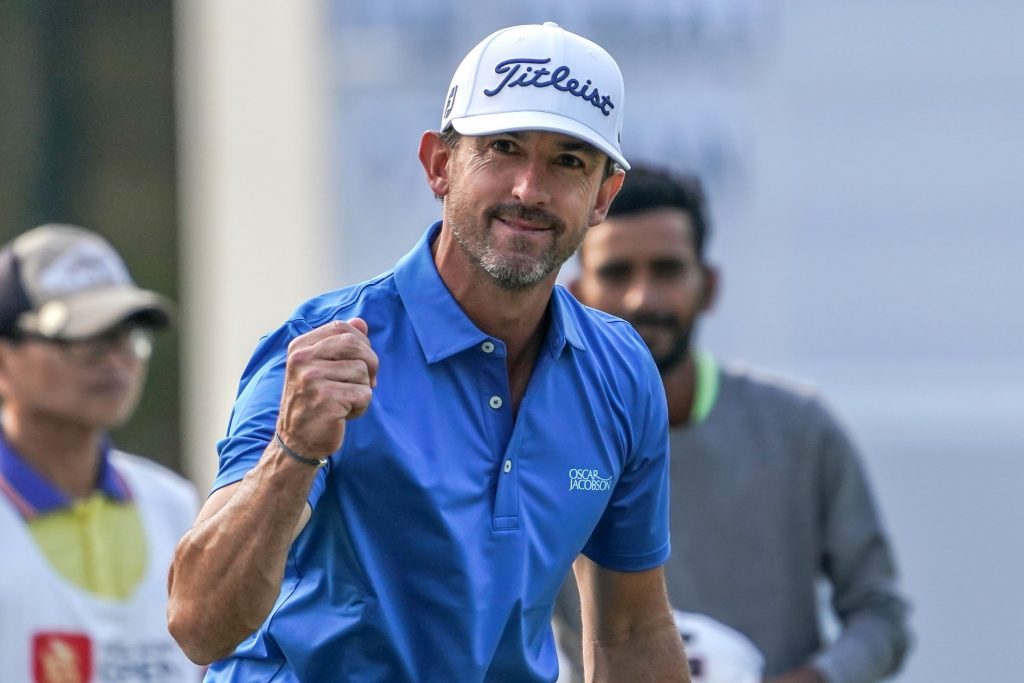
Australians Terry Pilkadaris and Travis Smyth, Berry Henson from the United States and Thailand’s Panuphol ‘Coconut’ Pittayarat have all become part of the committee.
They join existing members Indians Chiragh Kumar and Rahil Gangjee, Chinese Taipei’s Hung Chien-yao and Chan Shih-chang, and Filipino Angelo Que on the committee.
“We are delighted to welcome Terry, Travis, Berry and Panuphol to the Tournament Players’ Committee,” said Cho Minn Thant, Commissioner and Chief Executive Officer of the Asian Tour.
“They are all popular and experienced players who will serve the Tour well in their capacity as player representatives. Indeed, there was a tremendous air of positivity throughout the AGM and a sense of solidarity as we look to overcome a difficult season and move into 2021 with renewed vigor and confidence.”
This is the first time Pilkadaris, Smyth and Panuphol have joined the TPC, whereas Henson served once before.
The Asian Tour’s key decision-makers and stakeholders took part in what was the 16th staging of the AGM – which for the first time in its history was held online via Zoom conference.
India’s Shiv Kapur, Thailand’s Arnond Vongvanij and Marcus Both from Australia all retired from the TPC.
“We thank Shiv, Arnond and Marcus for their contributions over the years – their input has been invaluable in helping us make important strategic decisions,” added Cho.
The AGM saw a wide range of issues discussed, with announcements on the Tour’s next steps expected in due course.
Ends.
In the second and final part of our feature on three-time Asian Tour winner Anthony Kang, the American talks about his famous victory at the Maybank Malaysian Open, swing fundamentals and his transition into TV land.

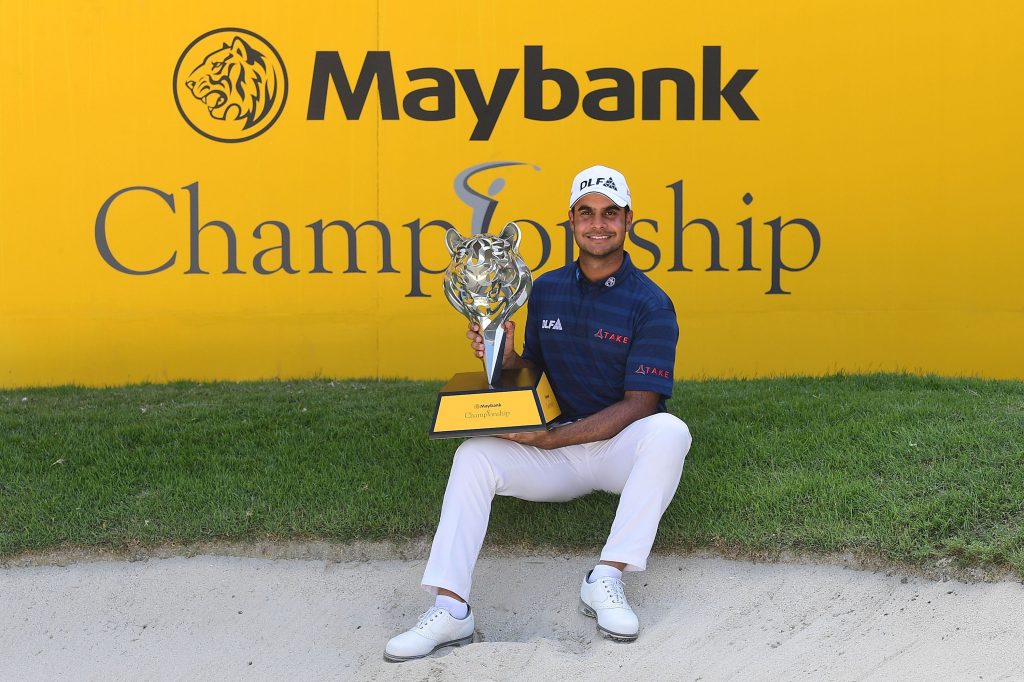
KUALA LUMPUR, MALAYSIA – FEBRUARY 15: Anthony Kang of USA poses with the trophy after winning the Final round of the 2009 Maybank Malaysian Open at Saujana Golf and Country Club on February 15, 2009 in Kuala Lumpur, Malaysia. (Photo by Ian Walton/Getty Images)
While Anthony Kang always looks back on his victory at Casino Filipino Philippine Open in 1999 as one of the great highlights of his career – because it was his maiden win – his triumph in Malaysia’s National Open 10 years later carries as much significance to him, and perhaps even more.
It is the manner of that win, which came down to a nail-biting finish, which is so important to him.
“At the Maybank Malaysian Open having a chance to hit my second shot on the par-five final hole of the tournament, the 72nd hole, and knowing if I pulled the shot off I was going to win the tournament was an incredible moment and experience.
“To me it is a rare occasion in golf to be in a position to hit that winning shot when the time is ticking off – it happens in other sports like American football, even soccer, or basketball or baseball. So I felt like it was that moment for me and to experience a moment like that, which all great players have – like Tiger Woods, Rory McIlroy and Dustin Johnson – I feel fortunate that at least in Malaysia that tournament provided me the opportunity to experience that moment and then fortunately to come out ahead on the right side of it.”
He birdied the 18th at Saujana Golf and Country Club to win by one from four players: England’s David Horsey and Miles Tunnicliff, Thailand’s Prayad Marksaeng and India’s Jyoti Randhawa.
It ended an eight-year title drought and as the event was jointly-sanctioned with the European Tour it secured him playing privileges there.
“As soon as I won, I called my brother and said do you want to come and caddie for me in Europe, because we are going to make millions!” said the American.

KUALA LUMPUR, MALAYSIA – FEBRUARY 15: Anthony Kang of USA in action during the Final round of the 2009 Maybank Malaysian Open at Saujana Golf and Country Club on February 15, 2009 in Kuala Lumpur, Malaysia. (Photo by Ian Walton/Getty Images)
He quickly points out that that did not come true but that the opportunity was the most important element.
He adds that his game was gathering momentum in the lead-up to Malaysia: “Before Malaysia, about two years prior to, I was playing pretty solid golf. I wasn’t hitting any wild shots. I was very consistent, week after week, and I was making putts. While I wasn’t contending very much, I still had a lot of top 10 to 20 finishes. I was loving it. I’d show up, play, make some money and sometimes have a chance to win. Week after week after week, everything was in the positive.”
Unfortunately, success at Saujana did not open the floodgates to more firsts. In fact, quite the opposite happened.
“My game started to go about one month after the Malaysian Open,” says Kang.
He remembers playing a practice tournament at the Ballantines Championship in Korea on Jeju Island with Ted Oh, Unho Park and Lam Chih Bing (his regular practice group) when things started to go wrong.
“On the eighth hole I hit this drive and it went six yards right and I couldn’t figure out why that shot happened and ever since that happened my game started to slowly erode. So every day after that I was trying to fix it – it was like that story of the kid in Amsterdam who is trying to plug the dam wall by plugging the leaks day after day.”
He feels it was his fundamentals and technique that let him down.
“My fundamentals were not very solid. I had a band aid week after week to make the ball go straighter. I was thinking if the ball went straight, whatever I was doing, that’s correct. As opposed to looking at the proper technique, proper sequence, proper timing.
“Back then the information was not available, the technology wasn’t there, the data wasn’t there, to say the swing has to be sequenced this way, the hips have to move this way – it was more trial and error. Back then it was legendary stories of Vijay Singh.
“That was the mentality I had. I needed to see the ball on the driving range going straight, didn’t matter what my swing felt or looked like.
“I think in the end having the lack of knowledge caught up to me.”

KUALA LUMPUR, MALAYSIA – FEBRUARY 15: Anthony Kang of USA celebrates after winning the Final round of the 2009 Maybank Malaysian Open at Saujana Golf and Country Club on February 15, 2009 in Kuala Lumpur, Malaysia. (Photo by Ian Walton/Getty Images)
Kang jokes that it was missing cuts that led to opportunities working in television commentary but in the ensuing years he still went on to become one of the most successful players on the Asian Tour with over US$2 million in career earnings. He currently sits in 22nd position on the Career Earnings list.
He first got into commentary at the Indonesian Open in 2014, where Dominique Boulet – a key member of Asian Tour Media broadcast team – suggested he turn his hand to some on course commentary.
“I had just missed another cut and it was a televised event and Dom came into the clubhouse and he sat down with us and asked me if I wanted to go on the golf course tomorrow and do on-course commentary. And I looked at him and I thought that might be fun. Let me give it a go,” says Kang.
“I still find it extremely difficult. It is really difficult. But it was especially in the beginning. I remember that first time in Indonesia in the morning when I arrived, I looked at the amount of people who were there and the amount of equipment. It was all foreign to me, I had never seen anything like it. And my first thought was I don’t want to be the one guy who messes this up for everybody. The first time is what like I was a soldier and I had never had any weapons training and they gave me a rifle and told me to go out there and do your thing.”
Kang was on our television screens in September working for FOX Sports covering the US Open.
“I still get very nervous before the show starts, especially the five minutes before the show starts, and probably about five to 10 minutes into it. But once you get through that you start to get into the flow of things and relax. When they say it’s going to go live it gets your nervous energy up,” he says.
“It is a lot of hard work. You do a lot more than show up and answer questions. You have to do your prep work. You have to make sure you are prepared and that you have something relevant and then on top of it you have to follow the structure of the programme.”
Kang turns 48 in November and fully intends to play the senior circuit in two years time.
He will be exempt on the European Seniors Tour (now called the Legends Tour) thanks to his win in Malaysia and says: “I am going to give that a go because through that Tour there is a very, very small window that can lead you onto the Champions Tour in the US. It is a very small window. But because of that I am going to give it a go.”
He has come a long way since growing up in Seoul before emigrating with his family to Hawaii when aged 10, in 1982 – which is when he started playing golf.
“Nobody taught us, we just went out with my Dad and Mum and played. They just thought it would be a good idea for the family to spend time at the weekend,” he says.
He picked up the game like a natural and by 1990 a couple of colleges offered him a golf scholarship but he settled on Oregon States University.
Said Kang: “I thought Oregon would be better for my golf career.”
An understatement if ever there was one and probably the most important ‘club’ selection of his career.
Thongchai Jaidee talks about his time on the Asian Tour and European Tour, breaking down barriers and being a role model for young Thai golfers. My Time is a documentary series in partnership with Rolex going in-depth into Asian Tour players careers.
Thai legend Thongchai hopes to inspire next generation – “In the future I really want to see the young Thai and Asian players perform better than Thongchai Jaidee. I want them to see that I started from nothing but I managed to get where I am today. I want to be their role model.”
[embedyt] https://www.youtube.com/watch?v=BoAFifWy6dE[/embedyt]
Read more about Thongchai’s illustrious career here.
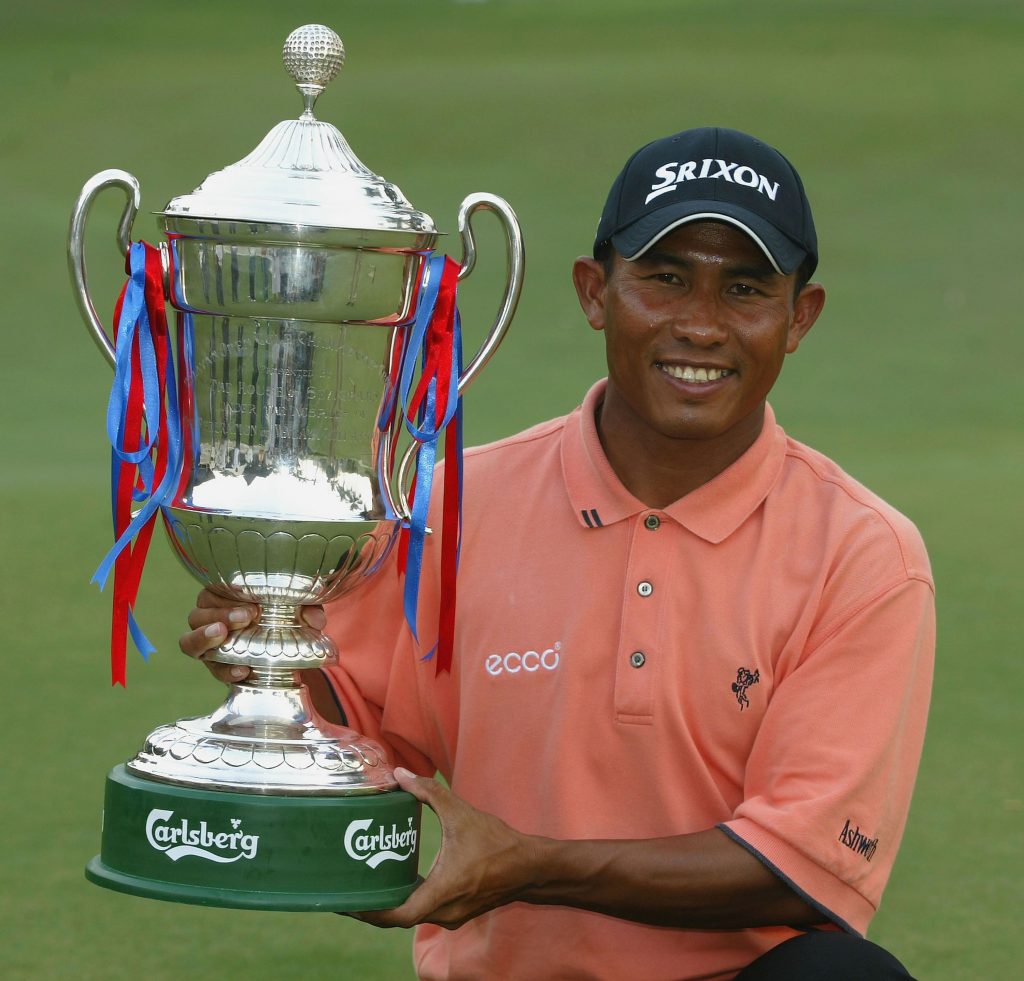
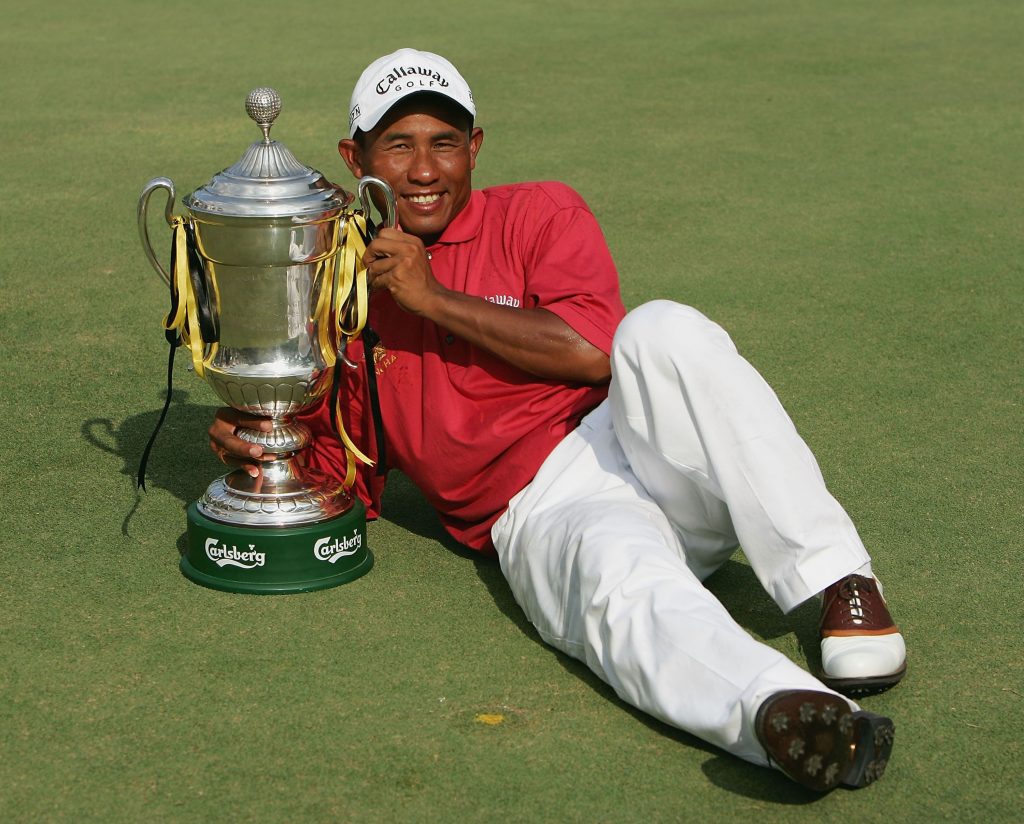
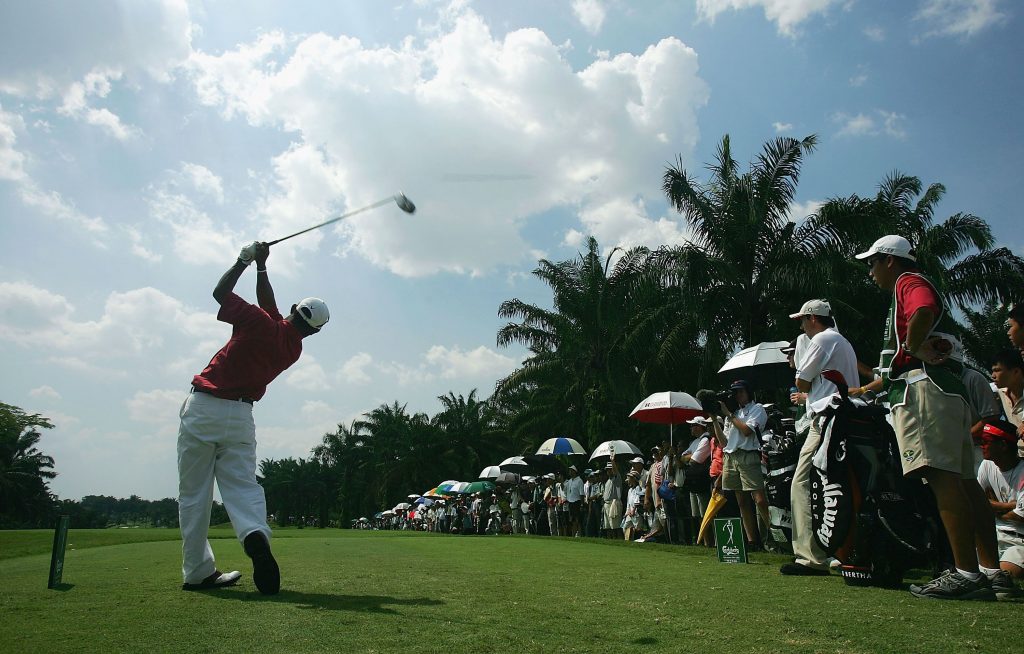
Thai legend Thongchai Jaidee’s hole-in-one on the par-three 16th hole in the final round of the Carlsberg Malaysian Open, at Saujana Golf and Country Club, in 2004 is one of the greatest shots hit in the history of the Asian Tour.
And it helped launch the career of one of Asia’s greatest golfers.
Thongchai's ace at the Malaysian Open in 2004
Throwback to the time Thongchai Jaidee made an ace at the Malaysian Open ??⛳#BandarMalaysiaOpen2020 #BMO2020 #whereitsAT
Posted by Asian Tour on Tuesday, March 3, 2020
The Thai star had already triumphed five times on the Asian Tour before his victory in Malaysia but as the event was jointly-sanctioned with the European Tour it thrust him into the global spotlight for the first time.
The two shots he gained with that ace helped him to secure a two-shot win over Australian Brad Kennedy and it opened the door for him to access the top-tier of tournaments in the game.
“I felt very proud when I won, every golfer needs to experience this,” said Thongchai, in a recent interview with Asian Tour Media.
“If you win it will change your life. It changed my life.”
It meant he became the first player from Thailand to win on the European Tour and the seventh Asian.
“It was the biggest moment in my life. After that tournament I started being recognized as an Asian Tour golfer instead of merely a Thai golfer. Now I had opportunities to play in Europe, not just Asia,” he adds.
“It changed my life and I had to improve myself. And I had to work harder than ever before because the competition was tougher.”
The following year he successfully defended his Malaysian Open title but it would be some time before he emulated his success in Asia, in Europe.
He admits the weather in Europe was one of the biggest obstacles he had to overcome and that it took him two or three years to adjust.
In fact, it was eight years after his first win in Malaysia before he tasted success in Europe – at the ISPS Handa Wales Open in 2012.

NEWPORT, WALES – JUNE 03: Thongchai Jaidee of Thailand poses with the trophy after winning the ISPS Handa Wales Open on the Twenty Ten course at the Celtic Manor Resort on June 3, 2012 in Newport, Wales. (Photo by Warren Little/Getty Images)
And it was he clearly a taste he enjoyed and savoured as he went on to win the Nordea Masters in Sweden in 2014, the Porsche European Open in Germany in 2015 and the Open de France in 2016.
Thongchai, who turned 50 last year, has always been quick to credit his military background (he was a paratrooper in the Thai Rangers) for his success in the game.
He said: “I used to be in the army and that helped me a lot. It taught me patience, discipline and strength. As a soldier I had to train very hard. So I took that mentality and translated it into my golf practice. It has made me a successful golfer.”
He also acknowledges it was not easy for him early on when he first started to think of making a living from the game.
“I never thought I would find a career in golf. At the beginning I was just a normal golfer. Back then playing professional golf was difficult,” he adds.
But his early concerns are now a very distant memory for a player who has claimed an unprecedented three Asian Tour Order of Merit titles, 13 Asian Tour victories and eight European Tour wins.

Thongchai with his wife Namfon when he won his first Order of Merit title in 2001.
“I want to set an example for the next generation,” said Thongchai.
“In the future I really want to see the young Thai and Asian players perform better than Thongchai Jaidee. I want them to see that I started from nothing but I managed to get where I am today. I want to be their role model.”
[embedyt] https://www.youtube.com/watch?v=BoAFifWy6dE[/embedyt]
The Asian Tour caught up with Anthony Kang recently to see how things have been for him since the world was turned on its head because of COVID-19. It proved to be a fascinating, funny and revealing conversation with the three-time Asian Tour winner – who is now part of the Tour’s highly-regarded broadcast commentary team. And because he had plenty to say we are telling the story over two parts – a front nine and a back nine of his career.

Anthony Kang has been at home in Portland, Oregon, since March – for reasons which probably don’t need too much explaining.
He had been working at the Bandar Malaysian Open in March and then headed to Thailand – where he got word that all countries were going to be in border lockdowns.
And rather than be in a foreign country with nothing to do he decided to get back home to Oregon, to help out with the family business: running a convenience store.
“Convenience stores are considered an essential business,” says Kang, “so it has not really affected us in terms of a daily routine, it is not like we have to stay at home and not move. We are doing the same things as we were doing two or three years ago.”
Remarkably, Kang has not played golf since missing the cut in the Sabah Masters in November last year and he also points out that there was a stretch last year when he did not play for eight months.
It is remarkable because the tall Korean American is only in his mid-40s and while he has one eye on the Seniors Tour, the other is looking back on a brilliant career on the Asian Tour which saw him win three times and earn over US$2 million in career earnings.

Anthony Kang lifting the Philippine Open trophy in 1999.
But the lack of playing time is not something that bothers the popular golfer, in fact it provides great insight to where he has been and where he is going.
“It has been progressing,” he says. “About three or four years ago I took a month off, came back and the next time was three months off, then eight months and now it has basically gone on about a year.”
He doesn’t mind it because he has experienced the hard grind of life on Tour and knows just how much hard work it takes to get to the top. He even admits that there was one point in the mid-2000s when he “fell out of love with the game because it started to feel like work” but thankfully he got over that.
He says that when he turned professional in 1996 his only motivation to play golf was to make a living and earn money.
“I thought if I put in the work here to get better at golf it returns to me in currency. And that is what drove me. It wasn’t about winning tournaments,” says Kang, who joined the Asian Tour the same year he turned professional.
And he admits that the early days on Tour were difficult.
“It was hard because like all struggling pros that doesn’t have a big pedigree coming out of the amateur game, like Tiger Woods, 95% of the guys out there are just grinding it out,” he says.
“In the beginning it was fun to travel the Tour because it was a new lifestyle, you get to travel to different places, experience different things and it was just fun but the bottom line was I had to penny pinch just like everybody else I was hanging out with.
“No matter how good a guy was, or how good his potential was, I have seen so many professional players that stop playing professional golf because they ran out of funds. Despite great talent, they don’t see a lucrative future ahead.”
But despite financial concerns those early years brought much joy.

NEW DELHI, INDIA – The USD $ 300.000 Panasonic Open India at the Delhi Golf Club, April 4-7, 2013, New Delhi, India. Picture by Paul Lakatos/Asian Tour.
“The first three years it was just fun to be out there, it didn’t really matter how much money I was spending. I wasn’t extravagant spending money but it was just fun. In my early 20s going out to Asia. I’m thinking I wanna stay out here.”
However, after three years of limited success in Asia he was having serious doubts about continuing on as Tour professional.
But it was at that point, mid-way through 1999, that it all started to change for him and one of the really great stories of Asian golf was born.
He says: “I had started the year with four missed cuts in five events and the one I made I think I finished 50th or 60th and I told myself this is not really working out how you thought it would work out, spending so much money and making nothing and if you do make the cut you are making 200 or 300 dollars profit and thinking is this really worth it?”
He was heading to play in the Casino Filipino Philippine Open at Manila Southwoods Golf and Country Club in May – which was going to be the final tournament before the summer stretch, from May until August, when no events were played on the Asian Tour.
“I had fully planned on taking on a job in the summer time working so I thought to myself, while heading into Manila, there is no need to put pressure on yourself, just go out and enjoy it, who knows maybe you will come back out [to Asia] or maybe you won’t. This could be the last one, so just go out, just have fun and don’t have a miserable time out there. And then it turned out weird.”
It was weird because from nowhere he won the tournament in very unique circumstances.
“I can’t pinpoint anything, besides fate and external forces,” he says.
“For my first two to three years I drove the ball well and I was a pretty mediocre long to mid-iron player but I was a decent wedge player and I could putt okay. And Manila Southwoods somehow fit into that category where if you drove the ball well then you were left with wedges and short irons, so you hit those well and make a couple of putts here and there and that’s kind of what happened.”
But there is also so much more to the story.

On the final day, he was at the hotel and went down to take the bus to the golf course but there was a notice saying the tee times were delayed two hours because of bad traffic going out to the golf course.
“And for the whole bus ride, for the life of me, I could not get rid of this song in my head which was ‘play that funky music white boy’ – it was in my head the whole ride. Why is it in my head I kept thinking?
“So we get to the golf course, and we start our round and we get to hole number six, the par four. Just over the wall on that hole there is a water park right outside and just before I hit my second shot (we were waiting for the green to clear) the song that starts blaring from the water park at that time was exactly the song that was in my head, ‘play that funky music white boy’!
“And at the moment I thought is this destiny? I was playing the second to the last group. I think I was two or three strokes off the lead. And I thought is this meant to be.”
He fired a brilliant 66 and won the tournament by one shot from South African James Kingston and Japan’s Kazuyoshi Yonekura.
But, whatever the circumstances, it was the big break he had been looking.
He explains: “I was planning to work and maybe even get away from the professional game after that week. But it allowed me to buy a membership at a golf course – the Badlands course in Las Vegas – instead of actually going to work. So I was able to practice all summer long, instead of working.”
So he practiced there and returned to the Asian Tour a few months later a more confident player and a golfer still only really at the start of an epic career.
[embedyt] https://www.youtube.com/watch?v=KsR9SyJMhFg[/embedyt]
To be continued…
The fact that Thailand’s Thongchai Jaidee only started playing golf when he was 16 years old and he turned professional when aged 30 makes his rise to the top of the game remarkable.
During an unparalleled career, he has claimed three Asian Tour Order of Merit titles, won 13 times on the Asian Tour and lifted eight European Tour trophies.
And, he currently tops the Asian Tour career earnings list with US$5,744,337.
It makes you wonder what he would have achieved if he had turned professional a decade earlier, like most of his contemporaries.

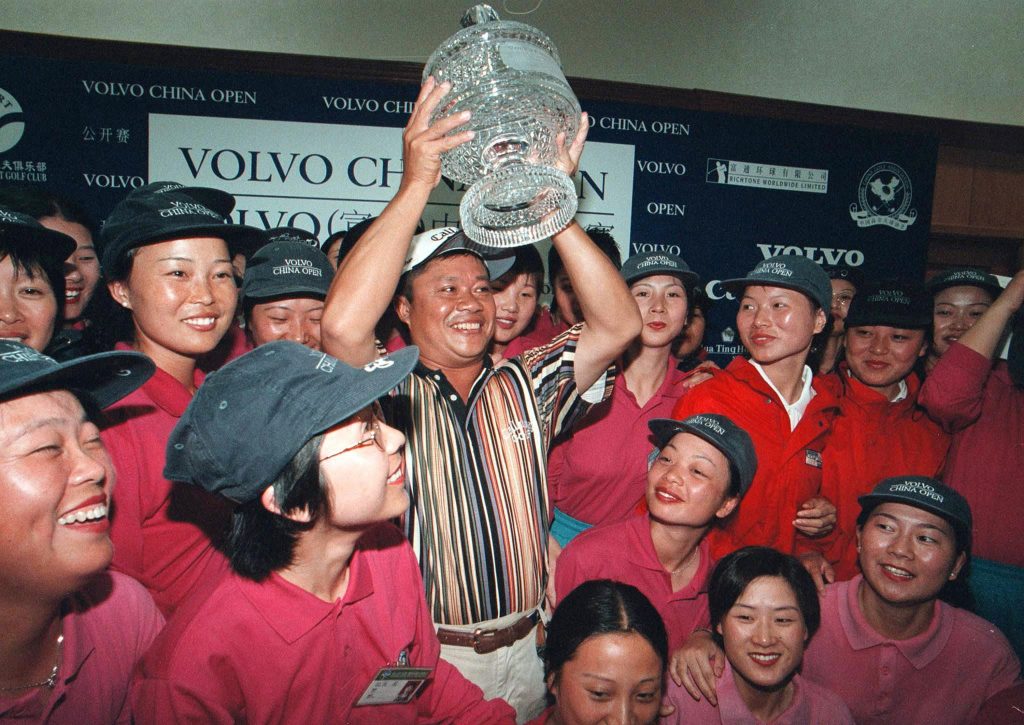
Thongchai Jaidee winning the Kolon Korea Open in 2000.
The Thai star, however, was not wasting away his talent in his twenties. As is well documented, he served his country both in the military – as a paratrooper in the Rangers – and on the national golf team, playing in Asia’s top amateur events.
He was extremely successful in the amateur game – he won both the Thailand and Singapore Amateur Championships in 1998 as well as the Putra Cup – so it was with good reason that his country wanted him to turn professional later.
The region waited patiently and with eager anticipation for him to join the professional game, but when that day came he did not disappoint.
On this day 20 years ago, the Thai star tasted victory for the first time on the Asian Tour when he triumphed in the Kolon Korea Open at Seoul Country Club.
Some big names in the game have won Korea’s National Open – including Spain’s Sergio Garcia in 2002, American John Daly the following year and Vijay Singh from Fiji in 2007 – but very few have been as significant as Thongchai’s.
The victory opened the floodgates for many more wins and announced the arrival of a player who would go on to become one of Asia’s greatest golfers.
Later in his career he was to say: “I will always remember my first win in Korea as that was also the first in my career. More importantly, that win also gave me the confidence to go on and achieve bigger things. If I didn’t win that tournament, I would have lost confidence and I don’t think I would have won so many tournaments. Winning in Korea made me hungry to win more tournaments.”
He had been a professional almost two years before winning in the Land of Morning Calm but, in that time, his performances showed that clearly he was a player on course for greatness.

Thongchai Jaidee of Thailand tees off on October 27, 2000 on day two of the Lexus International at the Windmill Park Country Club, Bangkok, Thailand. Jaidee finished the day after carding a three-under-par, 69. Jaidee finished in fourth place in the US$ 260.000 event. Picture by Paul Lakatos/Asian PGA.
In January of 1999, in his first event as a professional on the Asian Tour, he finished in a tie for fifth at the London Myanmar Open.
And the results kept coming, highlighted by a second place finish in the Sabah Masters at the end of that year.
He was also making cut after cut and it would be two and half years before he failed to make it through to the weekend for the first time – at the Singapore Open in June of 2001.
In 2000, he notched a couple of top-five finishes in the run up to the Korea Open so it would have been an understatement to say he was on the cusp of a maiden victory.
And he had the added advantage of having Wanchai Meechai, a Tournament Director on the Asian Tour, caddie for him in Korea.
He started the prestigious tournament with a two-under-par 70, which was four shots behind first-round leader Arjun Atwal from India.
And a 69 on day two saw him sit two adrift of Atwal – who shared the lead with Korean Jongkoo Yoo.
Atwal was unable to maintain his fine form and slipped back with a 74 after the third round while it was South African Craig Kamps who took over at the helm, shooting a 67 – for a one shot advantage over Thongchai, who carded a 69.
Kamps was one of the in-form golfers on Tour at the time and a regular contender but Thongchai was undeterred and set about his business with vigour and confidence on Sunday.
He played flawless golf on the front nine, making a birdie and eight pars.
And he took a firm grip of the tournament on the inward half when, after parring holes 10 to 14, he made decisive birdies on 15 and 16.
He was helped in his quest for his first title by the fact that his closest challengers dropped shots over the closing holes.

CASCAIS, PORTUGAL – JUNE 07: Thongchai Jaidee of Thailand celebrates his hole-in-one on the sixth hole during Day One of the GolfSixes at Oitavos Dunes on June 07, 2019 in Cascais, Portugal. (Photo by Luke Walker/Getty Images)
A play-off looked very much on the cards but Kamps dropped a shot on 17, Yoo bogeyed 15 and 18, while even more dramatically Korean Wooksoon Kang triple-bogeyed 17.
Thongchai also made bogey on the final hole but he was still able to secure a one-shot victory over Kamps.
The Thai received a cheque for US$63,213 – by far the biggest pay day of his career up until that point – and the self-belief that he could win at the highest level of the game.
Another 16 Tour victories, and multiple awards and accolades, followed over the next two decades but none would have meant as much as that day when his game discovered real “Seoul”.
Ends.
When American John Catlin hits a golf ball and turns to see where his shot is heading, there is a look of confidence and intensity about him that you don’t often see.
It is a distinctive and authoritative action which, of course, either sees the golf ball hit flush down the middle of the fairway or settle sweetly by the pin.
He has been hitting golf shots with purpose since turning professional in 2013 but last month the California-kid struck gold on the European Tour by winning two events in the space of three weeks: first a wire-to-wire win at the Estrella Damm N.A. Andalucia Masters in Spain – which was his maiden win in Europe – followed by victory at the Dubai Duty Free Irish Open in Northern Ireland.
It has been one of the great success stories during a turbulent season rocked by public enemy number one, COVID-19.

BALLYMENA, NORTHERN IRELAND – SEPTEMBER 27: John Catlin of the United States poses with the trophy after winning the Dubai Duty Free Irish Open at Galgorm Spa & Golf Resort on September 27, 2020 in Ballymena, Northern Ireland. (Photo by Warren Little/Getty Images)
And it has been an Asian Tour success story because it is on that circuit that he has been cultivating his game as a Tour professional over the past four years.
He first made a name for himself by winning on the Asian Development Tour (ADT) in 2016 at the Combiphar Golf Invitational in Indonesia.
Little did he know that would set in motion and be the start of an incredible run of first place finishes.
He won again on the ADT the following year at the PGM EurAsia Perak Championship in Malaysia, and the season after that exploded into life by winning three titles on the Asian Tour – the Asia Pacific Classic in China, the Sarawak Championship in Malaysia and the Yeangder Tournament Players Championship in Taiwan. That hat-trick led to him being voted the 2018 Players’ Player of the Year by his peers. He also won on the domestic circuit in Thailand that same year.
And, in 2019 he secured his fourth Asian Tour win at the Thailand Open.

So from Gunung Geulis Country Club, the scene of his first win on the ADT, to Galgorm Spa & Golf Resort, the host venue for the Irish Open, it has been a voyage of discovery – but one that has not been a complete surprise to him.
“You never know when it is going to happen but I always knew I was capable of it. You just keep pressing on. It has been a process of continually getting better and better and better, and now I am at where I am at, it is not going to stop. I am always going to try and improve,” said the 29-year-old last week.
“It has been nice to have achieved a lifelong goal of winning twice on a major Tour. I am looking forward to what the future has. I don’t know exactly all the doors it’s going to open as far as the end of the season and next year and what it is all going to look like. It is just nice to have achieved something that I worked really hard to get.”
Catlin was speaking just after missing the cut at the Aberdeen Standard Investments Scottish Open – where he was on the side of the draw that played in the worst of the conditions.
“It happens sometimes and that is part of being a professional. Golf is the luck of the draw,” commented the American.

SOTOGRANDE, SPAIN – SEPTEMBER 06: John Catlin of USA celebrates at the 18th hole during day four of the Estrella Damm N. A. Andalucia Masters golf tournament at Real Club Valderrama on September 06, 2020 in Sotogrande, Spain. (Photo by Mateo Villalba/Quality Sport Images/Getty Images)
It was a blip on the radar for the American who said his social media has exploded since the two wins in Europe and there has been a lot more public interest.
He adds: “Everyone back home was ecstatic for me. I am looking forward to getting back home after Italy [the Italian Open, the third week of October] and being able to share it with them, I still have not been home. It will be nice to be face to face with them to be able to enjoy it more. Once I won, it was a pretty special moment but to win again was more special.”
Home for Catlin has also been Hua Hin in Thailand – where he based himself when playing on the Asian Tour. He was in lockdown there from March to May and once the golf courses closed he channeled his energy into cooking.
“Life is so simple in Hua Hin,” he says.
“There are good golf courses, there is good food, good people. I live right by Springfield Golf Club out there. It was a whole stress free life and I really, really enjoyed that especially with all the travel we do. It is nice to have a place to go where you can unwind and destress. I have not been back to Thailand since May. I don’t think I can go back until next year.”
Indeed, Asia has been central to his success in the game and, in particular, he feels his time playing on the Asian Tour was a key learning curve.
“Being away from the comforts of home, travelling by yourself, and getting to know new people, kind of figuring out how you tick, so to speak, apart from your family and your friends – I think that has given me a lot of confidence. Knowing I can handle that situation on my own. It gave me the confidence to play anywhere, Asia, Europe, America, it doesn’t really matter – it is just golf.”
And when he was in the heat of battle in Spain and Ireland he was able to draw on the invaluable experiences he gained when winning in Asia.
“It is something which the Asian Tour really helped me with as well. My first win in China came down to the wire. I won by one or two there, in Sarawak I had to make a putt to win by one. The Thailand Open I had to win in a playoff. Those experiences really helped me,” he says.

John Catlin winning his first Asian Tour title at the 2018 Asia-Pacific Classic in China.
Catlin is understandably quick to thank his coach of seven years Noah Montgomerie – who also teaches Indian star Gaganjeet Bhullar – and his sponsors Srixon, Singha Corporation and Springfield for his incredible success.
He adds: “I really would not be here if it wasn’t for their support, they have been amazing. It is great to be a part of that family.”
He competes in the prestigious BMW PGA Championship this week where it will be no surprise to see him in contention on the famous and historic fairways of Wentworth Golf Club.
He was unflappable over the closing holes when winning twice last month – something he says is the result of dedication and determination.
“You know why you are there, that is the reason why you have practiced all those hours and the time I have spent in Thailand and with my coach in California. That is why you work so hard, to put yourself in that position. You trust your training and you trust the people who are in your corner. You give it your all and if it doesn’t work out then so be it. If it doesn’t work out it is not because of a lack of trying.”
Ends.
Jazz Janewattananond’s return to form at the weekend will have seen him, and his huge army of fans in Asia, take a huge sigh of relief after a frustrating season so far.
His joint third finish in the Dubai Duty Free Irish Open stopped the bleeding on a poor run of results and will give him much needed confidence heading into the final quarter of the 2020 – which starts this week at the Aberdeen Standard Investments Scottish Open, followed next week by the BMW PGA Championship.
The Thai star came very close to winning the prestigious Irish event and held the lead on the back nine on Sunday at Galgorm Spa & Golf Resort in Northern Ireland. But he dropped shots on the inward stretch to finish three adrift of the winner and fellow Asian Tour member John Catlin from the United States.
Great being back on the @europeantour this week at #DDFIrishOpen ?? and being in contention on a Sunday! Next stop ??????? #seriousface #trustgolf @fashion1thailand #thisisboss https://t.co/gVgeygyO9P pic.twitter.com/ZWHTVLdDZv
— Jazz Janewattananond (@jazzjanegolf) September 27, 2020
Jazz also obviously benefited from having his regular caddie, Camp Pulit, back on the bag having missed his previous few tournaments.
The result also had a significant impact on his world ranking: he moved up from 65th position to 56th and put him back on course to try and better his best placing on the ranking, which was 38th position – which was the result of his brilliant 2019 season.
Getting back into the top-50 – which opens the door to playing in the biggest events in the game – is now well and truly in his sights.
Catlin, whose win in Ireland was his second on the European Tour in September, also enjoyed a significant shift up the ranking, moving from 138th to 84th.
Jazz had started the year on a massive high after winning four times last season en route to winning the Asian Tour Order of Merit title. And a third place finish in the SMBC Singapore Open in January suggested more was to come.

BALLYMENA, NORTHERN IRELAND – SEPTEMBER 27: Jazz Janewattananond of Thailand looks on with his caddie on the 6th hole during Day Four of the Dubai Duty Free Irish Open at Galgorm Spa & Golf Resort on September 27, 2020 in Ballymena, United Kingdom. (Photo by Richard Heathcote/Getty Images)
However, he then missed the cut in seven of the next 11 events he played in; which, in fairness to Jazz, was the result of a change of geographical location and, of course, the upheaval caused by the coronavirus pandemic.
He has been playing on the PGA Tour, through sponsor invites, and also competed in the US Open and US PGA Championship – the event where he famously finish jointed 14th last year.
He missed the cut in both the Majors and also in four out of the other six PGA Tour events he played – although he will have no doubt learned a great deal as he bids to join his countryman Kiradech Aphibarnrat as a full member of the lucrative circuit.
But it was not always a struggle for Jazz in the States.
After bumping into Sweden’s Daniel Chopra – a winner on both the Asian Tour and PGA Tour – at Bay Hill in the week leading up to the Arnold Palmer Invitational in March, the Swede invited Jazz to stay with his family and when lockdown hit because of COVID-19 on March 13, Chopra did not hesitate to invite Jazz and his caddie, Camp, back to his Orlando home to seek refuge.
Earlier in the year he also benefitted from a lesson with Tiger Woods’ putting coach.
After struggling on the greens, Jazz sought the advice of Matt Killen, whose star pupils include 82-time PGA Tour winner Woods and 2017 FedExCup champion, Justin Thomas. It also helped that Jazz is part of the same management stable as Woods and Thomas. Jazz flew to Nashville for a three-hour lesson with Killen.
Ends.
Imagine a golf course consisting of the most iconic and challenging holes on the Asian Tour.
A fictional hybrid-layout that features one of the region’s standout opening holes, one of the finest second holes and goes all the way through to an epic 18th.
A layout that would be the ultimate challenge – where breaking par is a monumental achievement.
Well, just such a virtual course now exists, as an Asian Tour panel of experts has selected the appropriate holes to make up what is the golf course of all golf courses in Asia.
With a par of 70 and length of 7,430 yards, we have appropriately named it The Asian Tour Monster.

To navigate us through The Asian Tour Monster, we asked players and experts to describe each hole – all of which have played key roles in many of the biggest tournaments on the Asian Tour.
Let us know what your think on our social media channels – Facebook, Instagram, Twitter.
Feature: The Asian Tour Monster – Front nine

Taiwan Golf and Country Club
Hole 10 – Taiwan Golf and Country Club
Par: Three
Yardage: 221 yards
Hole scoring average: 3.36
Asian Tour event hosted: Mercuries Taiwan Masters
Hsieh Min-nan, who is one of the true legends of golf in Chinese Taipei, describes this hole as one of the most difficult par-three holes in the world. Considering his lofty standards, this hole is definitely worth including as one of the most difficult on the Asian Tour.
It has a smallish green but it looks tiny when you are standing over 220 yards away, with howling winds holding on to a three-iron or hybrid. You will end up in a deep bunker or a penalty area if you are too far to the left, while a gaping bunker guards the right side of this narrow table-top green, adding to the challenge of this beautiful beast of a hole.
Once you reach the green, you face a putting challenge like no other – the greens at Taiwan Golf and Country Club are renowned for confusing even the best of putters. It is worth noting that during the 2018 Mercuries Taiwan Masters, only seven birdies out of 349 attempts were made on this hole.
“In my opinion it’s the hardest par-three green to hit on the Asian Tour, and maybe in the world! I think I’ve only ever hit the green two times. Most of the time I’m playing to miss the green short because that green is so difficult to hold with a four iron. You can get it up and down from the front part of the green. The best shot I have ever seen on that hole was when I watched one of the Taiwan legends a couple years ago pull out driver and hit this high cut to like 20 feet. It was the best shot I’ve ever seen there. Every time I walk off that green with a par I feel like I’ve made birdie!”
Berry Henson: a winner on both the Asian Tour and Asian Development Tour, who was runner-up in the Mercuries Taiwan Masters in 2018.

Black Mountain Golf Club
Hole 11 – Black Mountain Golf Club
Par: Three
Yardage: 191 yards
Hole scoring average: 3.2
Asian Tour events hosted: Black Mountain Masters, Thailand Classic, King’s Cup, Royal Trophy
This intimidating downhill par-three is the signature hole at Black Mountain Golf Club. It has a narrow double-tiered green, with two-thirds of it surrounded by water. A wall of trees protects the bail out area on the left, ready to deflect any shots hit in this direction back into the water.
According to two-time Asian Tour winner Rikard Karlberg and resident professional, who is also a Black Mountain club member, he says: “Never think about the water as you can lose shots very easily. You just have to aim and hit it straight to the middle of the green and hope for the best”.
“The 11th hole, the signature hole at Black Mountain, has the Black Mountain hill as its back drop. It is a tough green to hit, especially when the wind is blowing.
There is a feeling the green is an island green – even though it is not.
There is no real bail out on this par three as there is water just right of the green and if you were to pull the shot slightly left then there are over hanging trees and a stream where the ball is most likely to end up. The hole certainly is a challenge and if you walk off with par then most people will be happy.”
Simon Yates: is a two-time winner on the Asian Tour and resident at Black Mountain.

Hole 12 – Macau Golf and Country Club
Par: Five
Yardage: 571 yards
Hole scoring average: 5.2
Asian Tour event hosted: Macau Open
This hole demands astute ball control. Being a mountainous course, it can get very challenging with the wind constantly changing directions due to the many ridges and valleys that intersperse the property.
Firstly, a well struck drive is needed to avoid the troublesome fairway bunkers and to carry the ball over water. An accurate second shot is then required to avoid the bunkers guarding the lay-up area and penalty area on the left of this par five, which stretches and rises across the irregular terrain. This sets you up for a mid to short iron approach shot to a severely sloping two-tier green. Being on the correct tier with your approach shot here is paramount as this green has yielded more than its fair share of four-putts.
India’s Anirban Lahiri birdied this hole in the final round of the 2016 Venetian Macao Open – which was the first of an incredible run of seven birdies to force a play-off with Thailand’s Pavit Tangkamolprasert. Pavit eventually prevailed for this first win on the Asian Tour.
“On that final Sunday [in 2016], I used a driver for my first shot on hole 12. This hole is a long par-five – no one can really reach in two. On the second shot I used a hybrid – you just really need to get it on the fairway. Third shot I had about 100 yards left, so I used a 56-degree wedge which I pitched left of the flag and then made about a six yard putt for birdie. The hole is not as tough as 13, but the green [on hole 12] is very tough, especially if the pin is on the back as there is a huge slope.”
Pavit Tangkamolprasert – a two-time champion on the Asian Tour, and winner of the 2016 Venetian Macao Open.

Hole 13 – TPC Kuala Lumpur (West course), Malaysia
Par: Four
Yardage: 459 yards
Hole scoring average: 4.38
Asian Tour event hosted: Malaysian Open
You will need both length and accuracy with your tee shot to play this hole – which is a lengthy uphill hole. A penalty area on the right and thick rough up the left side await wayward drives. A solid mid to long iron is then required to reach the elevated green. The right side of the green is preferred as deep bunkers guard the left side of the long and narrow green. Club selection will be important as the green has three tiers and any mis-clubbed approach shot can result in possibly having to negotiate some lengthy winding putts. Downhill putts will be especially challenging.
“I hit driver off the tee here, making sure I start my ball on the left side of the fairway. On this hole, the one place you don’t want to go is right. I try and hit a little fade as well. Most important is to keep it on the fairway. The toughest part of the hole is the second shot. There is a very high elevation, maybe about seven or eight metres up hill. I normally have a six iron in. I try to hit a draw as, if anything, you want to miss on the right side of that hole. If I walk away with par I will be very happy. So far I have played this hole well in tournaments, with a couple of birdies.”
Danny Chia: a two-time winner on the Asian Tour and four-time champion on the Asian Development Tour.

NEW DELHI, INDIA – MARCH 29: David Law of Scotland tees off the 14th hole during round two of the Hero Indian Open at the DLF Golf & Country Club on March 29, 2019 in New Delhi, India. (Photo by Ross Kinnaird/Getty Images)
Hole 14 – DLF Golf and Country Club, India
Par: Four
Yardage: 535 yards
Hole scoring average: 4.53
Asian Tour events hosted: Hero Indian Open, Avantha Masters, Johnnie Walker Classic
The 14th hole at the Gary Player-designed DLF Golf and Country Club is just a ruthless golf hole. Long is an understatement when describing this par-four which demands two massive and precise shots to reach the green. Adding to the challenge is the forced 250-yard carry off the tee over dense scrub that runs down the entire left side. Once you have the green in your sights, you will be faced with a downhill lie and needing at least a long iron to reach an elevated green with steep fall offs on either side.
It is a hole that probably cost American Julian Suri the Hero Indian Open title last year. Suri had a three-shot lead with six holes to play but made a quadruple-bogey eight, after taking six shots to get down from just off the green. He eventually had to settle for a share of fourth place.
“Normally when we play this hole, it is a par-four, otherwise for the club members it is a par-five. My personal view about that hole is that it is the toughest hole on the golf course and one of the hardest in the region. Firstly, for your tee shot you can’t hit a driver, some people do, because it is very narrow and there are some rocks placed beautifully on the right side of the fairway. Then you need to use anything from a rescue to a three-wood to a three iron depending on where your ball ends up, to a green that is a very narrow. You also come in from an angle – the green is basically towards the left side when you are standing in the middle of the fairway. Plus there is a huge swale before the green and on the right hand side of the green. And the green slopes left to right towards the swale. So it is difficult to stop the ball on the green unless you hit a high ball. Even if you try and hit a low shot and run it up you have to hit it way left because the green is all left to right and you have to have a perfect bounce.
If you go into the swale on the right … well the swale is at least 15 feet deep. During the tournament 80% of the golf balls end up there, even though players think their ball is on the green but everything slopes into the swale – where there are a lot of pitch marks. You want to make sure you hit a high lofted second shot onto the green, so it stays on the green. Some people try and take it left of the green but then what happens is it takes a big bounce and goes to the left hand side and you are left with a downhill chip and from there most of the time people chip it over into the swale on the right. Management is very important. A par on that hole is a bonus and you want to make the most of it and if you try and get too smart just try and make a bogey and move onto the next hole. I have never made a birdie there in tournaments, made a double once but normally pars or bogies.”
Jeev Milkha Singh: a two-time Asian Tour Order of Merit champion, and five-time winner on the Asian Tour. He has also claimed four titles in both Europe and Japan.

Hole 15 – The Serapong, Sentosa Golf Club, Singapore
Par: Four
Yardage: 429 yards
Hole scoring average: 4.20
Asian Tour event hosted: SMBC Singapore Open
A very intimidating par-four and one that enhances Serapong’s reputation as a true championship layout. The fairway is extremely narrow with a sea channel running all the way down the left side of the hole, where a countless number of balls have found a watery grave. It is also a long par-four that requires full concentration.
“The 15th is a really good hole. Visually intimidating off the tee, it is probably the most difficult tee-shot on Serapong, after the third hole.
I usually aim at the second bunker on the right with a three wood and play a draw. The reason for a draw is that in the worst case if you overdraw it and it ends up in the water you can at least drop the ball up in the fairway and still have a shot at the green. I have seen many players pull it straight left into the sea and have to drop the ball very near from the tee box … it’ll almost always be an automatic double when that happens.
If you are able to hit the fairway, I would say the hole becomes straight forward from there, but I have seen a lot of bail outs to the right.
If you are in the right rough, the second shot becomes tricky as you have to contend with the trees to carry for your approach.
A back left pin is the most difficult pin position on this hole. When the pin is there, we usually just aim for the middle of the green… if not you’d have to contend with the bunker and also water if you go long and left.
The majority of players will a hit fairway wood off this tee, however, there was one round when I played with Phil Mickelson and he pulled out a driver, hit it about 30 yards right of the fairway into the trees, but he was able to hit a really high shot over the trees and get away with par.”
Lam Chih Bing: a winner of 10 titles in the region including one victory on the Asian Tour at the Volvo Masters of Asia in 2008.

Hole 16 – Namseoul Country Club, Seoul, Korea
Par: Four
Yardage: 533 yards
Hole scoring average: 4.75
Asian Tour event hosted: GS Caltex Maekyung Open
The 16th hole is a straight and long downhill par-four with OB all the way down the right. It requires precision off the tee to a narrow fairway guarded by bunkers on the left and at the end of the landing area. A long iron or hybrid will be needed for your approach shot, however the downhill lie will hinder your efforts at keeping the ball on this green. Bunkers short and over the green are always in play with the OB once again in play down the right.
Prior to the 2017 edition of the GS Caltex Maekyung Open, this hole was played as a par-five for the tournament. After changing to a par-four, it has since become the toughest hole of the tournament for the last three years.
“Nam Seoul’s 16th hole is the hardest hole on the course. On the tee I usually hit five-wood or hybrid depending what club I use for that week. You want to hit something around 260 yards so you are just short of the fairway bunker and not too far from the hole.
I usually have about 200 to 215 for my second depending on how well I strike it. Most of the time I will use a five iron to this green. This hole is so hard because you will have to hit your second shot from a downhill slope, which it makes it so hard to stop the ball on the green, and there are two deep bunkers around the green. This hole is so hard that when I make par on this hole I feel like I made a birdie. One interesting story that I have involves the first round from last year. I had an afternoon tee time and I was playing well and I believe I was leading the tournament at that time, until the 16th hole. I don’t know what happened but I ended up making a quadruple bogey and everything went south from that point…”
Yikeun Chang: winner of the 2019 Yeangder TPC and the 2016 Qualifying School. He was also runner-up at the GS Caltex Maekyung Open in 2018.

Hole 17 – Royale Jakarta Golf Club, Indonesia
Par: Four
Yardage: 459 yards
Hole scoring average: 4.29
Asian Tour event hosted: BNI Indonesian Masters
The 17th hole is a lengthy par-four at Royale Jakarta Golf Club. To master this challenging hole, you need to execute a well-struck tee shot to a less than generous fairway. A penalty area that runs all the way down the right and thick rough down the left will definitely test your nerves. And depending on the wind direction and quality of your tee shot, the approach shot can be with anything from a short-iron to a long-iron, to an undulating green that is guarded by a bunker on the left and water short and to the right of the green.
“That is a great hole, it is definitely one of the most challenging holes, especially for the 17th hole of a golf tournament. For the longest time, I have always played that hole hitting three wood over the little bunker in the middle there because to me it’s the widest part of that fairway, although it is not very wide to begin with. Once you get up to 290 to 300 yards that’s where the fairway gets narrower. Typically the rough has always been thick at Royale Jakarta but the last few years it hasn’t been so, so it’s been manageable. Teddy [Teddy Harmidy his friend, and caddie at the 2019 BNI Indonesian Masters] had me try and hit driver there when we were preparing for the tournament, a few months before. He said if I am going to caddie for you I want you to try this. So I did that and hit it out there and once I saw where my ball ended up, even if it wasn’t in the fairway, I realized I am only hitting a nine iron at most into the green. Normally with a three wood off the tee I am hitting maybe a six, seven or eight iron into the green. So it’s been an ongoing debate, what’s more important? Hitting in the fairway or long. So I started to change my mind set. And I started to realize I do hit it quite far so I should take advantage of that on some of these longer holes, even if you are going to be in the rough. The green slopes left to right and so anything left of that green is dead. Where they put the pins there is quite challenging. I actually bogeyed it the first two days last year and birdied it the third round and parred on the last day. You need to hit a good second shot with that green. There are not many flat spots on the green, maybe one. A par on the hole is very good.”
Danny Masrin: a seven-time winner on the PGA Tour of Indonesia, who finished equal fifth in the 2019 BNI Indonesian Masters.

HONG KONG- The Hong Kong Open at the Fanling Golf Club, Fanling, Hong Kong, the Asian Tour USD$ 1 million event is the season opener. Picture by Paul Lakatos / Asian Tour.
Hole 18 – Composite Course, Hong Kong Golf Club
Par: Four
Yardage: 410 yards
Hole scoring average: 4.281
Asian Tour events hosted: Hong Kong Open, Alfred Dunhill Masters, Johnnie Walker Classic
Known as “The Ultimate”, this is the closing hole on the Eden Course at the Hong Kong Golf Club and also the final hole of the Composite Course – a famous layout consisting of the best holes of the Eden and New Courses, specifically configured for the Hong Kong Open.
It is a hole deeply ingrained in the rich history of Asian golf, and viewed as one of the great amphitheatres of tournament golf globally.
Though not a long par-four, by modern-day standards, it demands the utmost respect, and requires the fullest care and consideration.
The hole’s statistics at this year’s Hong Kong Open, tell a familiar story: measuring 410 yards, it was ranked the second hardest with an average score of 4.281; there were just 40 birdies, 215 pars, 101 bogeys, 19 double-bogeys and two “others”.
Off the tee, most players will favour a long iron to the widest part of the fairway on the left. However, if you are brave enough, you can choose to go with a three-wood or driver and attempt to thread the ball through the narrowest part of the fairway to set up an easier approach shot. With trees and OB threatening on the left and a dense cluster of trees and bunker to the right of the fairway, it is risk verses reward.
Having chosen your strategy and, hopefully, successfully executed it, it is time to take on the green. Although the elevated green is large, it is severely sloped from back to front, so it is always preferred to be putting from below the hole. There is a large lake in front of the green with bunkers the front and right. And any shot missed left will leave you in gnarly rough with a slim chance to get up and down.
It has been the setting for a wealth of gripping and well-documented drama over the decades.
Who can ever forget the heroics of Lin Wen-tang’s memorable play-off victory over Francesco Molinari and Rory McIlroy at the Hong Kong Open in 2008. Lin produced one of the finest shots ever seen on the 18th: after hooking his tee shot, he played a spectacular approach out of trees, over water, and a bunker, to within inches of the pin.
And, in 2011, McIlroy recorded his maiden triumph at the Hong Kong Open in remarkable fashion when he holed out from a greenside bunker at the last to finish two shots clear of France’s Gregory Havret.
“I usually hit three-wood these days, try to hit a fade off the trees on the left but usually end up in the trees! At the Hong Kong Open in 1996, I hit a two-iron off the tee and then an eight-iron to about 12-feet. I made the birdie putt to finish fourth.
In the 1996 Alfred Dunhill Masters I holed a bunker shot from the right bunker for birdie to finish T11, I think. There were massive crowds that year. Langer, Els, Ballesteros and Monty were all playing. There must have been 20,000 people there that day.”
Dominique Boulet: a former Asian Tour player and Hong Kong number one. Now a highly respected television commentator and long-time member of the Hong Kong Golf Club.
One of New Zealand’s pre-eminent sporting events, the New Zealand Golf Open, scheduled to be played at Millbrook Resort and The Hills in February 2021 has been cancelled.
The Chairman of the Organising Committee, Mr John Hart, confirmed the cancellation, due to the ongoing global Covid-19 pandemic and the related health and financial risks.
The 102nd New Zealand Open will now be played between 17th and 20th February 2022.
“We are extremely disappointed to have had to come to this decision but the effects of the pandemic, borders being closed, and the financial risk associated with a potential later cancellation due to any further Covid-19 outbreaks means we have no other alternative other than to cancel this event now.”
“With up to 300 international participants coming from offshore (including professional players, amateur players, caddies, and officials of our Tour partners (the PGA Tour of Australasia, the Asian Tour and the Japan Golf Tour), we need absolute certainty now in terms of accessibility to New Zealand and this is clearly not possible” said Hart.
“We would like to thank Millbrook Resort (the tournament underwriter), The Hills, our many commercial partners, both domestic and international, led by our presenting sponsor Sky Sport, Government and the Queenstown Lakes District Council for their support and understanding. Further thanks go to our Tour partners, New Zealand Golf, our professional players, our sold-out amateur field, and our amazing volunteer force.”
“This is not a decision we have made lightly, and we are particularly disappointed for the Queenstown region who have suffered many setbacks during this Covid-19 era.”
“We are very proud of what we have created with the New Zealand Open becoming one of New Zealand’s most recognised and applauded international sporting events.”
“We remain very committed to once again showcasing the very best of Queenstown and New Zealand in February 2022 at a time when hopefully we will all be operating in a more certain and safer environment” said Hart.
The cancellation of the New Zealand Open follows announcements in the past 10 days of the cancellation of Australia’s four major golf tournaments; the Australian Men’s Open, the Australian Women’s Open, the Australian PGA Championship, and the Victorian Open, all similarly planned for February 2021.
Ends.
The Asian Tour’s Annual General Meeting (AGM) took place today and saw a number of established and respected players join the Tournament Players’ Committee (TPC).
Sentosa, Singapore, October 27: The Asian Tour Annual General Meeting (AGM) took place today and saw a number of established and respected players join the Tournament Players’ Committee (TPC).
Australians Terry Pilkadaris and Travis Smyth, Berry Henson from the United States and Thailand’s Panuphol ‘Coconut’ Pittayarat have all become part of the committee.
They join existing members Indians Chiragh Kumar and Rahil Gangjee, Chinese Taipei’s Hung Chien-yao and Chan Shih-chang, and Filipino Angelo Que on the committee.
“We are delighted to welcome Terry, Travis, Berry and Panuphol to the Tournament Players’ Committee,” said Cho Minn Thant, Commissioner and Chief Executive Officer of the Asian Tour.
“They are all popular and experienced players who will serve the Tour well in their capacity as player representatives. Indeed, there was a tremendous air of positivity throughout the AGM and a sense of solidarity as we look to overcome a difficult season and move into 2021 with renewed vigor and confidence.”
This is the first time Pilkadaris, Smyth and Panuphol have joined the TPC, whereas Henson served once before.
The Asian Tour’s key decision-makers and stakeholders took part in what was the 16th staging of the AGM – which for the first time in its history was held online via Zoom conference.
India’s Shiv Kapur, Thailand’s Arnond Vongvanij and Marcus Both from Australia all retired from the TPC.
“We thank Shiv, Arnond and Marcus for their contributions over the years – their input has been invaluable in helping us make important strategic decisions,” added Cho.
The AGM saw a wide range of issues discussed, with announcements on the Tour’s next steps expected in due course.
Ends.
In the second and final part of our feature on three-time Asian Tour winner Anthony Kang, the American talks about his famous victory at the Maybank Malaysian Open, swing fundamentals and his transition into TV land.

KUALA LUMPUR, MALAYSIA – FEBRUARY 15: Anthony Kang of USA poses with the trophy after winning the Final round of the 2009 Maybank Malaysian Open at Saujana Golf and Country Club on February 15, 2009 in Kuala Lumpur, Malaysia. (Photo by Ian Walton/Getty Images)
While Anthony Kang always looks back on his victory at Casino Filipino Philippine Open in 1999 as one of the great highlights of his career – because it was his maiden win – his triumph in Malaysia’s National Open 10 years later carries as much significance to him, and perhaps even more.
It is the manner of that win, which came down to a nail-biting finish, which is so important to him.
“At the Maybank Malaysian Open having a chance to hit my second shot on the par-five final hole of the tournament, the 72nd hole, and knowing if I pulled the shot off I was going to win the tournament was an incredible moment and experience.
“To me it is a rare occasion in golf to be in a position to hit that winning shot when the time is ticking off – it happens in other sports like American football, even soccer, or basketball or baseball. So I felt like it was that moment for me and to experience a moment like that, which all great players have – like Tiger Woods, Rory McIlroy and Dustin Johnson – I feel fortunate that at least in Malaysia that tournament provided me the opportunity to experience that moment and then fortunately to come out ahead on the right side of it.”
He birdied the 18th at Saujana Golf and Country Club to win by one from four players: England’s David Horsey and Miles Tunnicliff, Thailand’s Prayad Marksaeng and India’s Jyoti Randhawa.
It ended an eight-year title drought and as the event was jointly-sanctioned with the European Tour it secured him playing privileges there.
“As soon as I won, I called my brother and said do you want to come and caddie for me in Europe, because we are going to make millions!” said the American.

KUALA LUMPUR, MALAYSIA – FEBRUARY 15: Anthony Kang of USA in action during the Final round of the 2009 Maybank Malaysian Open at Saujana Golf and Country Club on February 15, 2009 in Kuala Lumpur, Malaysia. (Photo by Ian Walton/Getty Images)
He quickly points out that that did not come true but that the opportunity was the most important element.
He adds that his game was gathering momentum in the lead-up to Malaysia: “Before Malaysia, about two years prior to, I was playing pretty solid golf. I wasn’t hitting any wild shots. I was very consistent, week after week, and I was making putts. While I wasn’t contending very much, I still had a lot of top 10 to 20 finishes. I was loving it. I’d show up, play, make some money and sometimes have a chance to win. Week after week after week, everything was in the positive.”
Unfortunately, success at Saujana did not open the floodgates to more firsts. In fact, quite the opposite happened.
“My game started to go about one month after the Malaysian Open,” says Kang.
He remembers playing a practice tournament at the Ballantines Championship in Korea on Jeju Island with Ted Oh, Unho Park and Lam Chih Bing (his regular practice group) when things started to go wrong.
“On the eighth hole I hit this drive and it went six yards right and I couldn’t figure out why that shot happened and ever since that happened my game started to slowly erode. So every day after that I was trying to fix it – it was like that story of the kid in Amsterdam who is trying to plug the dam wall by plugging the leaks day after day.”
He feels it was his fundamentals and technique that let him down.
“My fundamentals were not very solid. I had a band aid week after week to make the ball go straighter. I was thinking if the ball went straight, whatever I was doing, that’s correct. As opposed to looking at the proper technique, proper sequence, proper timing.
“Back then the information was not available, the technology wasn’t there, the data wasn’t there, to say the swing has to be sequenced this way, the hips have to move this way – it was more trial and error. Back then it was legendary stories of Vijay Singh.
“That was the mentality I had. I needed to see the ball on the driving range going straight, didn’t matter what my swing felt or looked like.
“I think in the end having the lack of knowledge caught up to me.”

KUALA LUMPUR, MALAYSIA – FEBRUARY 15: Anthony Kang of USA celebrates after winning the Final round of the 2009 Maybank Malaysian Open at Saujana Golf and Country Club on February 15, 2009 in Kuala Lumpur, Malaysia. (Photo by Ian Walton/Getty Images)
Kang jokes that it was missing cuts that led to opportunities working in television commentary but in the ensuing years he still went on to become one of the most successful players on the Asian Tour with over US$2 million in career earnings. He currently sits in 22nd position on the Career Earnings list.
He first got into commentary at the Indonesian Open in 2014, where Dominique Boulet – a key member of Asian Tour Media broadcast team – suggested he turn his hand to some on course commentary.
“I had just missed another cut and it was a televised event and Dom came into the clubhouse and he sat down with us and asked me if I wanted to go on the golf course tomorrow and do on-course commentary. And I looked at him and I thought that might be fun. Let me give it a go,” says Kang.
“I still find it extremely difficult. It is really difficult. But it was especially in the beginning. I remember that first time in Indonesia in the morning when I arrived, I looked at the amount of people who were there and the amount of equipment. It was all foreign to me, I had never seen anything like it. And my first thought was I don’t want to be the one guy who messes this up for everybody. The first time is what like I was a soldier and I had never had any weapons training and they gave me a rifle and told me to go out there and do your thing.”
Kang was on our television screens in September working for FOX Sports covering the US Open.
“I still get very nervous before the show starts, especially the five minutes before the show starts, and probably about five to 10 minutes into it. But once you get through that you start to get into the flow of things and relax. When they say it’s going to go live it gets your nervous energy up,” he says.
“It is a lot of hard work. You do a lot more than show up and answer questions. You have to do your prep work. You have to make sure you are prepared and that you have something relevant and then on top of it you have to follow the structure of the programme.”
Kang turns 48 in November and fully intends to play the senior circuit in two years time.
He will be exempt on the European Seniors Tour (now called the Legends Tour) thanks to his win in Malaysia and says: “I am going to give that a go because through that Tour there is a very, very small window that can lead you onto the Champions Tour in the US. It is a very small window. But because of that I am going to give it a go.”
He has come a long way since growing up in Seoul before emigrating with his family to Hawaii when aged 10, in 1982 – which is when he started playing golf.
“Nobody taught us, we just went out with my Dad and Mum and played. They just thought it would be a good idea for the family to spend time at the weekend,” he says.
He picked up the game like a natural and by 1990 a couple of colleges offered him a golf scholarship but he settled on Oregon States University.
Said Kang: “I thought Oregon would be better for my golf career.”
An understatement if ever there was one and probably the most important ‘club’ selection of his career.
Thai legend Thongchai Jaidee talks about his time on the Asian and European Tours, breaking down barriers and being a role model for young Thai golfers.
Thongchai Jaidee talks about his time on the Asian Tour and European Tour, breaking down barriers and being a role model for young Thai golfers. My Time is a documentary series in partnership with Rolex going in-depth into Asian Tour players careers.
Thai legend Thongchai hopes to inspire next generation – “In the future I really want to see the young Thai and Asian players perform better than Thongchai Jaidee. I want them to see that I started from nothing but I managed to get where I am today. I want to be their role model.”
[embedyt] https://www.youtube.com/watch?v=BoAFifWy6dE[/embedyt]
Read more about Thongchai’s illustrious career here.
Thai legend Thongchai Jaidee reflects on being a role model and an inspiration for the next generation of golfers.
Thai legend Thongchai Jaidee’s hole-in-one on the par-three 16th hole in the final round of the Carlsberg Malaysian Open, at Saujana Golf and Country Club, in 2004 is one of the greatest shots hit in the history of the Asian Tour.
And it helped launch the career of one of Asia’s greatest golfers.
Thongchai's ace at the Malaysian Open in 2004
Throwback to the time Thongchai Jaidee made an ace at the Malaysian Open ??⛳#BandarMalaysiaOpen2020 #BMO2020 #whereitsAT
Posted by Asian Tour on Tuesday, March 3, 2020
The Thai star had already triumphed five times on the Asian Tour before his victory in Malaysia but as the event was jointly-sanctioned with the European Tour it thrust him into the global spotlight for the first time.
The two shots he gained with that ace helped him to secure a two-shot win over Australian Brad Kennedy and it opened the door for him to access the top-tier of tournaments in the game.
“I felt very proud when I won, every golfer needs to experience this,” said Thongchai, in a recent interview with Asian Tour Media.
“If you win it will change your life. It changed my life.”
It meant he became the first player from Thailand to win on the European Tour and the seventh Asian.
“It was the biggest moment in my life. After that tournament I started being recognized as an Asian Tour golfer instead of merely a Thai golfer. Now I had opportunities to play in Europe, not just Asia,” he adds.
“It changed my life and I had to improve myself. And I had to work harder than ever before because the competition was tougher.”
The following year he successfully defended his Malaysian Open title but it would be some time before he emulated his success in Asia, in Europe.
He admits the weather in Europe was one of the biggest obstacles he had to overcome and that it took him two or three years to adjust.
In fact, it was eight years after his first win in Malaysia before he tasted success in Europe – at the ISPS Handa Wales Open in 2012.

NEWPORT, WALES – JUNE 03: Thongchai Jaidee of Thailand poses with the trophy after winning the ISPS Handa Wales Open on the Twenty Ten course at the Celtic Manor Resort on June 3, 2012 in Newport, Wales. (Photo by Warren Little/Getty Images)
And it was he clearly a taste he enjoyed and savoured as he went on to win the Nordea Masters in Sweden in 2014, the Porsche European Open in Germany in 2015 and the Open de France in 2016.
Thongchai, who turned 50 last year, has always been quick to credit his military background (he was a paratrooper in the Thai Rangers) for his success in the game.
He said: “I used to be in the army and that helped me a lot. It taught me patience, discipline and strength. As a soldier I had to train very hard. So I took that mentality and translated it into my golf practice. It has made me a successful golfer.”
He also acknowledges it was not easy for him early on when he first started to think of making a living from the game.
“I never thought I would find a career in golf. At the beginning I was just a normal golfer. Back then playing professional golf was difficult,” he adds.
But his early concerns are now a very distant memory for a player who has claimed an unprecedented three Asian Tour Order of Merit titles, 13 Asian Tour victories and eight European Tour wins.

Thongchai with his wife Namfon when he won his first Order of Merit title in 2001.
“I want to set an example for the next generation,” said Thongchai.
“In the future I really want to see the young Thai and Asian players perform better than Thongchai Jaidee. I want them to see that I started from nothing but I managed to get where I am today. I want to be their role model.”
[embedyt] https://www.youtube.com/watch?v=BoAFifWy6dE[/embedyt]
The Asian Tour caught up with Anthony Kang recently to see how things have been for him since the world was turned on its head because of COVID-19.
The Asian Tour caught up with Anthony Kang recently to see how things have been for him since the world was turned on its head because of COVID-19. It proved to be a fascinating, funny and revealing conversation with the three-time Asian Tour winner – who is now part of the Tour’s highly-regarded broadcast commentary team. And because he had plenty to say we are telling the story over two parts – a front nine and a back nine of his career.

Anthony Kang has been at home in Portland, Oregon, since March – for reasons which probably don’t need too much explaining.
He had been working at the Bandar Malaysian Open in March and then headed to Thailand – where he got word that all countries were going to be in border lockdowns.
And rather than be in a foreign country with nothing to do he decided to get back home to Oregon, to help out with the family business: running a convenience store.
“Convenience stores are considered an essential business,” says Kang, “so it has not really affected us in terms of a daily routine, it is not like we have to stay at home and not move. We are doing the same things as we were doing two or three years ago.”
Remarkably, Kang has not played golf since missing the cut in the Sabah Masters in November last year and he also points out that there was a stretch last year when he did not play for eight months.
It is remarkable because the tall Korean American is only in his mid-40s and while he has one eye on the Seniors Tour, the other is looking back on a brilliant career on the Asian Tour which saw him win three times and earn over US$2 million in career earnings.

Anthony Kang lifting the Philippine Open trophy in 1999.
But the lack of playing time is not something that bothers the popular golfer, in fact it provides great insight to where he has been and where he is going.
“It has been progressing,” he says. “About three or four years ago I took a month off, came back and the next time was three months off, then eight months and now it has basically gone on about a year.”
He doesn’t mind it because he has experienced the hard grind of life on Tour and knows just how much hard work it takes to get to the top. He even admits that there was one point in the mid-2000s when he “fell out of love with the game because it started to feel like work” but thankfully he got over that.
He says that when he turned professional in 1996 his only motivation to play golf was to make a living and earn money.
“I thought if I put in the work here to get better at golf it returns to me in currency. And that is what drove me. It wasn’t about winning tournaments,” says Kang, who joined the Asian Tour the same year he turned professional.
And he admits that the early days on Tour were difficult.
“It was hard because like all struggling pros that doesn’t have a big pedigree coming out of the amateur game, like Tiger Woods, 95% of the guys out there are just grinding it out,” he says.
“In the beginning it was fun to travel the Tour because it was a new lifestyle, you get to travel to different places, experience different things and it was just fun but the bottom line was I had to penny pinch just like everybody else I was hanging out with.
“No matter how good a guy was, or how good his potential was, I have seen so many professional players that stop playing professional golf because they ran out of funds. Despite great talent, they don’t see a lucrative future ahead.”
But despite financial concerns those early years brought much joy.

NEW DELHI, INDIA – The USD $ 300.000 Panasonic Open India at the Delhi Golf Club, April 4-7, 2013, New Delhi, India. Picture by Paul Lakatos/Asian Tour.
“The first three years it was just fun to be out there, it didn’t really matter how much money I was spending. I wasn’t extravagant spending money but it was just fun. In my early 20s going out to Asia. I’m thinking I wanna stay out here.”
However, after three years of limited success in Asia he was having serious doubts about continuing on as Tour professional.
But it was at that point, mid-way through 1999, that it all started to change for him and one of the really great stories of Asian golf was born.
He says: “I had started the year with four missed cuts in five events and the one I made I think I finished 50th or 60th and I told myself this is not really working out how you thought it would work out, spending so much money and making nothing and if you do make the cut you are making 200 or 300 dollars profit and thinking is this really worth it?”
He was heading to play in the Casino Filipino Philippine Open at Manila Southwoods Golf and Country Club in May – which was going to be the final tournament before the summer stretch, from May until August, when no events were played on the Asian Tour.
“I had fully planned on taking on a job in the summer time working so I thought to myself, while heading into Manila, there is no need to put pressure on yourself, just go out and enjoy it, who knows maybe you will come back out [to Asia] or maybe you won’t. This could be the last one, so just go out, just have fun and don’t have a miserable time out there. And then it turned out weird.”
It was weird because from nowhere he won the tournament in very unique circumstances.
“I can’t pinpoint anything, besides fate and external forces,” he says.
“For my first two to three years I drove the ball well and I was a pretty mediocre long to mid-iron player but I was a decent wedge player and I could putt okay. And Manila Southwoods somehow fit into that category where if you drove the ball well then you were left with wedges and short irons, so you hit those well and make a couple of putts here and there and that’s kind of what happened.”
But there is also so much more to the story.

On the final day, he was at the hotel and went down to take the bus to the golf course but there was a notice saying the tee times were delayed two hours because of bad traffic going out to the golf course.
“And for the whole bus ride, for the life of me, I could not get rid of this song in my head which was ‘play that funky music white boy’ – it was in my head the whole ride. Why is it in my head I kept thinking?
“So we get to the golf course, and we start our round and we get to hole number six, the par four. Just over the wall on that hole there is a water park right outside and just before I hit my second shot (we were waiting for the green to clear) the song that starts blaring from the water park at that time was exactly the song that was in my head, ‘play that funky music white boy’!
“And at the moment I thought is this destiny? I was playing the second to the last group. I think I was two or three strokes off the lead. And I thought is this meant to be.”
He fired a brilliant 66 and won the tournament by one shot from South African James Kingston and Japan’s Kazuyoshi Yonekura.
But, whatever the circumstances, it was the big break he had been looking.
He explains: “I was planning to work and maybe even get away from the professional game after that week. But it allowed me to buy a membership at a golf course – the Badlands course in Las Vegas – instead of actually going to work. So I was able to practice all summer long, instead of working.”
So he practiced there and returned to the Asian Tour a few months later a more confident player and a golfer still only really at the start of an epic career.
[embedyt] https://www.youtube.com/watch?v=KsR9SyJMhFg[/embedyt]
To be continued…
The fact that Thailand’s Thongchai Jaidee only started playing golf when he was 16 years old and he turned professional when aged 30 makes his rise to the top of the game remarkable.
During an unparalleled career, he has claimed three Asian Tour Order of Merit titles, won 13 times on the Asian Tour and lifted eight European Tour trophies.
And, he currently tops the Asian Tour career earnings list with US$5,744,337.
It makes you wonder what he would have achieved if he had turned professional a decade earlier, like most of his contemporaries.

Thongchai Jaidee winning the Kolon Korea Open in 2000.
The Thai star, however, was not wasting away his talent in his twenties. As is well documented, he served his country both in the military – as a paratrooper in the Rangers – and on the national golf team, playing in Asia’s top amateur events.
He was extremely successful in the amateur game – he won both the Thailand and Singapore Amateur Championships in 1998 as well as the Putra Cup – so it was with good reason that his country wanted him to turn professional later.
The region waited patiently and with eager anticipation for him to join the professional game, but when that day came he did not disappoint.
On this day 20 years ago, the Thai star tasted victory for the first time on the Asian Tour when he triumphed in the Kolon Korea Open at Seoul Country Club.
Some big names in the game have won Korea’s National Open – including Spain’s Sergio Garcia in 2002, American John Daly the following year and Vijay Singh from Fiji in 2007 – but very few have been as significant as Thongchai’s.
The victory opened the floodgates for many more wins and announced the arrival of a player who would go on to become one of Asia’s greatest golfers.
Later in his career he was to say: “I will always remember my first win in Korea as that was also the first in my career. More importantly, that win also gave me the confidence to go on and achieve bigger things. If I didn’t win that tournament, I would have lost confidence and I don’t think I would have won so many tournaments. Winning in Korea made me hungry to win more tournaments.”
He had been a professional almost two years before winning in the Land of Morning Calm but, in that time, his performances showed that clearly he was a player on course for greatness.

Thongchai Jaidee of Thailand tees off on October 27, 2000 on day two of the Lexus International at the Windmill Park Country Club, Bangkok, Thailand. Jaidee finished the day after carding a three-under-par, 69. Jaidee finished in fourth place in the US$ 260.000 event. Picture by Paul Lakatos/Asian PGA.
In January of 1999, in his first event as a professional on the Asian Tour, he finished in a tie for fifth at the London Myanmar Open.
And the results kept coming, highlighted by a second place finish in the Sabah Masters at the end of that year.
He was also making cut after cut and it would be two and half years before he failed to make it through to the weekend for the first time – at the Singapore Open in June of 2001.
In 2000, he notched a couple of top-five finishes in the run up to the Korea Open so it would have been an understatement to say he was on the cusp of a maiden victory.
And he had the added advantage of having Wanchai Meechai, a Tournament Director on the Asian Tour, caddie for him in Korea.
He started the prestigious tournament with a two-under-par 70, which was four shots behind first-round leader Arjun Atwal from India.
And a 69 on day two saw him sit two adrift of Atwal – who shared the lead with Korean Jongkoo Yoo.
Atwal was unable to maintain his fine form and slipped back with a 74 after the third round while it was South African Craig Kamps who took over at the helm, shooting a 67 – for a one shot advantage over Thongchai, who carded a 69.
Kamps was one of the in-form golfers on Tour at the time and a regular contender but Thongchai was undeterred and set about his business with vigour and confidence on Sunday.
He played flawless golf on the front nine, making a birdie and eight pars.
And he took a firm grip of the tournament on the inward half when, after parring holes 10 to 14, he made decisive birdies on 15 and 16.
He was helped in his quest for his first title by the fact that his closest challengers dropped shots over the closing holes.

CASCAIS, PORTUGAL – JUNE 07: Thongchai Jaidee of Thailand celebrates his hole-in-one on the sixth hole during Day One of the GolfSixes at Oitavos Dunes on June 07, 2019 in Cascais, Portugal. (Photo by Luke Walker/Getty Images)
A play-off looked very much on the cards but Kamps dropped a shot on 17, Yoo bogeyed 15 and 18, while even more dramatically Korean Wooksoon Kang triple-bogeyed 17.
Thongchai also made bogey on the final hole but he was still able to secure a one-shot victory over Kamps.
The Thai received a cheque for US$63,213 – by far the biggest pay day of his career up until that point – and the self-belief that he could win at the highest level of the game.
Another 16 Tour victories, and multiple awards and accolades, followed over the next two decades but none would have meant as much as that day when his game discovered real “Seoul”.
Ends.
When American John Catlin hits a golf ball and turns to see where his shot is heading, there is a look of confidence and intensity about him that you don’t often see.
It is a distinctive and authoritative action which, of course, either sees the golf ball hit flush down the middle of the fairway or settle sweetly by the pin.
He has been hitting golf shots with purpose since turning professional in 2013 but last month the California-kid struck gold on the European Tour by winning two events in the space of three weeks: first a wire-to-wire win at the Estrella Damm N.A. Andalucia Masters in Spain – which was his maiden win in Europe – followed by victory at the Dubai Duty Free Irish Open in Northern Ireland.
It has been one of the great success stories during a turbulent season rocked by public enemy number one, COVID-19.

BALLYMENA, NORTHERN IRELAND – SEPTEMBER 27: John Catlin of the United States poses with the trophy after winning the Dubai Duty Free Irish Open at Galgorm Spa & Golf Resort on September 27, 2020 in Ballymena, Northern Ireland. (Photo by Warren Little/Getty Images)
And it has been an Asian Tour success story because it is on that circuit that he has been cultivating his game as a Tour professional over the past four years.
He first made a name for himself by winning on the Asian Development Tour (ADT) in 2016 at the Combiphar Golf Invitational in Indonesia.
Little did he know that would set in motion and be the start of an incredible run of first place finishes.
He won again on the ADT the following year at the PGM EurAsia Perak Championship in Malaysia, and the season after that exploded into life by winning three titles on the Asian Tour – the Asia Pacific Classic in China, the Sarawak Championship in Malaysia and the Yeangder Tournament Players Championship in Taiwan. That hat-trick led to him being voted the 2018 Players’ Player of the Year by his peers. He also won on the domestic circuit in Thailand that same year.
And, in 2019 he secured his fourth Asian Tour win at the Thailand Open.

So from Gunung Geulis Country Club, the scene of his first win on the ADT, to Galgorm Spa & Golf Resort, the host venue for the Irish Open, it has been a voyage of discovery – but one that has not been a complete surprise to him.
“You never know when it is going to happen but I always knew I was capable of it. You just keep pressing on. It has been a process of continually getting better and better and better, and now I am at where I am at, it is not going to stop. I am always going to try and improve,” said the 29-year-old last week.
“It has been nice to have achieved a lifelong goal of winning twice on a major Tour. I am looking forward to what the future has. I don’t know exactly all the doors it’s going to open as far as the end of the season and next year and what it is all going to look like. It is just nice to have achieved something that I worked really hard to get.”
Catlin was speaking just after missing the cut at the Aberdeen Standard Investments Scottish Open – where he was on the side of the draw that played in the worst of the conditions.
“It happens sometimes and that is part of being a professional. Golf is the luck of the draw,” commented the American.

SOTOGRANDE, SPAIN – SEPTEMBER 06: John Catlin of USA celebrates at the 18th hole during day four of the Estrella Damm N. A. Andalucia Masters golf tournament at Real Club Valderrama on September 06, 2020 in Sotogrande, Spain. (Photo by Mateo Villalba/Quality Sport Images/Getty Images)
It was a blip on the radar for the American who said his social media has exploded since the two wins in Europe and there has been a lot more public interest.
He adds: “Everyone back home was ecstatic for me. I am looking forward to getting back home after Italy [the Italian Open, the third week of October] and being able to share it with them, I still have not been home. It will be nice to be face to face with them to be able to enjoy it more. Once I won, it was a pretty special moment but to win again was more special.”
Home for Catlin has also been Hua Hin in Thailand – where he based himself when playing on the Asian Tour. He was in lockdown there from March to May and once the golf courses closed he channeled his energy into cooking.
“Life is so simple in Hua Hin,” he says.
“There are good golf courses, there is good food, good people. I live right by Springfield Golf Club out there. It was a whole stress free life and I really, really enjoyed that especially with all the travel we do. It is nice to have a place to go where you can unwind and destress. I have not been back to Thailand since May. I don’t think I can go back until next year.”
Indeed, Asia has been central to his success in the game and, in particular, he feels his time playing on the Asian Tour was a key learning curve.
“Being away from the comforts of home, travelling by yourself, and getting to know new people, kind of figuring out how you tick, so to speak, apart from your family and your friends – I think that has given me a lot of confidence. Knowing I can handle that situation on my own. It gave me the confidence to play anywhere, Asia, Europe, America, it doesn’t really matter – it is just golf.”
And when he was in the heat of battle in Spain and Ireland he was able to draw on the invaluable experiences he gained when winning in Asia.
“It is something which the Asian Tour really helped me with as well. My first win in China came down to the wire. I won by one or two there, in Sarawak I had to make a putt to win by one. The Thailand Open I had to win in a playoff. Those experiences really helped me,” he says.

John Catlin winning his first Asian Tour title at the 2018 Asia-Pacific Classic in China.
Catlin is understandably quick to thank his coach of seven years Noah Montgomerie – who also teaches Indian star Gaganjeet Bhullar – and his sponsors Srixon, Singha Corporation and Springfield for his incredible success.
He adds: “I really would not be here if it wasn’t for their support, they have been amazing. It is great to be a part of that family.”
He competes in the prestigious BMW PGA Championship this week where it will be no surprise to see him in contention on the famous and historic fairways of Wentworth Golf Club.
He was unflappable over the closing holes when winning twice last month – something he says is the result of dedication and determination.
“You know why you are there, that is the reason why you have practiced all those hours and the time I have spent in Thailand and with my coach in California. That is why you work so hard, to put yourself in that position. You trust your training and you trust the people who are in your corner. You give it your all and if it doesn’t work out then so be it. If it doesn’t work out it is not because of a lack of trying.”
Ends.
Jazz Janewattananond’s return to form at the weekend will have seen him, and his huge army of fans in Asia, take a huge sigh of relief after a frustrating season so far.
His joint third finish in the Dubai Duty Free Irish Open stopped the bleeding on a poor run of results and will give him much needed confidence heading into the final quarter of the 2020 – which starts this week at the Aberdeen Standard Investments Scottish Open, followed next week by the BMW PGA Championship.
The Thai star came very close to winning the prestigious Irish event and held the lead on the back nine on Sunday at Galgorm Spa & Golf Resort in Northern Ireland. But he dropped shots on the inward stretch to finish three adrift of the winner and fellow Asian Tour member John Catlin from the United States.
Great being back on the @europeantour this week at #DDFIrishOpen ?? and being in contention on a Sunday! Next stop ??????? #seriousface #trustgolf @fashion1thailand #thisisboss https://t.co/gVgeygyO9P pic.twitter.com/ZWHTVLdDZv
— Jazz Janewattananond (@jazzjanegolf) September 27, 2020
Jazz also obviously benefited from having his regular caddie, Camp Pulit, back on the bag having missed his previous few tournaments.
The result also had a significant impact on his world ranking: he moved up from 65th position to 56th and put him back on course to try and better his best placing on the ranking, which was 38th position – which was the result of his brilliant 2019 season.
Getting back into the top-50 – which opens the door to playing in the biggest events in the game – is now well and truly in his sights.
Catlin, whose win in Ireland was his second on the European Tour in September, also enjoyed a significant shift up the ranking, moving from 138th to 84th.
Jazz had started the year on a massive high after winning four times last season en route to winning the Asian Tour Order of Merit title. And a third place finish in the SMBC Singapore Open in January suggested more was to come.

BALLYMENA, NORTHERN IRELAND – SEPTEMBER 27: Jazz Janewattananond of Thailand looks on with his caddie on the 6th hole during Day Four of the Dubai Duty Free Irish Open at Galgorm Spa & Golf Resort on September 27, 2020 in Ballymena, United Kingdom. (Photo by Richard Heathcote/Getty Images)
However, he then missed the cut in seven of the next 11 events he played in; which, in fairness to Jazz, was the result of a change of geographical location and, of course, the upheaval caused by the coronavirus pandemic.
He has been playing on the PGA Tour, through sponsor invites, and also competed in the US Open and US PGA Championship – the event where he famously finish jointed 14th last year.
He missed the cut in both the Majors and also in four out of the other six PGA Tour events he played – although he will have no doubt learned a great deal as he bids to join his countryman Kiradech Aphibarnrat as a full member of the lucrative circuit.
But it was not always a struggle for Jazz in the States.
After bumping into Sweden’s Daniel Chopra – a winner on both the Asian Tour and PGA Tour – at Bay Hill in the week leading up to the Arnold Palmer Invitational in March, the Swede invited Jazz to stay with his family and when lockdown hit because of COVID-19 on March 13, Chopra did not hesitate to invite Jazz and his caddie, Camp, back to his Orlando home to seek refuge.
Earlier in the year he also benefitted from a lesson with Tiger Woods’ putting coach.
After struggling on the greens, Jazz sought the advice of Matt Killen, whose star pupils include 82-time PGA Tour winner Woods and 2017 FedExCup champion, Justin Thomas. It also helped that Jazz is part of the same management stable as Woods and Thomas. Jazz flew to Nashville for a three-hour lesson with Killen.
Ends.
Imagine a golf course consisting of the most iconic and challenging holes on the Asian Tour.
A fictional hybrid-layout that features one of the region’s standout opening holes, one of the finest second holes and goes all the way through to an epic 18th.
A layout that would be the ultimate challenge – where breaking par is a monumental achievement.
Well, just such a virtual course now exists, as an Asian Tour panel of experts has selected the appropriate holes to make up what is the golf course of all golf courses in Asia.
With a par of 70 and length of 7,430 yards, we have appropriately named it The Asian Tour Monster.

To navigate us through The Asian Tour Monster, we asked players and experts to describe each hole – all of which have played key roles in many of the biggest tournaments on the Asian Tour.
Let us know what your think on our social media channels – Facebook, Instagram, Twitter.
Feature: The Asian Tour Monster – Front nine

Taiwan Golf and Country Club
Hole 10 – Taiwan Golf and Country Club
Par: Three
Yardage: 221 yards
Hole scoring average: 3.36
Asian Tour event hosted: Mercuries Taiwan Masters
Hsieh Min-nan, who is one of the true legends of golf in Chinese Taipei, describes this hole as one of the most difficult par-three holes in the world. Considering his lofty standards, this hole is definitely worth including as one of the most difficult on the Asian Tour.
It has a smallish green but it looks tiny when you are standing over 220 yards away, with howling winds holding on to a three-iron or hybrid. You will end up in a deep bunker or a penalty area if you are too far to the left, while a gaping bunker guards the right side of this narrow table-top green, adding to the challenge of this beautiful beast of a hole.
Once you reach the green, you face a putting challenge like no other – the greens at Taiwan Golf and Country Club are renowned for confusing even the best of putters. It is worth noting that during the 2018 Mercuries Taiwan Masters, only seven birdies out of 349 attempts were made on this hole.
“In my opinion it’s the hardest par-three green to hit on the Asian Tour, and maybe in the world! I think I’ve only ever hit the green two times. Most of the time I’m playing to miss the green short because that green is so difficult to hold with a four iron. You can get it up and down from the front part of the green. The best shot I have ever seen on that hole was when I watched one of the Taiwan legends a couple years ago pull out driver and hit this high cut to like 20 feet. It was the best shot I’ve ever seen there. Every time I walk off that green with a par I feel like I’ve made birdie!”
Berry Henson: a winner on both the Asian Tour and Asian Development Tour, who was runner-up in the Mercuries Taiwan Masters in 2018.

Black Mountain Golf Club
Hole 11 – Black Mountain Golf Club
Par: Three
Yardage: 191 yards
Hole scoring average: 3.2
Asian Tour events hosted: Black Mountain Masters, Thailand Classic, King’s Cup, Royal Trophy
This intimidating downhill par-three is the signature hole at Black Mountain Golf Club. It has a narrow double-tiered green, with two-thirds of it surrounded by water. A wall of trees protects the bail out area on the left, ready to deflect any shots hit in this direction back into the water.
According to two-time Asian Tour winner Rikard Karlberg and resident professional, who is also a Black Mountain club member, he says: “Never think about the water as you can lose shots very easily. You just have to aim and hit it straight to the middle of the green and hope for the best”.
“The 11th hole, the signature hole at Black Mountain, has the Black Mountain hill as its back drop. It is a tough green to hit, especially when the wind is blowing.
There is a feeling the green is an island green – even though it is not.
There is no real bail out on this par three as there is water just right of the green and if you were to pull the shot slightly left then there are over hanging trees and a stream where the ball is most likely to end up. The hole certainly is a challenge and if you walk off with par then most people will be happy.”
Simon Yates: is a two-time winner on the Asian Tour and resident at Black Mountain.

Hole 12 – Macau Golf and Country Club
Par: Five
Yardage: 571 yards
Hole scoring average: 5.2
Asian Tour event hosted: Macau Open
This hole demands astute ball control. Being a mountainous course, it can get very challenging with the wind constantly changing directions due to the many ridges and valleys that intersperse the property.
Firstly, a well struck drive is needed to avoid the troublesome fairway bunkers and to carry the ball over water. An accurate second shot is then required to avoid the bunkers guarding the lay-up area and penalty area on the left of this par five, which stretches and rises across the irregular terrain. This sets you up for a mid to short iron approach shot to a severely sloping two-tier green. Being on the correct tier with your approach shot here is paramount as this green has yielded more than its fair share of four-putts.
India’s Anirban Lahiri birdied this hole in the final round of the 2016 Venetian Macao Open – which was the first of an incredible run of seven birdies to force a play-off with Thailand’s Pavit Tangkamolprasert. Pavit eventually prevailed for this first win on the Asian Tour.
“On that final Sunday [in 2016], I used a driver for my first shot on hole 12. This hole is a long par-five – no one can really reach in two. On the second shot I used a hybrid – you just really need to get it on the fairway. Third shot I had about 100 yards left, so I used a 56-degree wedge which I pitched left of the flag and then made about a six yard putt for birdie. The hole is not as tough as 13, but the green [on hole 12] is very tough, especially if the pin is on the back as there is a huge slope.”
Pavit Tangkamolprasert – a two-time champion on the Asian Tour, and winner of the 2016 Venetian Macao Open.

Hole 13 – TPC Kuala Lumpur (West course), Malaysia
Par: Four
Yardage: 459 yards
Hole scoring average: 4.38
Asian Tour event hosted: Malaysian Open
You will need both length and accuracy with your tee shot to play this hole – which is a lengthy uphill hole. A penalty area on the right and thick rough up the left side await wayward drives. A solid mid to long iron is then required to reach the elevated green. The right side of the green is preferred as deep bunkers guard the left side of the long and narrow green. Club selection will be important as the green has three tiers and any mis-clubbed approach shot can result in possibly having to negotiate some lengthy winding putts. Downhill putts will be especially challenging.
“I hit driver off the tee here, making sure I start my ball on the left side of the fairway. On this hole, the one place you don’t want to go is right. I try and hit a little fade as well. Most important is to keep it on the fairway. The toughest part of the hole is the second shot. There is a very high elevation, maybe about seven or eight metres up hill. I normally have a six iron in. I try to hit a draw as, if anything, you want to miss on the right side of that hole. If I walk away with par I will be very happy. So far I have played this hole well in tournaments, with a couple of birdies.”
Danny Chia: a two-time winner on the Asian Tour and four-time champion on the Asian Development Tour.

NEW DELHI, INDIA – MARCH 29: David Law of Scotland tees off the 14th hole during round two of the Hero Indian Open at the DLF Golf & Country Club on March 29, 2019 in New Delhi, India. (Photo by Ross Kinnaird/Getty Images)
Hole 14 – DLF Golf and Country Club, India
Par: Four
Yardage: 535 yards
Hole scoring average: 4.53
Asian Tour events hosted: Hero Indian Open, Avantha Masters, Johnnie Walker Classic
The 14th hole at the Gary Player-designed DLF Golf and Country Club is just a ruthless golf hole. Long is an understatement when describing this par-four which demands two massive and precise shots to reach the green. Adding to the challenge is the forced 250-yard carry off the tee over dense scrub that runs down the entire left side. Once you have the green in your sights, you will be faced with a downhill lie and needing at least a long iron to reach an elevated green with steep fall offs on either side.
It is a hole that probably cost American Julian Suri the Hero Indian Open title last year. Suri had a three-shot lead with six holes to play but made a quadruple-bogey eight, after taking six shots to get down from just off the green. He eventually had to settle for a share of fourth place.
“Normally when we play this hole, it is a par-four, otherwise for the club members it is a par-five. My personal view about that hole is that it is the toughest hole on the golf course and one of the hardest in the region. Firstly, for your tee shot you can’t hit a driver, some people do, because it is very narrow and there are some rocks placed beautifully on the right side of the fairway. Then you need to use anything from a rescue to a three-wood to a three iron depending on where your ball ends up, to a green that is a very narrow. You also come in from an angle – the green is basically towards the left side when you are standing in the middle of the fairway. Plus there is a huge swale before the green and on the right hand side of the green. And the green slopes left to right towards the swale. So it is difficult to stop the ball on the green unless you hit a high ball. Even if you try and hit a low shot and run it up you have to hit it way left because the green is all left to right and you have to have a perfect bounce.
If you go into the swale on the right … well the swale is at least 15 feet deep. During the tournament 80% of the golf balls end up there, even though players think their ball is on the green but everything slopes into the swale – where there are a lot of pitch marks. You want to make sure you hit a high lofted second shot onto the green, so it stays on the green. Some people try and take it left of the green but then what happens is it takes a big bounce and goes to the left hand side and you are left with a downhill chip and from there most of the time people chip it over into the swale on the right. Management is very important. A par on that hole is a bonus and you want to make the most of it and if you try and get too smart just try and make a bogey and move onto the next hole. I have never made a birdie there in tournaments, made a double once but normally pars or bogies.”
Jeev Milkha Singh: a two-time Asian Tour Order of Merit champion, and five-time winner on the Asian Tour. He has also claimed four titles in both Europe and Japan.

Hole 15 – The Serapong, Sentosa Golf Club, Singapore
Par: Four
Yardage: 429 yards
Hole scoring average: 4.20
Asian Tour event hosted: SMBC Singapore Open
A very intimidating par-four and one that enhances Serapong’s reputation as a true championship layout. The fairway is extremely narrow with a sea channel running all the way down the left side of the hole, where a countless number of balls have found a watery grave. It is also a long par-four that requires full concentration.
“The 15th is a really good hole. Visually intimidating off the tee, it is probably the most difficult tee-shot on Serapong, after the third hole.
I usually aim at the second bunker on the right with a three wood and play a draw. The reason for a draw is that in the worst case if you overdraw it and it ends up in the water you can at least drop the ball up in the fairway and still have a shot at the green. I have seen many players pull it straight left into the sea and have to drop the ball very near from the tee box … it’ll almost always be an automatic double when that happens.
If you are able to hit the fairway, I would say the hole becomes straight forward from there, but I have seen a lot of bail outs to the right.
If you are in the right rough, the second shot becomes tricky as you have to contend with the trees to carry for your approach.
A back left pin is the most difficult pin position on this hole. When the pin is there, we usually just aim for the middle of the green… if not you’d have to contend with the bunker and also water if you go long and left.
The majority of players will a hit fairway wood off this tee, however, there was one round when I played with Phil Mickelson and he pulled out a driver, hit it about 30 yards right of the fairway into the trees, but he was able to hit a really high shot over the trees and get away with par.”
Lam Chih Bing: a winner of 10 titles in the region including one victory on the Asian Tour at the Volvo Masters of Asia in 2008.

Hole 16 – Namseoul Country Club, Seoul, Korea
Par: Four
Yardage: 533 yards
Hole scoring average: 4.75
Asian Tour event hosted: GS Caltex Maekyung Open
The 16th hole is a straight and long downhill par-four with OB all the way down the right. It requires precision off the tee to a narrow fairway guarded by bunkers on the left and at the end of the landing area. A long iron or hybrid will be needed for your approach shot, however the downhill lie will hinder your efforts at keeping the ball on this green. Bunkers short and over the green are always in play with the OB once again in play down the right.
Prior to the 2017 edition of the GS Caltex Maekyung Open, this hole was played as a par-five for the tournament. After changing to a par-four, it has since become the toughest hole of the tournament for the last three years.
“Nam Seoul’s 16th hole is the hardest hole on the course. On the tee I usually hit five-wood or hybrid depending what club I use for that week. You want to hit something around 260 yards so you are just short of the fairway bunker and not too far from the hole.
I usually have about 200 to 215 for my second depending on how well I strike it. Most of the time I will use a five iron to this green. This hole is so hard because you will have to hit your second shot from a downhill slope, which it makes it so hard to stop the ball on the green, and there are two deep bunkers around the green. This hole is so hard that when I make par on this hole I feel like I made a birdie. One interesting story that I have involves the first round from last year. I had an afternoon tee time and I was playing well and I believe I was leading the tournament at that time, until the 16th hole. I don’t know what happened but I ended up making a quadruple bogey and everything went south from that point…”
Yikeun Chang: winner of the 2019 Yeangder TPC and the 2016 Qualifying School. He was also runner-up at the GS Caltex Maekyung Open in 2018.

Hole 17 – Royale Jakarta Golf Club, Indonesia
Par: Four
Yardage: 459 yards
Hole scoring average: 4.29
Asian Tour event hosted: BNI Indonesian Masters
The 17th hole is a lengthy par-four at Royale Jakarta Golf Club. To master this challenging hole, you need to execute a well-struck tee shot to a less than generous fairway. A penalty area that runs all the way down the right and thick rough down the left will definitely test your nerves. And depending on the wind direction and quality of your tee shot, the approach shot can be with anything from a short-iron to a long-iron, to an undulating green that is guarded by a bunker on the left and water short and to the right of the green.
“That is a great hole, it is definitely one of the most challenging holes, especially for the 17th hole of a golf tournament. For the longest time, I have always played that hole hitting three wood over the little bunker in the middle there because to me it’s the widest part of that fairway, although it is not very wide to begin with. Once you get up to 290 to 300 yards that’s where the fairway gets narrower. Typically the rough has always been thick at Royale Jakarta but the last few years it hasn’t been so, so it’s been manageable. Teddy [Teddy Harmidy his friend, and caddie at the 2019 BNI Indonesian Masters] had me try and hit driver there when we were preparing for the tournament, a few months before. He said if I am going to caddie for you I want you to try this. So I did that and hit it out there and once I saw where my ball ended up, even if it wasn’t in the fairway, I realized I am only hitting a nine iron at most into the green. Normally with a three wood off the tee I am hitting maybe a six, seven or eight iron into the green. So it’s been an ongoing debate, what’s more important? Hitting in the fairway or long. So I started to change my mind set. And I started to realize I do hit it quite far so I should take advantage of that on some of these longer holes, even if you are going to be in the rough. The green slopes left to right and so anything left of that green is dead. Where they put the pins there is quite challenging. I actually bogeyed it the first two days last year and birdied it the third round and parred on the last day. You need to hit a good second shot with that green. There are not many flat spots on the green, maybe one. A par on the hole is very good.”
Danny Masrin: a seven-time winner on the PGA Tour of Indonesia, who finished equal fifth in the 2019 BNI Indonesian Masters.

HONG KONG- The Hong Kong Open at the Fanling Golf Club, Fanling, Hong Kong, the Asian Tour USD$ 1 million event is the season opener. Picture by Paul Lakatos / Asian Tour.
Hole 18 – Composite Course, Hong Kong Golf Club
Par: Four
Yardage: 410 yards
Hole scoring average: 4.281
Asian Tour events hosted: Hong Kong Open, Alfred Dunhill Masters, Johnnie Walker Classic
Known as “The Ultimate”, this is the closing hole on the Eden Course at the Hong Kong Golf Club and also the final hole of the Composite Course – a famous layout consisting of the best holes of the Eden and New Courses, specifically configured for the Hong Kong Open.
It is a hole deeply ingrained in the rich history of Asian golf, and viewed as one of the great amphitheatres of tournament golf globally.
Though not a long par-four, by modern-day standards, it demands the utmost respect, and requires the fullest care and consideration.
The hole’s statistics at this year’s Hong Kong Open, tell a familiar story: measuring 410 yards, it was ranked the second hardest with an average score of 4.281; there were just 40 birdies, 215 pars, 101 bogeys, 19 double-bogeys and two “others”.
Off the tee, most players will favour a long iron to the widest part of the fairway on the left. However, if you are brave enough, you can choose to go with a three-wood or driver and attempt to thread the ball through the narrowest part of the fairway to set up an easier approach shot. With trees and OB threatening on the left and a dense cluster of trees and bunker to the right of the fairway, it is risk verses reward.
Having chosen your strategy and, hopefully, successfully executed it, it is time to take on the green. Although the elevated green is large, it is severely sloped from back to front, so it is always preferred to be putting from below the hole. There is a large lake in front of the green with bunkers the front and right. And any shot missed left will leave you in gnarly rough with a slim chance to get up and down.
It has been the setting for a wealth of gripping and well-documented drama over the decades.
Who can ever forget the heroics of Lin Wen-tang’s memorable play-off victory over Francesco Molinari and Rory McIlroy at the Hong Kong Open in 2008. Lin produced one of the finest shots ever seen on the 18th: after hooking his tee shot, he played a spectacular approach out of trees, over water, and a bunker, to within inches of the pin.
And, in 2011, McIlroy recorded his maiden triumph at the Hong Kong Open in remarkable fashion when he holed out from a greenside bunker at the last to finish two shots clear of France’s Gregory Havret.
“I usually hit three-wood these days, try to hit a fade off the trees on the left but usually end up in the trees! At the Hong Kong Open in 1996, I hit a two-iron off the tee and then an eight-iron to about 12-feet. I made the birdie putt to finish fourth.
In the 1996 Alfred Dunhill Masters I holed a bunker shot from the right bunker for birdie to finish T11, I think. There were massive crowds that year. Langer, Els, Ballesteros and Monty were all playing. There must have been 20,000 people there that day.”
Dominique Boulet: a former Asian Tour player and Hong Kong number one. Now a highly respected television commentator and long-time member of the Hong Kong Golf Club.


Recent Comments