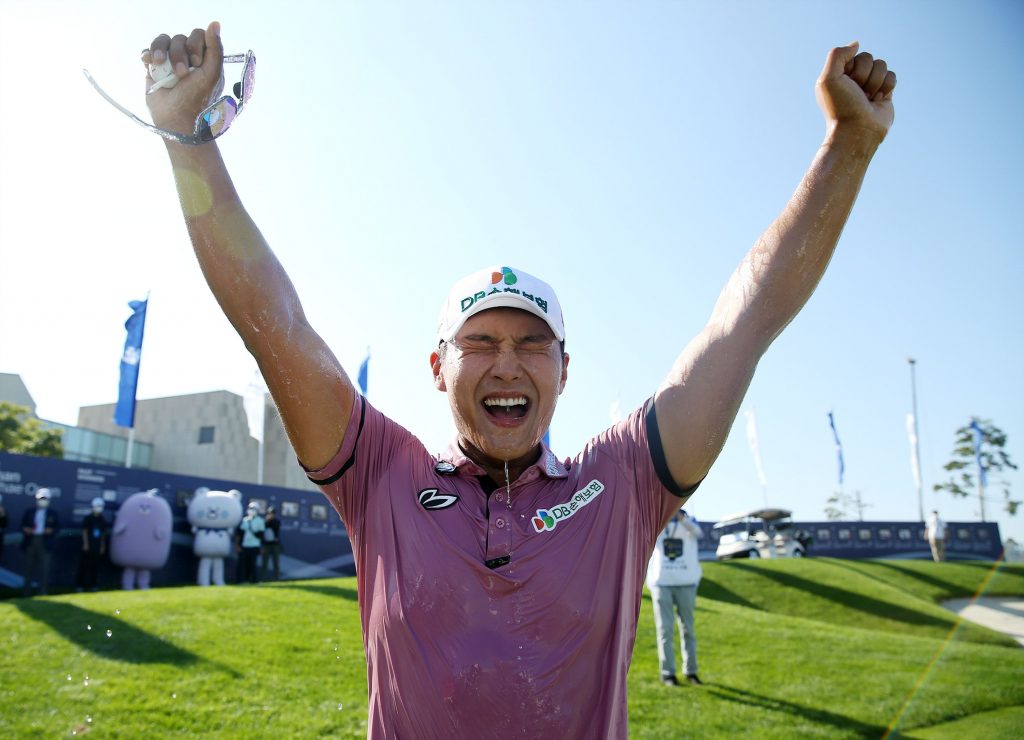
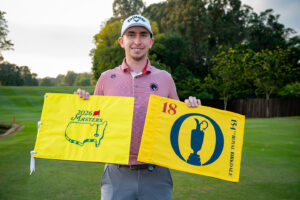
Korea’s Wooksoon Kang is one of the Asian Tour’s greatest players. A two-time winner of the Order of Merit, he was the dominant player in the late 90s. We caught up with him last week, in Korea, and discovered that he is on-passing his gift for the game to the next generation of golfers in the Land of Morning Calm.
Food is perhaps an appropriate subject to discuss first with Korean golf legend Wooksoon Kang.
Not because some kind of secret diet was behind a celebrated career that saw him win the Asian Tour Order of Merit title in 1996 and 1998, claim seven Asian Tour events, and 12 Korean Tour tournaments.

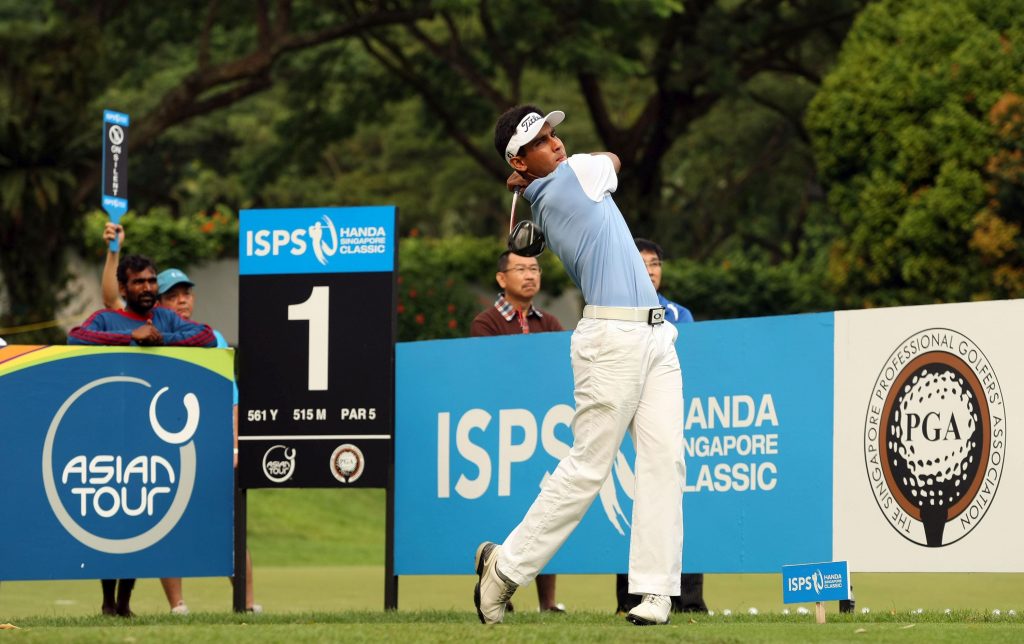
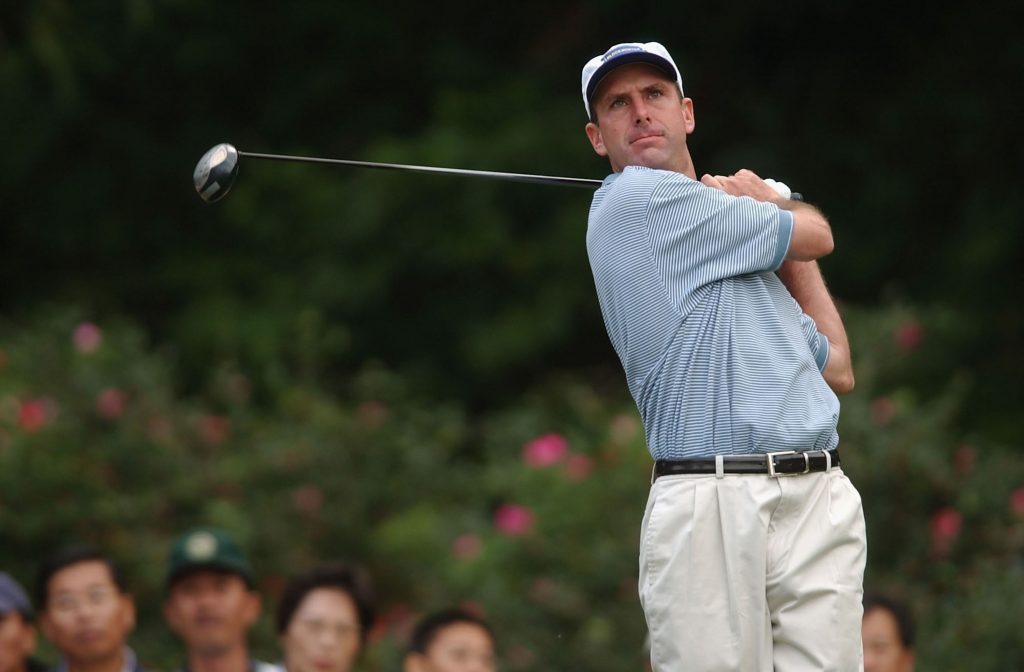
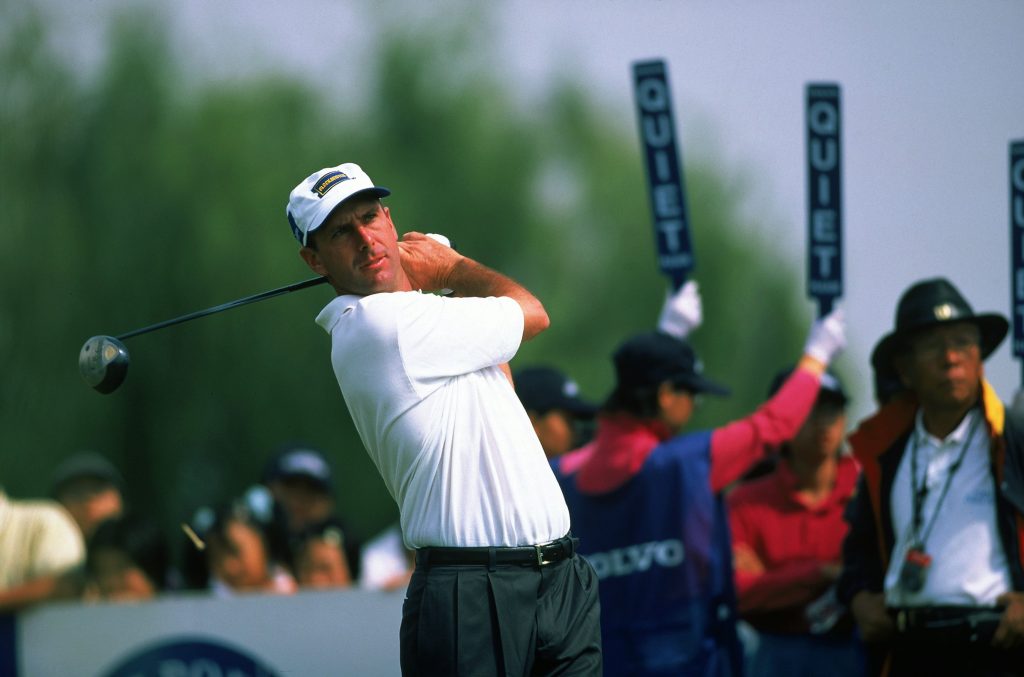
22 Feb 2001: Kang Wook-soon of Korea before he plays his second shot to the 4th green during the first round of The Caltex Singapore Masters being held at The Singapore Island Country Club, Singapore. X Digital Image. Mandatory Credit: Matt Turner/ALLSPORT
But rather quite the opposite, as it was widely reported that it was cuisine that partly led to the curtailment of his career.
To be more precise it was American, or western, food that quickly brought an end to his dream of playing on the PGA Tour.
In 2003, having swept all before him in Asia and having the claimed the last of his Asian Tour titles at the 2001 Thailand Masters, he chose to head to that most feared of golfing contests, the PGA Tour Qualifying School.
He made an impressive first appearance, making it through to the Final Stage and just missing his card by one stroke. Although it was not the result he was looking for, it gave him passage onto the lucrative second-tier Nationwide Tour.

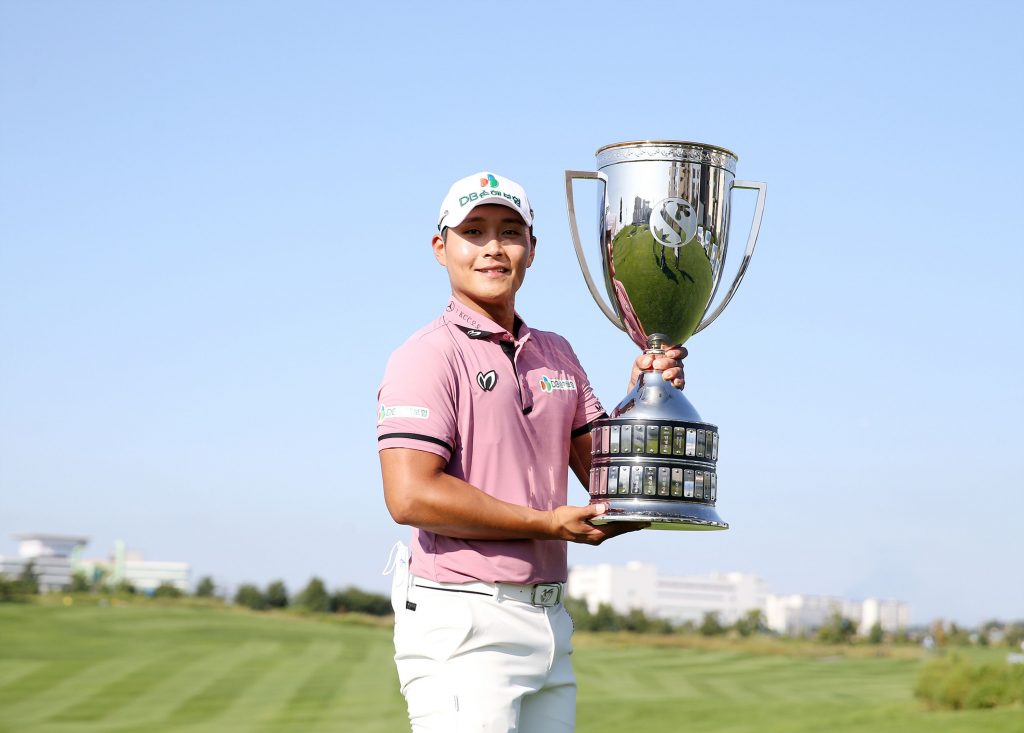
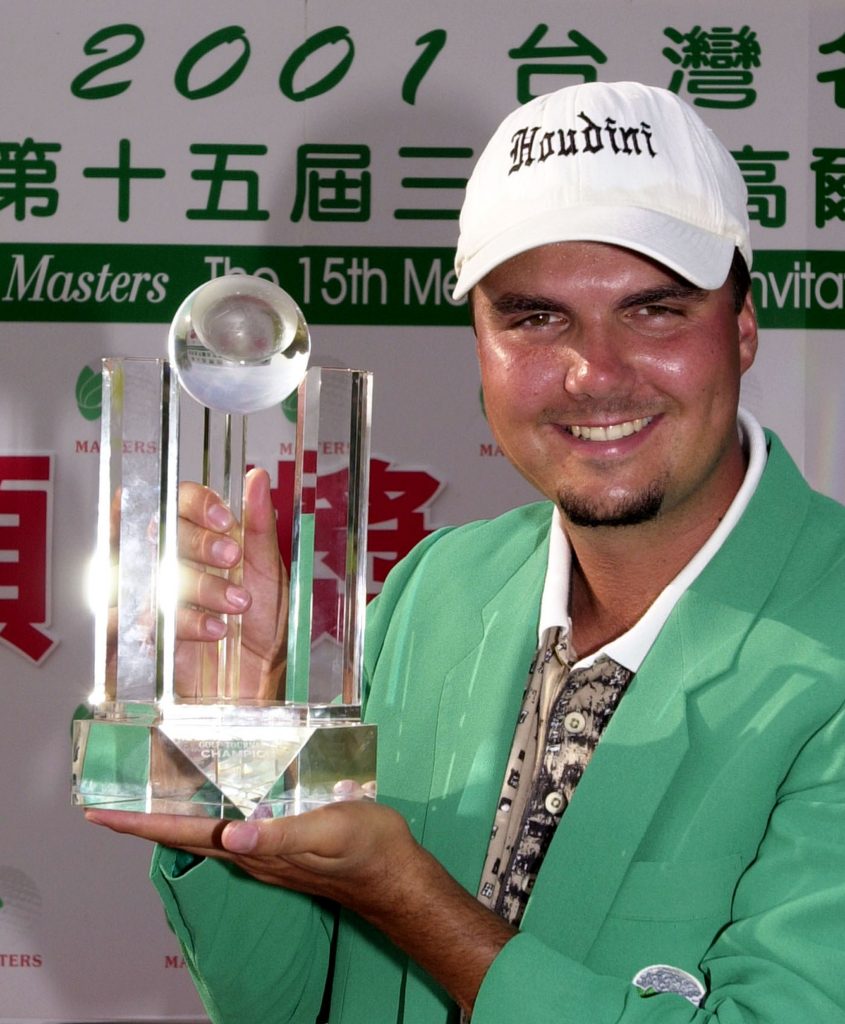
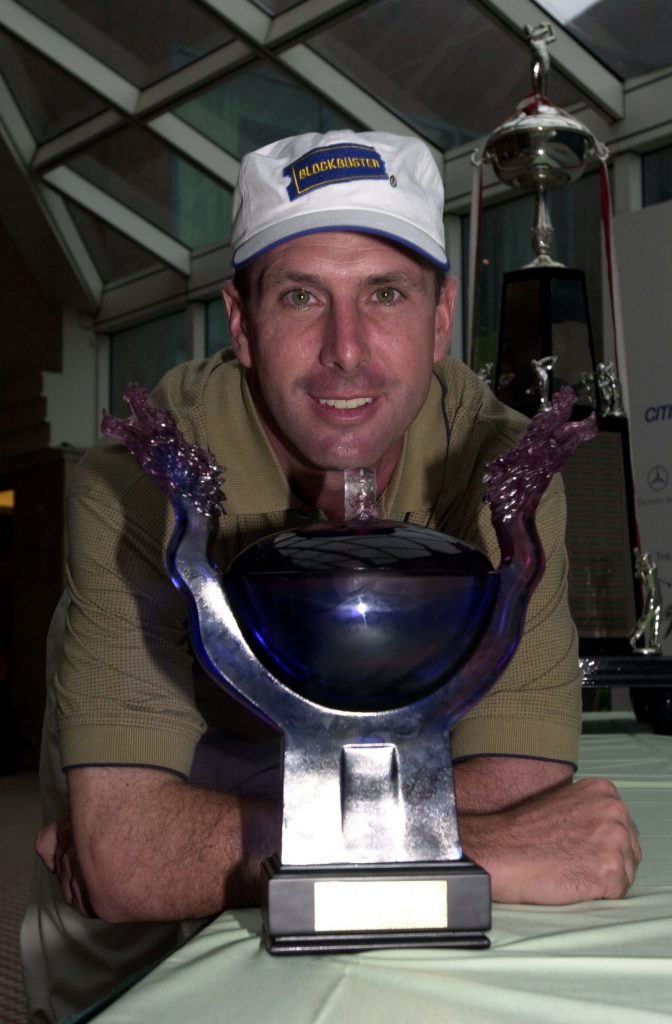
South Korea’s Kang Wook-soon holds up the trophy after clinching the four-day 300,000 US dollar Hong Kong Golf Open with a two-stroke victory after firing a four-under-par final round 68, 29 November in Hong Kong. Kang held off England’s Edward Fryatt to finish with a 12-under-par total 272. AFP PHOTO/Robyn BECK (Photo by Robyn BECK / AFP) (Photo credit should read ROBYN BECK/AFP via Getty Images)
However, after playing six events, in 2004, he decided to pull up stakes and head home.
“There was a problem because of the food,” said the 54-year-old.
“I played for about six months in the first half of the year, and my score was good. But in America they have bread in the morning. It’s not easy to eat. I had a problem with my body.”
He said he prepared thoroughly for his attempt to play on the PGA Tour and that the courses were very good, but he desperately missed the tastes of home.
At one point he even tried to get his caddie to cook for him, but that was unsuccessful
“The caddie was a man, so it was not easy for him to cook well,” joked Kang.
After returning to Korea he claimed a couple of events on home soil before gradually winding down his playing career.

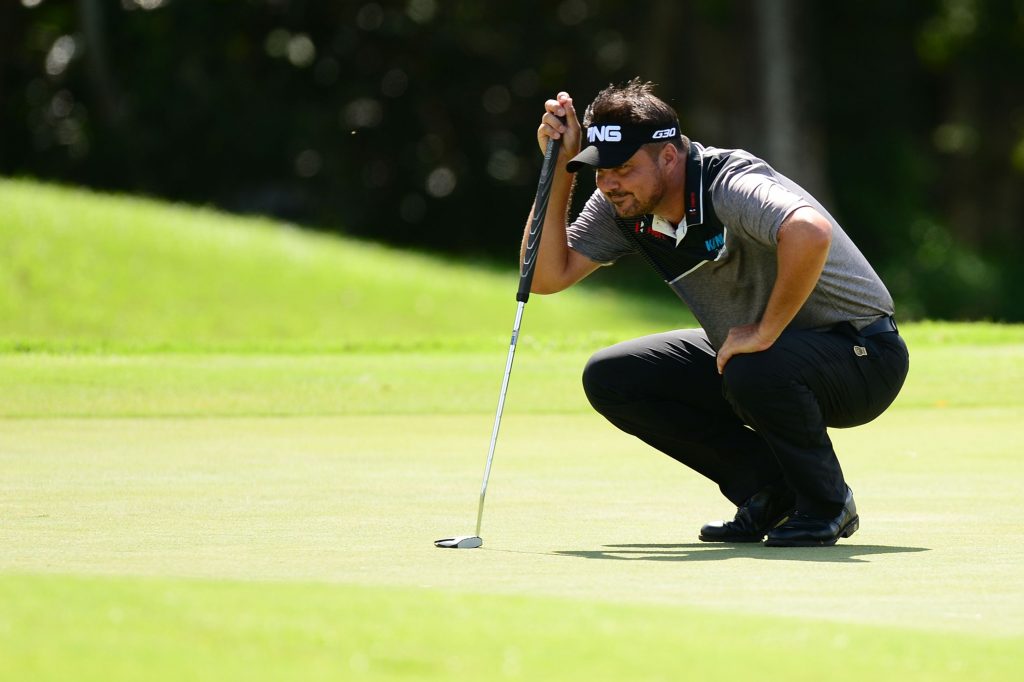
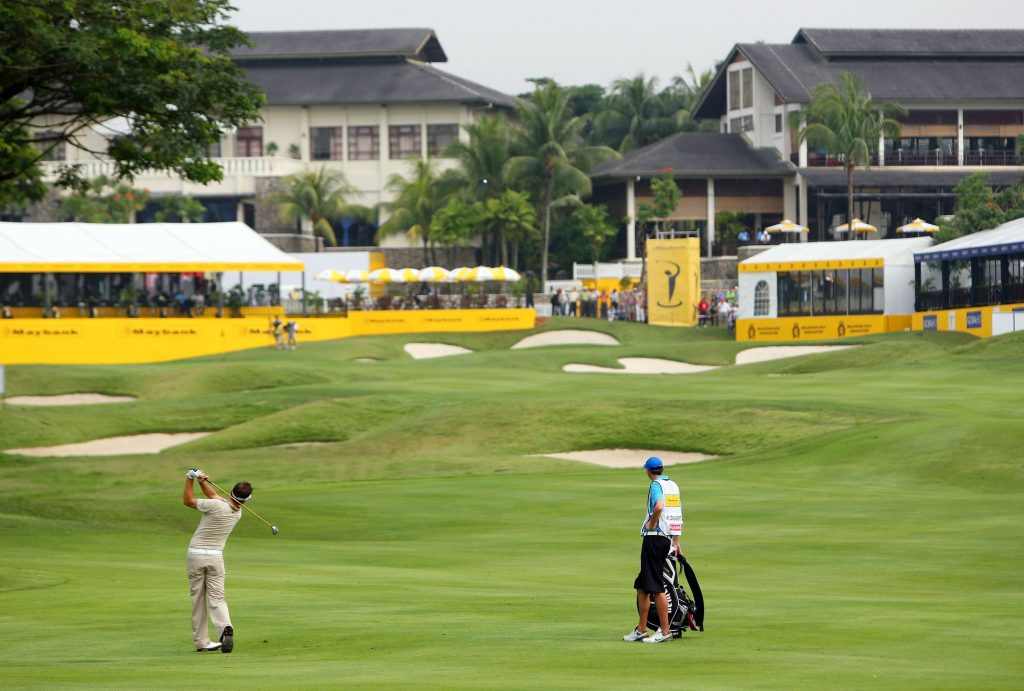
16 Feb 2001: Kang Wook-Soon of Korea plays his third shot to the 14th green during the second round of the Carlsberg Malaysian Open being held at Saujana Golf and Country Club, Kuala Lumpur, Malaysia. X Digital Image. Mandatory Credit: Matt Turner/ALLSPORT
So, how does the quiet and unassuming Korean spend his time these days?
He explains: “Last year, I participated in several tournaments on the KPGA Champions Tour but I’m no longer playing. Since 2017, I have focused on my academy – the Wooksoon Kang Golf Academy. It focuses on finding talented young people and potential CEOs. And I also commentate on golf competitions – more recently the Genesis Open and GS Caltex Maekyung Open – plus I appear on the air.”
He said that it has taken him 10 years to build his business, after overcoming some difficulties early on. He first secured the business in 2008, when he was competing in the SBS Johnnie Walker Blue Label Open.
“After hearing that I had won the business, I won that tournament,” he says.
Kang adds that he was influenced greatly by Kunhee Lee, the late Chairman of Samsung Group, and that his academy is not just a typical golf driving range and par-three course, but rather a ‘system of education’.
“Each year, 1,000 young people learn golf here. They come to learn golf through educational organizations, local sports associations, and other associations. It is for Korean golf,” he says.
The Korean was on business in Vietnam in February of last year when coronavirus first broke out and by the time he had returned home soon after the situation had become serious.
“We could go to practice ranges as they complied with the government’s COVID-19 quarantine rule to stay 2.5 metres apart. But there were many days when indoor facilities, such as fitness centres, swimming pools, and saunas, were closed. Fortunately, as golf is an outdoor game it did not affect us too much,” he adds.
However, he does point out that when he does go for a round of golf, the culture has changed a lot, and he heads home immediately after, not stopping for a chat, shower or food.
Kang considers his finest win to be the Maekyung LG Fashion Open in 2000.
He beat Australian Kim Felton by one stroke in what is considered one of Korean golf’s Majors.
“The galleries were huge and the difficulty was very high. There was a difference in tension compared with other competitions, so I remember it the most,” he added.
And so, amongst all the highs during a sparking career, was the biggest disappointment?
“It was the 1996 Alfred Dunhill Masters [played at the Hong Kong Golf Club]. At that time, I had a neck-and-neck race with Bernhard Langer. I often faced Langer. I was defeated by him at that time and that is the most regrettable moment of my career.”
Thailand’s rising star Jazz Janewattananond had a day to remember at the Arnold Palmer Invitational presented by Mastercard on Saturday.
The 25-year-old, who is playing this week on a tournament’s exemption, sank his career first hole-in-one on the PGA TOUR at the par-three 14th hole at Bay Hill Club and Lodge en route to a three-under 69 which moved him into tied seventh place, four shots behind leader Lee Westwood who leads on 11-under-par 205.

ORLANDO, FLORIDA – MARCH 06: Jazz Janewattananond of Thailand watches his shot from the third tee during the third round of the Arnold Palmer Invitational Presented by MasterCard at the Bay Hill Club and Lodge on March 06, 2021 in Orlando, Florida. (Photo by Sam Greenwood/Getty Images)
A day after he carded a superb 65 to improve from an opening 75, Jazz made three other birdies against two bogeys on a day he missed 50 percent of fairways and greens in regulation. The one shot that counted most was a beautifully flighted six iron which took four little bounces on the green before rolling into the hole, much to the delighted a small crowd gathered around the green.
“Good call, good club,” said a beaming Jazz, whose effort meant that Mastercard would donate US$200,000 to the Arnold & Winnie Palmer Foundation.
“I was a member here for four months during COVID last year and I didn’t have one hole-in-one. So it’s good to have in a tournament and it’s very special to have Mastercard donating US$200,000 to Arnie’s Foundation.
“I was in between a hard 7 and a soft 6 (iron). And my caddie was just nudging me into the soft 6 and the rest is history. The round was very choppy at the end and choppy at the start as well. The middle was pretty good. Overall, pretty happy as it was tough conditions.”
"LET'S GO!"
Jazz Janewattananond's reaction to his hole-in-one is as genuine as it gets.#QuickHits pic.twitter.com/uzbu3L6m3I
— PGA TOUR (@PGATOUR) March 6, 2021
His scrambling saved him on a few occasions which now gives him a shot an unlikely win after how his week started with his 3-over par round. He made a 26-foot birdie on 16, rolled in a putt of 22 feet to save par on 17 and got up and down from the bunker four times to outscore playing partner Max Homa, who won The Genesis Invitational recently, by three shots.
“I think we might get a little bit more sun tomorrow. The golf course might play a bit different so we can go at more pins than today. But yeah, the same plan is really try to hit the fairway, try to hit the green. It’s great because I know Roy (Saunders, VP of Bay Hill) personally and he’s the one who give me the invite to play here, so it’s really good to be able to give back to that,” said Jazz.
He spent nearly six months in the U.S. last year after the coronavirus pandemic shut down sports leagues and international borders around the world, and stayed over an extended period with two-time PGA TOUR winner Daniel Chopra, who lives in Orlando and is a Bay Hill member. He is staying with Chopra and family again this week.
“I mean, there’s home course knowledge that helps in the fact here for sure. I must have played over a hundred rounds in shoot-outs like they have every day with the members and we kind of had fun and it’s great. Just learning the culture here as well,” said Jazz.
“I’m really fortunate because when the PLAYERS got cancelled after round 1 last year, Thailand’s border was closed so I didn’t have anywhere to go. I called my friend Daniel, whom I’m staying with this week as well, asking if I could stay with him for a few days and it turned into a few months. So it’s a great story.”
It would be a greater story if Jazz can pull off a victory on Sunday as no Thai player has won on the PGA TOUR.
Thailand’s Jazz Janewattananond fired the day’s low score with a superb seven-under-par 65 on Friday, which was a 10 shot improvement from his opening round at the Arnold Palmer Invitational presented by Mastercard.
The reigning Asian Tour Order of Merit champion took advantage of his local course knowledge as he is Bay Hill member after staying with two-time PGA TOUR winner, Daniel Chopra for nearly four months during the COVID-19 pandemic last year. He enters the third round in tied 11th place, five off the lead on four-under-par 140 total.
Jazz was delighted to bounce back to life in the morning wave. The 25-year-old burst out of the gate with five birdies on the back nine, starting at the par-four 11th hole, where he rolled in a 15-foot putt to get his day started. He added three more birdies on Nos. 14 through 16, the first of which he poured in from 33 feet, before adding one final birdie at the 18th prior to making the turn.
Though he dropped back to four-under with a bogey at the par-3 second, Jazz closed with three birdies over his final five holes. He connected on lengthy putts from 17 and 16 feet at Nos. five and six, respectively, before tallying his eighth and final birdie of the day at the last, when he stuck his approach shot inside 10 feet.
“Yesterday, none of the putts dropped but I guess I kept it all for today,” said Jazz. “Everything I seemed to do was better, like I hit my irons a little better and putt a little better which added to a good round. Last year, I was here for like three to four months. I’m a member here which helps as it’s like home course advantage. I’ve played on this course more than any other place in my life. Usually when I’m home I don’t really play that much.
“After THE PLAYERS Championship got cancelled (last year), I literally didn’t have anywhere to go because Thailand was shut. I was in Jacksonville and I called Daniel and said ‘hey can I stay here for a few days’ and I ended up staying with his family for three to four months. He caddied for me a couple of times on TOUR too.”
By advancing to the weekend at Bay Hill, Jazz has now made the cut in three of four starts during the 2020-21 PGA TOUR season. He tied for 60th at the ZOZO CHAMPIONSHIP @ SHERWOOD and tied for 51st at The Masters Tournament. His best finish on TOUR remains a tie for 14th, which he accomplished twice in 2019 the PGA Championship and World Golf Championships-HSBC Champions.

ORLANDO, FLORIDA – MARCH 05: Sungjae Im of Korea plays his shot from the seventh tee during the second round of the Arnold Palmer Invitational Presented by MasterCard at the Bay Hill Club and Lodge on March 05, 2021 in Orlando, Florida. (Photo by Sam Greenwood/Getty Images)
For the third consecutive year, Korean standout Sungjae Im will enter the weekend rounds inside the top 10 on the leaderboard. He finished in the top-three in his first two appearances at Bay Hill Club & Lodge and hopes to be third-time lucky by winning the prestigious PGA TOUR tournament.
Im, who is ranked 17th in the world, posted a second round 70 on Friday and sits at five-under 139 in tied seventh place through 36 holes. He trails leader Corey Conners by four, while Martin Laird sits in solo second at eight-under. Viktor Hovland, Rory McIlroy and Lanto Griffin are a further stroke back in share of third place.
Chasing a second TOUR win, Im made the turn at even par — a 22-foot birdie putt at the par-3 second was offset with a bogey at the par-5 sixth— before moving into red numbers with a birdie at the 10th. Though a double bogey at the 13th moved him to 1-over for the day, the 22-year-old quickly rallied at the ensuing par-3, pouring in a 30-foot birdie putt to get back to even-par. He ended his day on a high note at the par-5 16th, which he eagled after hitting his 190-yard approach shot inside 10 feet. He eagled the 16th on Thursday as well.
“I hit my driver well and found a lot of fairways. It helped me with my second shots. The rough is difficult here, so keeping the ball on the fairway is key. I have made some good scores over the past two days due to my driving,” said Im, who missed only one fairway during his second round.
A return to Bay Hill, home to the late golf legend Arnold Palmer, is always special. As the 2019 Rookie of the Year and recipient of the Arnold Palmer Award, the Korean star enjoyed the privilege of a tour of Palmer’s office last year. “I know Arnold Palmer is a legend in golf and a great player in the era,” Im said previously. “I think I have something connected to Arnold Palmer.”
With his putter finding its range where he ranks sixth in Strokes Gained: Putting over two rounds, Im hopes his flatstick will continue to produce the birdies and eagles in hope of a victory at the Arnold Palmer Invitational, which is one of three elevated tournaments on the PGA TOUR. “I think my form is almost the same as the last couple of weeks. If I can make some putts at the critical moments, I would be good enough to compete for the top,” he said.
Sentosa Golf Club, home of the Asian Tour, is widely respected as one of the world’s greatest golf clubs with two pristine conditioned golf courses, showcasing breath-taking views of the Singapore Straits and metropolitan Singapore.
Since reopening in December, the Club’s world-class championship course, The Serapong, has attracted positive headlines from across the globe. As the host venue for the SMBC Singapore Open, The Serapong is one of the world’s best golf courses, having been named ‘Singapore’s Best Golf Course’ for the third consecutive year at the World Golf Awards in 2020, as well as being ranked 59th in Golf Digest’s ‘Top 100 World’s Greatest Golf Courses 2020-21’.
The man tasked with taking one of golf’s most iconic courses and making it even better, right in the midst of a global pandemic, was the Club’s own General Manager and Director of Agronomy, Andrew Johnston. With three months having passed since the course reopened, we sat down with him to discuss how The Serapong is shaping up and what we can expect from this prestigious course in the future….

Picture by Paul Lakatos/Lagardere Sports.
Since The Serapong reopened at the end of last year, what has the feedback been like?
The feedback so far from our members and guests regarding the renovations has been extremely positive. Our aim was always to provide them with the best possible playing experience, whilst also setting the course up to deliver an exciting challenge for golfers of all abilities.
Our members and guests have become used to experiencing the highest standards of playing conditions 365 days of the year on The Serapong, which is what we pride ourselves on, and this was definitely something we factored in during the renovations. We are continuously looking to improve the quality of the experience at Sentosa Golf Club and hope that the positive feedback from everyone who has played The Serapong continues to circulate.

Each and everyone of the fairways on The Serapong has been rejuvenated.
Because of COVID-19, we know all the staff at the club had to help out with the renovations. What was that experience like? You must be very proud.
With the renovations on The Serapong commencing just as Singapore was about to go into the ‘Circuit Breaker’, there were many challenges faced. The Club had to be nimble and remain aligned with the changing restrictions throughout the pandemic. The rules of operation were fast changing in the early stages from wearing masks, testing protocols and limited staff allowed on site, to quarantining and working from home.
So, a major challenge that we faced during the renovations was attempting to keep up with the tight construction deadlines, while still meeting all the Safe Management Measures (SMM) in Singapore. We were also only allowed a certain number of staff on-site at the Club on any given day. Our contractor had 150 labourers and operators involved with the project, but just 25 days before the works started 140 of them were quarantined for over four months, meaning our staff had to step in and support and go the extra mile to get the job done.
I am very proud of everyone associated with the Club and the role they played throughout the entirety of the renovations. Despite facing a number of difficult circumstances, we all take great pride in how the renovations have turned out.
We have managed to take one of the world’s top 100 golf courses and make it even better than before, as well as future-proofing it for many years to come. However, we would not have been able to complete such a project without the help of all our staff. It took a huge amount of effort and dedication from everyone associated with SGC, whatever department they worked in, including front of house staff, F&B staff, committee members, and many more, to get the renovations over the line.
Their motivation to make The Serapong even better never changed and a ‘win-at-all-costs’ mentality meant our staff continued to strive for the same levels of perfection that would normally have been expected of them on a day-to-day basis prior to lockdown. All whilst adhering to and meeting the SMM required of them.
The Serapong’s iconic 5th hole has seen extensive renovations to its bunkers.
When Sentosa hosts its next tournament on The Serapong, how do you think the players will feel about the changes? Is the course even harder?
We believe the players would say the newly renovated Serapong still provides a fair, but challenging test. The Serapong has always offered one of the most formidable challenges in Asia and by changing small aspects of the layout, golfers are now required to think hard about their strategy and find new ways of overcoming the obstacles they face during their round.
One of the showstopping features added to the course is the new bunkering that has given The Serapong a fresh new look with creative serrated edging. They look deeper, larger, and truly capture a golfer’s imagination when they are lining up their next shot.
Another fundamental change to the course layout involves the works undertaken on the 6th hole. We have realigned the tee complexes and moved them to the right of the cart path, therefore changing the visual alignment of the hole and making golfers look further down towards the water on the right at the edge of the rock wall.
Also, a large new waste bunker has been added, as well as 60 palm trees, which means players will have to change their strategy if they opt to hit away from the water and avoid the sand, as their line into the green will now be affected. We have also added a new false front to the 6th green, named ‘The Dragon’s Tongue’, that requires golfers to add a touch of precision to their game in order to walk away with at least a well-earned par.

The 14th hole at The Serapong
The Serapong receives rave reviews from players every year. In your view what makes the course so special?
The Serapong has always been special because it provides breath-taking views wherever you are on the course. This is especially true for ‘The Dragon’s Tail’ (holes 4-7) and the personality of the course has only been enhanced by the renovations.
We realigned the tee complex on the 4th hole and by doing so have opened up the visual alignment of how the serpentine shoreline and walls lie in front of a player’s vision and now takes them on a continuous journey all the way up to the green, therefore adding to The Serapong’s storyline. This small adjustment enhances the coastal theme and plays a big part over the next four holes in how the course, and Sentosa’s story, plays out.
The 5th Hole continues to showcase spectacular views of metropolitan Singapore, whilst Hole 6 now aligns with the shore, offering views of Pulau Brani and delivering a reoccurring visual experience. It is not every day that players will be able to experience such an incredible setting and I always think players find this stretch pretty unique. The Serapong is a one-of-a-kind journey that is proud to welcome golfers from around the world to take on its challenge.
![]()
In layman’s terms, which were the bits of clever technology used for the renovations?
Good question! Throughout the renovations there were a number of specific pieces of technology used to help enhance the course. All the tee boxes were re-lasered to reinstate a tabletop flat finish and return them to their original size, as well as updating the grass to allow them to be maintained at super low mowing height of 3mm.
The greens were also improved through a drill-and-fill process that saw machines inject a pre-made sand mix solution into them in order to rebuild and enhance the soil structure condition. With an enhanced air ratio, it will see the putting surfaces stand the test of time and the tropical climate in Singapore for the next decade.
Last question. Which is your favourite Singapore Open and why?
Well, I certainly have quite a few and there are so many great memories over the years. One of my fondest is watching Angel Cabrera down 18 in the final round. He hit a booming drive with a bit of fade off the water (his caddie thought it was going in the water, but Angel knew it had cleared). Then hit a 6-iron from 200 metres out, pin high, for an easy two putt birdie and to close the tournament out by one from Vijay Singh. A 6-iron from that distance these days might not seem that much, but back then it was something special from that range. That week in 2007 had everything. Angel played majestic golf all week, including a 63 in the second round and we have to also remember his driver head came off during his first round and he still managed to shoot level par!
I will also never forget Adam Scott’s three-peat. There’s just something about Singapore and Sentosa Golf Club that just clicked with Adam. He’s given us a lot of great memories here too.

SENTOSA, SINGAPORE – SEPTEMBER 11: Adam Scott of Australia poses with the Trophy after he won it by 13 under par 271 during the Final Round of the Singapore Open at the Sentosa Golf Club on September 11, 2005 in Sentosa, Singapore. (Photo by Stanley Chou/Getty Images)
*The Sentosa Golf Club is part of the Asian Tour Destinations, an exclusive network of world-class golfing properties around the region that offer a comprehensive range of facilities and services to club members and guests, as well as to Asian Tour players and officials.
American star Collin Morikawa won the WGC-Workday Championship on Sunday at The Concession Golf Club, in Florida, by shooting a three-under-par 69 to finish at 18 under – three ahead of countrymen Billy Horschel and Brooks Koepka and Norwegian Viktor Hovland.
Following a first round 70 on Thursday, Morikawa went on to birdie 20 of his next 45 holes to impressively pull away from the elite field and claim his first title since last August’s PGA Championship.

(Photo by Sam Greenwood/Getty Images)
“It shows that I can come out here and compete,” said Morikawa, after his fourth PGA Tour win in just 39 starts.
“What a week. I was working on so much over the last couple of weeks … My game felt so good. I’m so excited right now.”
With much of the field dressed in red and black to honor Tiger Woods, after his near-fatal car crash earlier this week, Morikawa was emotional in the end after his victory.
“Tiger means everything to me,” said the 24-year-old. “Yes, he had the crash, thankfully he’s all right and hopefully he has a quick and great recovery. I don’t think we can say thank you enough. I want to say thank you to Tiger … Sometimes you lose people too early. You don’t get to say thank you enough.”

(Photo by Mike Ehrmann/Getty Images)
The Asian Tour’s top-two ranked players on the Order of Merit, Australian Wade Ormsby and American Trevor Simsby performed with distinction.
Ormsby, ranked first on the Merit list, closed with a 72 to finish in a tie for 52nd, while Simsby carded the same score and ended in equal 37th. The American, playing in his first WGC event, made a hole-in-one on the par-three sixth on day three.
Australia’s Wade Ormsby and American Trevor Simsby – the Asian Tour’s top-two ranked players on the Order of Merit – will play in the opening tee-times today in the World Golf Championships-Workday Championship at The Concession, in Florida – the first WGC event of the year.
Ormsby – ranked first on the Merit list thanks to his win in last year’s Hong Kong Open – tees-off at 10.58am (Florida time) with South African Eric van Rooyen and Brendon Todd from the Unites States.
Last year’s Malaysian Open winner, Simsby, starts at the same time, but on the 10th with Australian Minwoo Lee – the brother of LPGA star Minjee Lee.

(Photo by Sadiq Asyraf/Getty Images)
The tournament is being played at The Concession Golf Club, and boasts prizemoney of US$10.5 million. The event was due to be played in Mexico but logistical challenges, posed by the COVID-19 pandemic, meant the location had to be changed.
Ormsby claimed the Hong Kong Open last January, for the second time in his career, and shot to the top of the Asian Tour Order of Merit.
Simsby soon joined him near the top of the Merit list by winning the Malaysian Open in March, before the pandemic brought the season to an abrupt halt.
This will mark the third time Ormsby has played in a WGC event, while its Simsby’s debut.
American Patrick Reed claimed the title last year; his compatriot Dustin Johnson triumphed in 2019 and 2017; while another American Phil Mickelson won in 2018.
World number one Johnson starts as hot favourite and has been paired with compatriots Brooks Koepka and Patrick Berger.
WGC events feature a field a of 72 players with no halfway cut.
Thailand’s Thongchai Jaidee successfully defended his Malaysian Open crown on this day, 16 years ago. Perhaps, more than any of his victories – to date he has claimed 13 on the Asian Tour, and eight on the European Tour – this event defined him as a player. We look back at those two memorable victories, both played at Saujana Golf & Country Club.
Thongchai Jaidee had already tasted victory on five occasions by the time he arrived at the Malaysian Open in 2004.
In fact, he had claimed the Myanmar Open the week beforehand – for the second time in his career – and so started the National Open of Malaysia as one of the favourites.

KUALA LUMPUR, MALAYSIA – FEBRUARY 22: Thongchai Jaidee of Thailand poses with the trophy for winning The Carlsberg Malaysian Open Golf at Saujana Golf and Country Club on February 22, 2004 in Kuala Lumpur, Malaysia. (Photo by Stuart Franklin/Getty Images)
Ace Performance
He faced a formidable field as, for the fifth year on-the-trot, the tournament was jointly-sanctioned by the Asian and European Tours. Ireland’s Padraig Harrington – who was beaten in a play-off by Fijian Vijay Singh at the event three years before – Denmark’s Thomas Bjorn, Irishman Paul McGinley and Sweden’s emerging young star Henrik Stenson, were some of the headline acts.
It was, no doubt, the quality of the field that helped contributed to Thongchai’s virtuoso performance.
That week, he created a piece of European Tour history when he became the first player from Thailand to win on the European Tour – the anniversary of which is on Monday, February 22 – with a two-stroke victory over Australian Brad Kennedy.
After struggling on the front nine on Sunday, he raced home in a blistering 30 strokes, highlighted by that most celebrated of golf shots – an ace on the par-three 16th.
He had been tied for the lead with three holes to play and magnificently rose to the challenge by spectacularly sinking a six iron from 188 yards, for the second ace of his professional career. A birdie on the last gave him a closing round of 68, four under par, for a 14 under par total winning total of 274.
Hs compatriots Prayad Marksaeng and Chawalit Plaphol, tied for third, four shots back, along with Frenchman Thomas Levet.
It was also Thongchai’s third win in six starts, as he also won the Volvo Masters of Asia at the end of 2003.
“It’s been my dream to play on the European Tour and now I will have to get used to life in Europe,” he said. “I’m looking forward to taking the opportunity to play alongside some of the best players in the world.”
The winners’ cheque of €158,153 (approximately US$191,000) was the largest of his career at the time, and he also became the sixth player from the Asian continent to win on the European Tour, along with India’s Arjun Atwal, Isao Aoki from Japan, Korean KJ Choi, Taiwan’s Yeh Wei-tze and Zhang Lian-wei from China.

KUALA LUMPUR, MALAYSIA – FEBRUARY 20: Thongchai Jaidee of Thailand with the trophy for winning The Carlsberg Malaysian Open at Saujana Golf Resort on February 20, 2005 in Kuala Lumpur, Malaysia. (Photo by Stuart Franklin/Getty Images)
Back-to-back brilliance
The circumstances of his victory the following year were somewhat more relaxed, as he started the final round with a six-shot lead and eventually triumphed by three, but there were a few anxious moments when Stenson and India’s Jyoti Randhawa, the closest challengers, sensed an opening.
Thongchai bogeyed the ninth and then drove out of bounds with a hooked drive on the 11th; but he steadied the ship with his second ball: holing from eight feet to drop just the one stroke and maintain a two-stroke advantage.
At that stage most of the pressure was coming from Stenson who was making huge strides into the seven shot deficit he faced at the start of the round. Four birdies on the front nine closed the gap to three and his birdie on the 11th left him only two adrift.
But 13 lived up to its tag and proved unlucky. Pressing for an eagle three, Stenson misjudged the wind and pulled his seven iron approach. His ball ended up sitting on top of the rocks by the edge of the water and, in attempting to nick it clean off the stone, the clubhead bounced and he only moved the ball forward a few feet. His next chip ran 10 feet past and, to his astonishment, the par putt stayed out.
Thongchai, playing in the final group behind Stenson, responded with a birdie on that hole: pitching to within a couple of feet to restore his four-shot cushion over the Swede.
Thongchai’s closing 70 gave him a winning total of 21-under-par total of 267 – three clear of Randhawa, with Stenson a further shot adrift.

KUALA LUMPUR, MALAYSIA – FEBRUARY 20: Thongchai Jaidee of Thailand plays his tee shot on the 15th hole during the final round of The Carlsberg Malaysian Open at Saujana Golf Resort on February 20, 2005 in Kuala Lumpur, Malaysia. (Photo by Stuart Franklin/Getty Images)
The Thai star’s win saw him join a select group of players to have won the event back-to-back, the others being: Australian Graham Marsh (1974-75), and Japan’s Tomo Ishii (1964-65).
It also earned him a cheque for €156,763 (approximately US$190,000) and it was his seventh Asian Tour victory, placing him alongside Korea’s Wooksoon Kang as the most prolific winners on the Asian Tour at the time.
“This feels fantastic,” said Thongchai. “This win is better than last year. I just told myself to play my own game. The driver didn’t work well for me today but the irons worked nicely.”
Thongchai would go onto to win another 10 titles on Tour after that and complete his place among the greats of Asian golf
We asked Myanmar legend Kyi Hla Han, who turns 60-years-old today, nine questions about his unparalleled 25-year playing career.
Favourite tournament?
My career spanned 25 years. In the early 90’s the Johnnie Walker Classic was one of the best tournaments in Asia. It was played on really good courses with top-class star players and the atmosphere of the event was incredible. The same goes with tournaments in Australia – like the Australian Open and Australian Masters. It was fun to play in Melbourne.
In Asia in the last 15 years, the Singapore Open, the Maybank Championship and the Hong Kong Open are my favourite events; they are played on really good courses and the events have a great atmosphere.
Favourite course?
I don’t have a real favourite but I prefer the old traditional layouts. During my career I was fortunate to play the Sandbelt courses in Melbourne; Kingston Heath and Royal Melbourne are, in particular, my favourites. Especially the way the holes are designed, the bunkering, and the fact they test shot making. They don’t favour a particular kind of shot, you need to play all kinds of shots. Even in recent times the scores were not low on those courses, which shows that power doesn’t come into play. The same would apply to great Open courses like Muirfield, Carnoustie, Royal Birkdale etc. I would love to have played US Opens on traditional layouts like Winged Foot, Baltusrol, Marion etc
Closer to home, Sentosa’s Serapong Course is right up there, as is the Composite Course at the Hong Kong Golf Club ― used during the Hong Kong Open ― plus Delhi Golf Club and Royal Calcutta, come to mind. There are a lot of good courses in Thailand too.

(Photo by Paul Lakatos/Asian Tour via Getty Images)
You won 12 times during your career. Which one did you enjoy the most?
My best win would be the 1999 Volvo China Open. It was raining and windy all four days and I won by eight shots. My father walked with me for all four days in that weather and he was 75-years-old! After that win I played well all year and won the Asian Tour Order Of Merit. The 1994 Singapore Open at Tanah Merah and the 1997 Rolex Singapore Masters at SICC Bukit were also memorable, and ironically I’m living in Singapore now!
Best thing about being a Tour pro?
I had wanted to be a pro golfer since I was 10 years old. I’ve been very fortunate to pursue a sport that I loved. Traveling all over the world, meeting new people, making so many friends, and playing a lot of great tournaments and golf courses. I was the only Asian playing in Europe in the 80s and in Australia. I cherish those moments. And, now that I have stopped playing, I reflect on those moments all the time.
I played in Europe for about five years. When I didn’t get into the main tour events I played the tours in Sweden and France, Germany and Italy. There wasn’t a structured Challenge tour in those days. In those days we kind of made up our own tour and a lot of players just travelled together. In the summer I played in Europe and then in October I went to Australia. And then I played the old Asian Tour from February to April. Without any centralized circuit we played around the world. Pretty much most of the players did the same thing.
I tried the US PGA Tour Q School five times, and got to the finals but never really got my card. I could have stayed there more, and played mini tours, but I decided the best thing was to play around the world. Maybe I was just burnt out by the time I played in their Q School in September/October. That was a disappointment but I have had a lot of enjoyment from being a Tour pro.

(Photo by Stanley Chou/AFP via Getty Images)
Most nervous you have been on the course?
The first tee shot at St Andrews in the 2000 Open Championship, and also the first tee shot playing with Tiger Woods in the 2000 Johnnie Walker Classic at Alpine, in Bangkok. The first tee shot was nerve-racking, but after that I was okay. Thinking back, it’s those nervous moments that I cherish. I miss the competition and playing with a lot of pressure, even if your heart is beating like crazy and your palms are sweaty … it’s what I miss.
What do you consider is the best shot of your career?
I really remember the drive I hit on the last hole of the 1994 Singapore Open at Tanah Merah. I had a one-shot lead and I knew if I hit a good drive I’d be ok. I was really nervous but I hit the longest and straightest drive of the four days. The first three days I had a four or five iron in for my second on that hole but I had an easy seven on the last day. I used a Callaway Big Bertha – they had just come out – and a Titleist balata 90. I used that ball because it was soft, it didn’t go far, but with my irons I got a lot of control, I like to work the ball.
Worst shot of your career?
I shanked a shot playing with Tiger Woods in the 2000 Johnnie Walker Classic. That was probably the most embarrassing because it was a par five at Alpine. It was over water and I hit a great second shot just over the green and was looking at a birdie; it was an easy chip but I shanked it and I made six.
And, there was once in Australia when I was leading a tournament and I had a two-shot lead going into the last day. The first hole was a par five and I hit my second 10 yards short of the green but I basically just chunked my third and made six, and pretty much didn’t have a good round.

(Photo by Paul Lakatos/Asian Tour/Asian Tour via Getty Images)
Your best ever putt?
It wasn’t through putts that I won tournaments, there wasn’t a key putt. I remember the putt I made on 17 in the Korean Open in 1999, I was going head-to-head with KJ Choi. I was one behind and I had a 30-footer downhill that was almost impossible to make, but I holed it to put some pressure on him and to go one back into the last hole. I hit a great shot into 10 feet on the last but I missed it and I lost by a shot.
And the same year in the Taiwan Open I was one behind, and I made a 20-footer on the last hole to put pressure on Wooksoon Kang, but he made a 20-footer on top of me to win by one.
I made those putts when I really needed them; I still think about those putts. I was using the broom handle putter then ― I had switched in 1996 ― and I am still using that putter today. It’s in my bag; they don’t make them anymore.
Who is your favourite golfer?
I grew up admiring Jack Nicklaus. My father was a big fan of Jack and he gave that book Golf My Way by Jack Nicklaus. I basically learned a lot from that book. I was 10 years old and that book was my bible. I met Jack at the 2013 Presidents Cup, when it was held at his course Muirfield Village in Ohio. I was Chairman of the Asian Tour, and I got to have lunch with him. I told him that I learned golf from his book and he said he’d give me another one with his signature on it!
Nowadays it would be Tiger Woods. When I played with him in 2000, I could see that there would not be a player like him for a long time.

Han in action during the Johnnie Walker Hongkong Open in 1989. (Photo by Chu Ming-hoi/South China Morning Post via Getty Images).
Former Asian Tour number one Liang Wen-chong, from China, has called for “everyone to work together to fight off the pandemic”, and has taken a safe and sensible approach to the life-changing developments caused by COVID-19.
Speaking from his home in Hengdian, Zhejiang Province, China ― where he is currently celebrating the Lunar New Year with family and friends ― he said: “In what has been a season of rest, for most of last year, I told myself to stay positive. The pandemic is something that will catch you off guard, but it has since become a norm for most. What we need to do is to adapt to it and make changes to our daily lives.
“It’s a new knowledge, so we need to have patience and face it with determination. Everyone needs to work together to fight off the pandemic, hoping life will return to usual in the near future.

(Photo by Arep Kulal/Getty Images)
“Thanks to this pandemic, I have learned how important it is to stay physically fit. Regular exercise can improve your resistance to virus. Therefore, golf is a good option too.”
The 42-year-old played in the Asian Tour events at the start of last year, before the pandemic hit, and was able to compete in a couple of events in Japan, at the end of the year.
“The pandemic affected all golfers and Tours; schedules were changed; tournaments were postponed or suspended. I can only stay at home when there are no tournaments to play. It was back to playing my role as a father and doing my best to adhere to all safety measures.”
Liang has enjoyed a decorated career, to date.
He succeeded his mentor Zhang Lian-wei ―China’s pioneering first world-class player ― by recording achievements after achievements, including: winning three times on the Asian Tour; claiming two titles in Japan; becoming the first player from the mainland to compete in the US PGA Championship; and, at the Open in 2008, becoming the first Chinese golfer to make the cut at a Major.

(Photo by Zhe Ji/Getty Images)
It was in 2007 when he won the Asian Tour Order of Merit title, the first player from China to achieve that feat. That year he also claimed the Singapore Masters ― which was co-sanctioned by the Asian Tour and the European Tour, and meant he became the second golfer from China to win on the European Tour, after Zhang.
“In this brand new 2021, I hope to return to the golf course for more tournaments and obtain good results,” added the Chinese star.
“My long-term goal in golf is to try and prolong my golfing career for as long as I can; maintain my competitiveness on the golf course; and at the same time, do my best in promoting and developing the game across the region.”
It is hard to believe that it was on this day 24 years ago when American Tiger Woods took Bangkok by storm and claimed the Asian Honda Classic at Thai Country Club, just outside Bangkok.
The region had rarely witnessed such a sporting occasion and the world’s media turned out in full force to cover his every move.
The young American had arrived in the Thai capital to much pomp and ceremony and at times frenzied excitement.

(Credit: Richard Castka/Sportfive)
He had competed in Thailand once before ― as an amateur in the 1994 Johnnie Walker Classic at Blue Canyon Country Club in Phuket ― but this was the first time he was playing there as a professional.
Aged 21 years old he was accompanied by his mother, Kultida, who grew up 70 miles north of Bangkok; she proudly chaperoned him throughout the week.
He was also surrounded by tight security during the trip ― which was much needed amid wild welcoming scenes at Don Muang airport.
Having only just turned professional the year before, he had already claimed three titles on the PGA Tour, although at this point he had not won Major.
Woods cruised to a 10-shot victory in the US$300,000 event; which also saw Australian Steve Elkington, Frank Nobilo from New Zealand and American Curtis Strange competing.

(Credit: Richard Castka/Sportfive)
He shot rounds of 70-64-66-68 for a brilliant four-round aggregate of 20-under-par 268; Korean Mo Joong Kyung secured second place.
He treated the fans to a level of golf they had never seen before, including driving the 389-yard par-four 10th hole during the third round.
It was a stunning performance, with his helicopter rides to and from the course adding to the spectacle.
Thousands of fans chanted his name as he walked down the 18th fairway on Sunday.
After the win, Tiger said: “Winning is great, but to win here in Thailand is something special. This is like home to me.”

(Credit: Richard Castka/Sportfive)
“I knew my swing wasn’t working well,” added Woods. “I made some bad shots out there, but I made some key putts and that’s what wins golf tournaments.”
Woods, who earned a cheque for US$48,000, had five birdies during the final round and nearly eagled the fourth hole. He had a bogey on the 17th hole when his drive sliced into the water.
Two months later he was to go on and win the US Masters for the first time ― by the incredible margin of 12 shots ― and commence a career that would see him win 15 Majors and 82 PGA Tour titles.
But few will forget how things began for him during that unforgettable week at the Asian Honda Classic ― nearly a quarter of a century ago.
An interview with one of the Tour’s greatest players …
Korea’s Wooksoon Kang is one of the Asian Tour’s greatest players. A two-time winner of the Order of Merit, he was the dominant player in the late 90s. We caught up with him last week, in Korea, and discovered that he is on-passing his gift for the game to the next generation of golfers in the Land of Morning Calm.
Food is perhaps an appropriate subject to discuss first with Korean golf legend Wooksoon Kang.
Not because some kind of secret diet was behind a celebrated career that saw him win the Asian Tour Order of Merit title in 1996 and 1998, claim seven Asian Tour events, and 12 Korean Tour tournaments.

22 Feb 2001: Kang Wook-soon of Korea before he plays his second shot to the 4th green during the first round of The Caltex Singapore Masters being held at The Singapore Island Country Club, Singapore. X Digital Image. Mandatory Credit: Matt Turner/ALLSPORT
But rather quite the opposite, as it was widely reported that it was cuisine that partly led to the curtailment of his career.
To be more precise it was American, or western, food that quickly brought an end to his dream of playing on the PGA Tour.
In 2003, having swept all before him in Asia and having the claimed the last of his Asian Tour titles at the 2001 Thailand Masters, he chose to head to that most feared of golfing contests, the PGA Tour Qualifying School.
He made an impressive first appearance, making it through to the Final Stage and just missing his card by one stroke. Although it was not the result he was looking for, it gave him passage onto the lucrative second-tier Nationwide Tour.

South Korea’s Kang Wook-soon holds up the trophy after clinching the four-day 300,000 US dollar Hong Kong Golf Open with a two-stroke victory after firing a four-under-par final round 68, 29 November in Hong Kong. Kang held off England’s Edward Fryatt to finish with a 12-under-par total 272. AFP PHOTO/Robyn BECK (Photo by Robyn BECK / AFP) (Photo credit should read ROBYN BECK/AFP via Getty Images)
However, after playing six events, in 2004, he decided to pull up stakes and head home.
“There was a problem because of the food,” said the 54-year-old.
“I played for about six months in the first half of the year, and my score was good. But in America they have bread in the morning. It’s not easy to eat. I had a problem with my body.”
He said he prepared thoroughly for his attempt to play on the PGA Tour and that the courses were very good, but he desperately missed the tastes of home.
At one point he even tried to get his caddie to cook for him, but that was unsuccessful
“The caddie was a man, so it was not easy for him to cook well,” joked Kang.
After returning to Korea he claimed a couple of events on home soil before gradually winding down his playing career.

16 Feb 2001: Kang Wook-Soon of Korea plays his third shot to the 14th green during the second round of the Carlsberg Malaysian Open being held at Saujana Golf and Country Club, Kuala Lumpur, Malaysia. X Digital Image. Mandatory Credit: Matt Turner/ALLSPORT
So, how does the quiet and unassuming Korean spend his time these days?
He explains: “Last year, I participated in several tournaments on the KPGA Champions Tour but I’m no longer playing. Since 2017, I have focused on my academy – the Wooksoon Kang Golf Academy. It focuses on finding talented young people and potential CEOs. And I also commentate on golf competitions – more recently the Genesis Open and GS Caltex Maekyung Open – plus I appear on the air.”
He said that it has taken him 10 years to build his business, after overcoming some difficulties early on. He first secured the business in 2008, when he was competing in the SBS Johnnie Walker Blue Label Open.
“After hearing that I had won the business, I won that tournament,” he says.
Kang adds that he was influenced greatly by Kunhee Lee, the late Chairman of Samsung Group, and that his academy is not just a typical golf driving range and par-three course, but rather a ‘system of education’.
“Each year, 1,000 young people learn golf here. They come to learn golf through educational organizations, local sports associations, and other associations. It is for Korean golf,” he says.
The Korean was on business in Vietnam in February of last year when coronavirus first broke out and by the time he had returned home soon after the situation had become serious.
“We could go to practice ranges as they complied with the government’s COVID-19 quarantine rule to stay 2.5 metres apart. But there were many days when indoor facilities, such as fitness centres, swimming pools, and saunas, were closed. Fortunately, as golf is an outdoor game it did not affect us too much,” he adds.
However, he does point out that when he does go for a round of golf, the culture has changed a lot, and he heads home immediately after, not stopping for a chat, shower or food.
Kang considers his finest win to be the Maekyung LG Fashion Open in 2000.
He beat Australian Kim Felton by one stroke in what is considered one of Korean golf’s Majors.
“The galleries were huge and the difficulty was very high. There was a difference in tension compared with other competitions, so I remember it the most,” he added.
And so, amongst all the highs during a sparking career, was the biggest disappointment?
“It was the 1996 Alfred Dunhill Masters [played at the Hong Kong Golf Club]. At that time, I had a neck-and-neck race with Bernhard Langer. I often faced Langer. I was defeated by him at that time and that is the most regrettable moment of my career.”
Thai star Jazz Janewattananond sank a spectacular hole-in-one on the 14th hole before signing for a commendable third-round three-under-par 69 at the Arnold Palmer Invitational presented by Mastercard on Saturday.
Thailand’s rising star Jazz Janewattananond had a day to remember at the Arnold Palmer Invitational presented by Mastercard on Saturday.
The 25-year-old, who is playing this week on a tournament’s exemption, sank his career first hole-in-one on the PGA TOUR at the par-three 14th hole at Bay Hill Club and Lodge en route to a three-under 69 which moved him into tied seventh place, four shots behind leader Lee Westwood who leads on 11-under-par 205.

ORLANDO, FLORIDA – MARCH 06: Jazz Janewattananond of Thailand watches his shot from the third tee during the third round of the Arnold Palmer Invitational Presented by MasterCard at the Bay Hill Club and Lodge on March 06, 2021 in Orlando, Florida. (Photo by Sam Greenwood/Getty Images)
A day after he carded a superb 65 to improve from an opening 75, Jazz made three other birdies against two bogeys on a day he missed 50 percent of fairways and greens in regulation. The one shot that counted most was a beautifully flighted six iron which took four little bounces on the green before rolling into the hole, much to the delighted a small crowd gathered around the green.
“Good call, good club,” said a beaming Jazz, whose effort meant that Mastercard would donate US$200,000 to the Arnold & Winnie Palmer Foundation.
“I was a member here for four months during COVID last year and I didn’t have one hole-in-one. So it’s good to have in a tournament and it’s very special to have Mastercard donating US$200,000 to Arnie’s Foundation.
“I was in between a hard 7 and a soft 6 (iron). And my caddie was just nudging me into the soft 6 and the rest is history. The round was very choppy at the end and choppy at the start as well. The middle was pretty good. Overall, pretty happy as it was tough conditions.”
"LET'S GO!"
Jazz Janewattananond's reaction to his hole-in-one is as genuine as it gets.#QuickHits pic.twitter.com/uzbu3L6m3I
— PGA TOUR (@PGATOUR) March 6, 2021
His scrambling saved him on a few occasions which now gives him a shot an unlikely win after how his week started with his 3-over par round. He made a 26-foot birdie on 16, rolled in a putt of 22 feet to save par on 17 and got up and down from the bunker four times to outscore playing partner Max Homa, who won The Genesis Invitational recently, by three shots.
“I think we might get a little bit more sun tomorrow. The golf course might play a bit different so we can go at more pins than today. But yeah, the same plan is really try to hit the fairway, try to hit the green. It’s great because I know Roy (Saunders, VP of Bay Hill) personally and he’s the one who give me the invite to play here, so it’s really good to be able to give back to that,” said Jazz.
He spent nearly six months in the U.S. last year after the coronavirus pandemic shut down sports leagues and international borders around the world, and stayed over an extended period with two-time PGA TOUR winner Daniel Chopra, who lives in Orlando and is a Bay Hill member. He is staying with Chopra and family again this week.
“I mean, there’s home course knowledge that helps in the fact here for sure. I must have played over a hundred rounds in shoot-outs like they have every day with the members and we kind of had fun and it’s great. Just learning the culture here as well,” said Jazz.
“I’m really fortunate because when the PLAYERS got cancelled after round 1 last year, Thailand’s border was closed so I didn’t have anywhere to go. I called my friend Daniel, whom I’m staying with this week as well, asking if I could stay with him for a few days and it turned into a few months. So it’s a great story.”
It would be a greater story if Jazz can pull off a victory on Sunday as no Thai player has won on the PGA TOUR.
Thailand’s Jazz Janewattananond fired the day’s low score with a superb seven-under-par 65 on Friday, which was a 10 shot improvement from his opening round at the Arnold Palmer Invitational presented by Mastercard.
The reigning Asian Tour Order of Merit champion took advantage of his local course knowledge as he is Bay Hill member after staying with two-time PGA TOUR winner, Daniel Chopra for nearly four months during the COVID-19 pandemic last year. He enters the third round in tied 11th place, five off the lead on four-under-par 140 total.
Jazz was delighted to bounce back to life in the morning wave. The 25-year-old burst out of the gate with five birdies on the back nine, starting at the par-four 11th hole, where he rolled in a 15-foot putt to get his day started. He added three more birdies on Nos. 14 through 16, the first of which he poured in from 33 feet, before adding one final birdie at the 18th prior to making the turn.
Though he dropped back to four-under with a bogey at the par-3 second, Jazz closed with three birdies over his final five holes. He connected on lengthy putts from 17 and 16 feet at Nos. five and six, respectively, before tallying his eighth and final birdie of the day at the last, when he stuck his approach shot inside 10 feet.
“Yesterday, none of the putts dropped but I guess I kept it all for today,” said Jazz. “Everything I seemed to do was better, like I hit my irons a little better and putt a little better which added to a good round. Last year, I was here for like three to four months. I’m a member here which helps as it’s like home course advantage. I’ve played on this course more than any other place in my life. Usually when I’m home I don’t really play that much.
“After THE PLAYERS Championship got cancelled (last year), I literally didn’t have anywhere to go because Thailand was shut. I was in Jacksonville and I called Daniel and said ‘hey can I stay here for a few days’ and I ended up staying with his family for three to four months. He caddied for me a couple of times on TOUR too.”
By advancing to the weekend at Bay Hill, Jazz has now made the cut in three of four starts during the 2020-21 PGA TOUR season. He tied for 60th at the ZOZO CHAMPIONSHIP @ SHERWOOD and tied for 51st at The Masters Tournament. His best finish on TOUR remains a tie for 14th, which he accomplished twice in 2019 the PGA Championship and World Golf Championships-HSBC Champions.

ORLANDO, FLORIDA – MARCH 05: Sungjae Im of Korea plays his shot from the seventh tee during the second round of the Arnold Palmer Invitational Presented by MasterCard at the Bay Hill Club and Lodge on March 05, 2021 in Orlando, Florida. (Photo by Sam Greenwood/Getty Images)
For the third consecutive year, Korean standout Sungjae Im will enter the weekend rounds inside the top 10 on the leaderboard. He finished in the top-three in his first two appearances at Bay Hill Club & Lodge and hopes to be third-time lucky by winning the prestigious PGA TOUR tournament.
Im, who is ranked 17th in the world, posted a second round 70 on Friday and sits at five-under 139 in tied seventh place through 36 holes. He trails leader Corey Conners by four, while Martin Laird sits in solo second at eight-under. Viktor Hovland, Rory McIlroy and Lanto Griffin are a further stroke back in share of third place.
Chasing a second TOUR win, Im made the turn at even par — a 22-foot birdie putt at the par-3 second was offset with a bogey at the par-5 sixth— before moving into red numbers with a birdie at the 10th. Though a double bogey at the 13th moved him to 1-over for the day, the 22-year-old quickly rallied at the ensuing par-3, pouring in a 30-foot birdie putt to get back to even-par. He ended his day on a high note at the par-5 16th, which he eagled after hitting his 190-yard approach shot inside 10 feet. He eagled the 16th on Thursday as well.
“I hit my driver well and found a lot of fairways. It helped me with my second shots. The rough is difficult here, so keeping the ball on the fairway is key. I have made some good scores over the past two days due to my driving,” said Im, who missed only one fairway during his second round.
A return to Bay Hill, home to the late golf legend Arnold Palmer, is always special. As the 2019 Rookie of the Year and recipient of the Arnold Palmer Award, the Korean star enjoyed the privilege of a tour of Palmer’s office last year. “I know Arnold Palmer is a legend in golf and a great player in the era,” Im said previously. “I think I have something connected to Arnold Palmer.”
With his putter finding its range where he ranks sixth in Strokes Gained: Putting over two rounds, Im hopes his flatstick will continue to produce the birdies and eagles in hope of a victory at the Arnold Palmer Invitational, which is one of three elevated tournaments on the PGA TOUR. “I think my form is almost the same as the last couple of weeks. If I can make some putts at the critical moments, I would be good enough to compete for the top,” he said.
Andrew Johnston, General Manager of the Sentosa Golf Club, talks about the newly-renovated Serapong course and what we to expect in future.
Sentosa Golf Club, home of the Asian Tour, is widely respected as one of the world’s greatest golf clubs with two pristine conditioned golf courses, showcasing breath-taking views of the Singapore Straits and metropolitan Singapore.
Since reopening in December, the Club’s world-class championship course, The Serapong, has attracted positive headlines from across the globe. As the host venue for the SMBC Singapore Open, The Serapong is one of the world’s best golf courses, having been named ‘Singapore’s Best Golf Course’ for the third consecutive year at the World Golf Awards in 2020, as well as being ranked 59th in Golf Digest’s ‘Top 100 World’s Greatest Golf Courses 2020-21’.
The man tasked with taking one of golf’s most iconic courses and making it even better, right in the midst of a global pandemic, was the Club’s own General Manager and Director of Agronomy, Andrew Johnston. With three months having passed since the course reopened, we sat down with him to discuss how The Serapong is shaping up and what we can expect from this prestigious course in the future….

Picture by Paul Lakatos/Lagardere Sports.
Since The Serapong reopened at the end of last year, what has the feedback been like?
The feedback so far from our members and guests regarding the renovations has been extremely positive. Our aim was always to provide them with the best possible playing experience, whilst also setting the course up to deliver an exciting challenge for golfers of all abilities.
Our members and guests have become used to experiencing the highest standards of playing conditions 365 days of the year on The Serapong, which is what we pride ourselves on, and this was definitely something we factored in during the renovations. We are continuously looking to improve the quality of the experience at Sentosa Golf Club and hope that the positive feedback from everyone who has played The Serapong continues to circulate.

Each and everyone of the fairways on The Serapong has been rejuvenated.
Because of COVID-19, we know all the staff at the club had to help out with the renovations. What was that experience like? You must be very proud.
With the renovations on The Serapong commencing just as Singapore was about to go into the ‘Circuit Breaker’, there were many challenges faced. The Club had to be nimble and remain aligned with the changing restrictions throughout the pandemic. The rules of operation were fast changing in the early stages from wearing masks, testing protocols and limited staff allowed on site, to quarantining and working from home.
So, a major challenge that we faced during the renovations was attempting to keep up with the tight construction deadlines, while still meeting all the Safe Management Measures (SMM) in Singapore. We were also only allowed a certain number of staff on-site at the Club on any given day. Our contractor had 150 labourers and operators involved with the project, but just 25 days before the works started 140 of them were quarantined for over four months, meaning our staff had to step in and support and go the extra mile to get the job done.
I am very proud of everyone associated with the Club and the role they played throughout the entirety of the renovations. Despite facing a number of difficult circumstances, we all take great pride in how the renovations have turned out.
We have managed to take one of the world’s top 100 golf courses and make it even better than before, as well as future-proofing it for many years to come. However, we would not have been able to complete such a project without the help of all our staff. It took a huge amount of effort and dedication from everyone associated with SGC, whatever department they worked in, including front of house staff, F&B staff, committee members, and many more, to get the renovations over the line.
Their motivation to make The Serapong even better never changed and a ‘win-at-all-costs’ mentality meant our staff continued to strive for the same levels of perfection that would normally have been expected of them on a day-to-day basis prior to lockdown. All whilst adhering to and meeting the SMM required of them.
The Serapong’s iconic 5th hole has seen extensive renovations to its bunkers.
When Sentosa hosts its next tournament on The Serapong, how do you think the players will feel about the changes? Is the course even harder?
We believe the players would say the newly renovated Serapong still provides a fair, but challenging test. The Serapong has always offered one of the most formidable challenges in Asia and by changing small aspects of the layout, golfers are now required to think hard about their strategy and find new ways of overcoming the obstacles they face during their round.
One of the showstopping features added to the course is the new bunkering that has given The Serapong a fresh new look with creative serrated edging. They look deeper, larger, and truly capture a golfer’s imagination when they are lining up their next shot.
Another fundamental change to the course layout involves the works undertaken on the 6th hole. We have realigned the tee complexes and moved them to the right of the cart path, therefore changing the visual alignment of the hole and making golfers look further down towards the water on the right at the edge of the rock wall.
Also, a large new waste bunker has been added, as well as 60 palm trees, which means players will have to change their strategy if they opt to hit away from the water and avoid the sand, as their line into the green will now be affected. We have also added a new false front to the 6th green, named ‘The Dragon’s Tongue’, that requires golfers to add a touch of precision to their game in order to walk away with at least a well-earned par.

The 14th hole at The Serapong
The Serapong receives rave reviews from players every year. In your view what makes the course so special?
The Serapong has always been special because it provides breath-taking views wherever you are on the course. This is especially true for ‘The Dragon’s Tail’ (holes 4-7) and the personality of the course has only been enhanced by the renovations.
We realigned the tee complex on the 4th hole and by doing so have opened up the visual alignment of how the serpentine shoreline and walls lie in front of a player’s vision and now takes them on a continuous journey all the way up to the green, therefore adding to The Serapong’s storyline. This small adjustment enhances the coastal theme and plays a big part over the next four holes in how the course, and Sentosa’s story, plays out.
The 5th Hole continues to showcase spectacular views of metropolitan Singapore, whilst Hole 6 now aligns with the shore, offering views of Pulau Brani and delivering a reoccurring visual experience. It is not every day that players will be able to experience such an incredible setting and I always think players find this stretch pretty unique. The Serapong is a one-of-a-kind journey that is proud to welcome golfers from around the world to take on its challenge.
![]()
In layman’s terms, which were the bits of clever technology used for the renovations?
Good question! Throughout the renovations there were a number of specific pieces of technology used to help enhance the course. All the tee boxes were re-lasered to reinstate a tabletop flat finish and return them to their original size, as well as updating the grass to allow them to be maintained at super low mowing height of 3mm.
The greens were also improved through a drill-and-fill process that saw machines inject a pre-made sand mix solution into them in order to rebuild and enhance the soil structure condition. With an enhanced air ratio, it will see the putting surfaces stand the test of time and the tropical climate in Singapore for the next decade.
Last question. Which is your favourite Singapore Open and why?
Well, I certainly have quite a few and there are so many great memories over the years. One of my fondest is watching Angel Cabrera down 18 in the final round. He hit a booming drive with a bit of fade off the water (his caddie thought it was going in the water, but Angel knew it had cleared). Then hit a 6-iron from 200 metres out, pin high, for an easy two putt birdie and to close the tournament out by one from Vijay Singh. A 6-iron from that distance these days might not seem that much, but back then it was something special from that range. That week in 2007 had everything. Angel played majestic golf all week, including a 63 in the second round and we have to also remember his driver head came off during his first round and he still managed to shoot level par!
I will also never forget Adam Scott’s three-peat. There’s just something about Singapore and Sentosa Golf Club that just clicked with Adam. He’s given us a lot of great memories here too.

SENTOSA, SINGAPORE – SEPTEMBER 11: Adam Scott of Australia poses with the Trophy after he won it by 13 under par 271 during the Final Round of the Singapore Open at the Sentosa Golf Club on September 11, 2005 in Sentosa, Singapore. (Photo by Stanley Chou/Getty Images)
*The Sentosa Golf Club is part of the Asian Tour Destinations, an exclusive network of world-class golfing properties around the region that offer a comprehensive range of facilities and services to club members and guests, as well as to Asian Tour players and officials.
American star wins by three at The Concession.
American star Collin Morikawa won the WGC-Workday Championship on Sunday at The Concession Golf Club, in Florida, by shooting a three-under-par 69 to finish at 18 under – three ahead of countrymen Billy Horschel and Brooks Koepka and Norwegian Viktor Hovland.
Following a first round 70 on Thursday, Morikawa went on to birdie 20 of his next 45 holes to impressively pull away from the elite field and claim his first title since last August’s PGA Championship.

(Photo by Sam Greenwood/Getty Images)
“It shows that I can come out here and compete,” said Morikawa, after his fourth PGA Tour win in just 39 starts.
“What a week. I was working on so much over the last couple of weeks … My game felt so good. I’m so excited right now.”
With much of the field dressed in red and black to honor Tiger Woods, after his near-fatal car crash earlier this week, Morikawa was emotional in the end after his victory.
“Tiger means everything to me,” said the 24-year-old. “Yes, he had the crash, thankfully he’s all right and hopefully he has a quick and great recovery. I don’t think we can say thank you enough. I want to say thank you to Tiger … Sometimes you lose people too early. You don’t get to say thank you enough.”

(Photo by Mike Ehrmann/Getty Images)
The Asian Tour’s top-two ranked players on the Order of Merit, Australian Wade Ormsby and American Trevor Simsby performed with distinction.
Ormsby, ranked first on the Merit list, closed with a 72 to finish in a tie for 52nd, while Simsby carded the same score and ended in equal 37th. The American, playing in his first WGC event, made a hole-in-one on the par-three sixth on day three.
The Asian Tour’s top two ranked players all set for big event.
Australia’s Wade Ormsby and American Trevor Simsby – the Asian Tour’s top-two ranked players on the Order of Merit – will play in the opening tee-times today in the World Golf Championships-Workday Championship at The Concession, in Florida – the first WGC event of the year.
Ormsby – ranked first on the Merit list thanks to his win in last year’s Hong Kong Open – tees-off at 10.58am (Florida time) with South African Eric van Rooyen and Brendon Todd from the Unites States.
Last year’s Malaysian Open winner, Simsby, starts at the same time, but on the 10th with Australian Minwoo Lee – the brother of LPGA star Minjee Lee.

(Photo by Sadiq Asyraf/Getty Images)
The tournament is being played at The Concession Golf Club, and boasts prizemoney of US$10.5 million. The event was due to be played in Mexico but logistical challenges, posed by the COVID-19 pandemic, meant the location had to be changed.
Ormsby claimed the Hong Kong Open last January, for the second time in his career, and shot to the top of the Asian Tour Order of Merit.
Simsby soon joined him near the top of the Merit list by winning the Malaysian Open in March, before the pandemic brought the season to an abrupt halt.
This will mark the third time Ormsby has played in a WGC event, while its Simsby’s debut.
American Patrick Reed claimed the title last year; his compatriot Dustin Johnson triumphed in 2019 and 2017; while another American Phil Mickelson won in 2018.
World number one Johnson starts as hot favourite and has been paired with compatriots Brooks Koepka and Patrick Berger.
WGC events feature a field a of 72 players with no halfway cut.
We look back at Thongchai’s remarkable success at Saujana.
Thailand’s Thongchai Jaidee successfully defended his Malaysian Open crown on this day, 16 years ago. Perhaps, more than any of his victories – to date he has claimed 13 on the Asian Tour, and eight on the European Tour – this event defined him as a player. We look back at those two memorable victories, both played at Saujana Golf & Country Club.
Thongchai Jaidee had already tasted victory on five occasions by the time he arrived at the Malaysian Open in 2004.
In fact, he had claimed the Myanmar Open the week beforehand – for the second time in his career – and so started the National Open of Malaysia as one of the favourites.

KUALA LUMPUR, MALAYSIA – FEBRUARY 22: Thongchai Jaidee of Thailand poses with the trophy for winning The Carlsberg Malaysian Open Golf at Saujana Golf and Country Club on February 22, 2004 in Kuala Lumpur, Malaysia. (Photo by Stuart Franklin/Getty Images)
Ace Performance
He faced a formidable field as, for the fifth year on-the-trot, the tournament was jointly-sanctioned by the Asian and European Tours. Ireland’s Padraig Harrington – who was beaten in a play-off by Fijian Vijay Singh at the event three years before – Denmark’s Thomas Bjorn, Irishman Paul McGinley and Sweden’s emerging young star Henrik Stenson, were some of the headline acts.
It was, no doubt, the quality of the field that helped contributed to Thongchai’s virtuoso performance.
That week, he created a piece of European Tour history when he became the first player from Thailand to win on the European Tour – the anniversary of which is on Monday, February 22 – with a two-stroke victory over Australian Brad Kennedy.
After struggling on the front nine on Sunday, he raced home in a blistering 30 strokes, highlighted by that most celebrated of golf shots – an ace on the par-three 16th.
He had been tied for the lead with three holes to play and magnificently rose to the challenge by spectacularly sinking a six iron from 188 yards, for the second ace of his professional career. A birdie on the last gave him a closing round of 68, four under par, for a 14 under par total winning total of 274.
Hs compatriots Prayad Marksaeng and Chawalit Plaphol, tied for third, four shots back, along with Frenchman Thomas Levet.
It was also Thongchai’s third win in six starts, as he also won the Volvo Masters of Asia at the end of 2003.
“It’s been my dream to play on the European Tour and now I will have to get used to life in Europe,” he said. “I’m looking forward to taking the opportunity to play alongside some of the best players in the world.”
The winners’ cheque of €158,153 (approximately US$191,000) was the largest of his career at the time, and he also became the sixth player from the Asian continent to win on the European Tour, along with India’s Arjun Atwal, Isao Aoki from Japan, Korean KJ Choi, Taiwan’s Yeh Wei-tze and Zhang Lian-wei from China.

KUALA LUMPUR, MALAYSIA – FEBRUARY 20: Thongchai Jaidee of Thailand with the trophy for winning The Carlsberg Malaysian Open at Saujana Golf Resort on February 20, 2005 in Kuala Lumpur, Malaysia. (Photo by Stuart Franklin/Getty Images)
Back-to-back brilliance
The circumstances of his victory the following year were somewhat more relaxed, as he started the final round with a six-shot lead and eventually triumphed by three, but there were a few anxious moments when Stenson and India’s Jyoti Randhawa, the closest challengers, sensed an opening.
Thongchai bogeyed the ninth and then drove out of bounds with a hooked drive on the 11th; but he steadied the ship with his second ball: holing from eight feet to drop just the one stroke and maintain a two-stroke advantage.
At that stage most of the pressure was coming from Stenson who was making huge strides into the seven shot deficit he faced at the start of the round. Four birdies on the front nine closed the gap to three and his birdie on the 11th left him only two adrift.
But 13 lived up to its tag and proved unlucky. Pressing for an eagle three, Stenson misjudged the wind and pulled his seven iron approach. His ball ended up sitting on top of the rocks by the edge of the water and, in attempting to nick it clean off the stone, the clubhead bounced and he only moved the ball forward a few feet. His next chip ran 10 feet past and, to his astonishment, the par putt stayed out.
Thongchai, playing in the final group behind Stenson, responded with a birdie on that hole: pitching to within a couple of feet to restore his four-shot cushion over the Swede.
Thongchai’s closing 70 gave him a winning total of 21-under-par total of 267 – three clear of Randhawa, with Stenson a further shot adrift.

KUALA LUMPUR, MALAYSIA – FEBRUARY 20: Thongchai Jaidee of Thailand plays his tee shot on the 15th hole during the final round of The Carlsberg Malaysian Open at Saujana Golf Resort on February 20, 2005 in Kuala Lumpur, Malaysia. (Photo by Stuart Franklin/Getty Images)
The Thai star’s win saw him join a select group of players to have won the event back-to-back, the others being: Australian Graham Marsh (1974-75), and Japan’s Tomo Ishii (1964-65).
It also earned him a cheque for €156,763 (approximately US$190,000) and it was his seventh Asian Tour victory, placing him alongside Korea’s Wooksoon Kang as the most prolific winners on the Asian Tour at the time.
“This feels fantastic,” said Thongchai. “This win is better than last year. I just told myself to play my own game. The driver didn’t work well for me today but the irons worked nicely.”
Thongchai would go onto to win another 10 titles on Tour after that and complete his place among the greats of Asian golf
A fascinating Q & A with the Myanmar legend – who turns 60 today.
We asked Myanmar legend Kyi Hla Han, who turns 60-years-old today, nine questions about his unparalleled 25-year playing career.
Favourite tournament?
My career spanned 25 years. In the early 90’s the Johnnie Walker Classic was one of the best tournaments in Asia. It was played on really good courses with top-class star players and the atmosphere of the event was incredible. The same goes with tournaments in Australia – like the Australian Open and Australian Masters. It was fun to play in Melbourne.
In Asia in the last 15 years, the Singapore Open, the Maybank Championship and the Hong Kong Open are my favourite events; they are played on really good courses and the events have a great atmosphere.
Favourite course?
I don’t have a real favourite but I prefer the old traditional layouts. During my career I was fortunate to play the Sandbelt courses in Melbourne; Kingston Heath and Royal Melbourne are, in particular, my favourites. Especially the way the holes are designed, the bunkering, and the fact they test shot making. They don’t favour a particular kind of shot, you need to play all kinds of shots. Even in recent times the scores were not low on those courses, which shows that power doesn’t come into play. The same would apply to great Open courses like Muirfield, Carnoustie, Royal Birkdale etc. I would love to have played US Opens on traditional layouts like Winged Foot, Baltusrol, Marion etc
Closer to home, Sentosa’s Serapong Course is right up there, as is the Composite Course at the Hong Kong Golf Club ― used during the Hong Kong Open ― plus Delhi Golf Club and Royal Calcutta, come to mind. There are a lot of good courses in Thailand too.

(Photo by Paul Lakatos/Asian Tour via Getty Images)
You won 12 times during your career. Which one did you enjoy the most?
My best win would be the 1999 Volvo China Open. It was raining and windy all four days and I won by eight shots. My father walked with me for all four days in that weather and he was 75-years-old! After that win I played well all year and won the Asian Tour Order Of Merit. The 1994 Singapore Open at Tanah Merah and the 1997 Rolex Singapore Masters at SICC Bukit were also memorable, and ironically I’m living in Singapore now!
Best thing about being a Tour pro?
I had wanted to be a pro golfer since I was 10 years old. I’ve been very fortunate to pursue a sport that I loved. Traveling all over the world, meeting new people, making so many friends, and playing a lot of great tournaments and golf courses. I was the only Asian playing in Europe in the 80s and in Australia. I cherish those moments. And, now that I have stopped playing, I reflect on those moments all the time.
I played in Europe for about five years. When I didn’t get into the main tour events I played the tours in Sweden and France, Germany and Italy. There wasn’t a structured Challenge tour in those days. In those days we kind of made up our own tour and a lot of players just travelled together. In the summer I played in Europe and then in October I went to Australia. And then I played the old Asian Tour from February to April. Without any centralized circuit we played around the world. Pretty much most of the players did the same thing.
I tried the US PGA Tour Q School five times, and got to the finals but never really got my card. I could have stayed there more, and played mini tours, but I decided the best thing was to play around the world. Maybe I was just burnt out by the time I played in their Q School in September/October. That was a disappointment but I have had a lot of enjoyment from being a Tour pro.

(Photo by Stanley Chou/AFP via Getty Images)
Most nervous you have been on the course?
The first tee shot at St Andrews in the 2000 Open Championship, and also the first tee shot playing with Tiger Woods in the 2000 Johnnie Walker Classic at Alpine, in Bangkok. The first tee shot was nerve-racking, but after that I was okay. Thinking back, it’s those nervous moments that I cherish. I miss the competition and playing with a lot of pressure, even if your heart is beating like crazy and your palms are sweaty … it’s what I miss.
What do you consider is the best shot of your career?
I really remember the drive I hit on the last hole of the 1994 Singapore Open at Tanah Merah. I had a one-shot lead and I knew if I hit a good drive I’d be ok. I was really nervous but I hit the longest and straightest drive of the four days. The first three days I had a four or five iron in for my second on that hole but I had an easy seven on the last day. I used a Callaway Big Bertha – they had just come out – and a Titleist balata 90. I used that ball because it was soft, it didn’t go far, but with my irons I got a lot of control, I like to work the ball.
Worst shot of your career?
I shanked a shot playing with Tiger Woods in the 2000 Johnnie Walker Classic. That was probably the most embarrassing because it was a par five at Alpine. It was over water and I hit a great second shot just over the green and was looking at a birdie; it was an easy chip but I shanked it and I made six.
And, there was once in Australia when I was leading a tournament and I had a two-shot lead going into the last day. The first hole was a par five and I hit my second 10 yards short of the green but I basically just chunked my third and made six, and pretty much didn’t have a good round.

(Photo by Paul Lakatos/Asian Tour/Asian Tour via Getty Images)
Your best ever putt?
It wasn’t through putts that I won tournaments, there wasn’t a key putt. I remember the putt I made on 17 in the Korean Open in 1999, I was going head-to-head with KJ Choi. I was one behind and I had a 30-footer downhill that was almost impossible to make, but I holed it to put some pressure on him and to go one back into the last hole. I hit a great shot into 10 feet on the last but I missed it and I lost by a shot.
And the same year in the Taiwan Open I was one behind, and I made a 20-footer on the last hole to put pressure on Wooksoon Kang, but he made a 20-footer on top of me to win by one.
I made those putts when I really needed them; I still think about those putts. I was using the broom handle putter then ― I had switched in 1996 ― and I am still using that putter today. It’s in my bag; they don’t make them anymore.
Who is your favourite golfer?
I grew up admiring Jack Nicklaus. My father was a big fan of Jack and he gave that book Golf My Way by Jack Nicklaus. I basically learned a lot from that book. I was 10 years old and that book was my bible. I met Jack at the 2013 Presidents Cup, when it was held at his course Muirfield Village in Ohio. I was Chairman of the Asian Tour, and I got to have lunch with him. I told him that I learned golf from his book and he said he’d give me another one with his signature on it!
Nowadays it would be Tiger Woods. When I played with him in 2000, I could see that there would not be a player like him for a long time.

Han in action during the Johnnie Walker Hongkong Open in 1989. (Photo by Chu Ming-hoi/South China Morning Post via Getty Images).
Chinese star has words of wisdom as we enter year of the Ox.
Former Asian Tour number one Liang Wen-chong, from China, has called for “everyone to work together to fight off the pandemic”, and has taken a safe and sensible approach to the life-changing developments caused by COVID-19.
Speaking from his home in Hengdian, Zhejiang Province, China ― where he is currently celebrating the Lunar New Year with family and friends ― he said: “In what has been a season of rest, for most of last year, I told myself to stay positive. The pandemic is something that will catch you off guard, but it has since become a norm for most. What we need to do is to adapt to it and make changes to our daily lives.
“It’s a new knowledge, so we need to have patience and face it with determination. Everyone needs to work together to fight off the pandemic, hoping life will return to usual in the near future.

(Photo by Arep Kulal/Getty Images)
“Thanks to this pandemic, I have learned how important it is to stay physically fit. Regular exercise can improve your resistance to virus. Therefore, golf is a good option too.”
The 42-year-old played in the Asian Tour events at the start of last year, before the pandemic hit, and was able to compete in a couple of events in Japan, at the end of the year.
“The pandemic affected all golfers and Tours; schedules were changed; tournaments were postponed or suspended. I can only stay at home when there are no tournaments to play. It was back to playing my role as a father and doing my best to adhere to all safety measures.”
Liang has enjoyed a decorated career, to date.
He succeeded his mentor Zhang Lian-wei ―China’s pioneering first world-class player ― by recording achievements after achievements, including: winning three times on the Asian Tour; claiming two titles in Japan; becoming the first player from the mainland to compete in the US PGA Championship; and, at the Open in 2008, becoming the first Chinese golfer to make the cut at a Major.

(Photo by Zhe Ji/Getty Images)
It was in 2007 when he won the Asian Tour Order of Merit title, the first player from China to achieve that feat. That year he also claimed the Singapore Masters ― which was co-sanctioned by the Asian Tour and the European Tour, and meant he became the second golfer from China to win on the European Tour, after Zhang.
“In this brand new 2021, I hope to return to the golf course for more tournaments and obtain good results,” added the Chinese star.
“My long-term goal in golf is to try and prolong my golfing career for as long as I can; maintain my competitiveness on the golf course; and at the same time, do my best in promoting and developing the game across the region.”
Nearly a quarter of a century ago, a 21-year-old Tiger Woods won the Asian Honda Classic in Bangkok – amid wild and, at times, frenzied scenes.
It is hard to believe that it was on this day 24 years ago when American Tiger Woods took Bangkok by storm and claimed the Asian Honda Classic at Thai Country Club, just outside Bangkok.
The region had rarely witnessed such a sporting occasion and the world’s media turned out in full force to cover his every move.
The young American had arrived in the Thai capital to much pomp and ceremony and at times frenzied excitement.

(Credit: Richard Castka/Sportfive)
He had competed in Thailand once before ― as an amateur in the 1994 Johnnie Walker Classic at Blue Canyon Country Club in Phuket ― but this was the first time he was playing there as a professional.
Aged 21 years old he was accompanied by his mother, Kultida, who grew up 70 miles north of Bangkok; she proudly chaperoned him throughout the week.
He was also surrounded by tight security during the trip ― which was much needed amid wild welcoming scenes at Don Muang airport.
Having only just turned professional the year before, he had already claimed three titles on the PGA Tour, although at this point he had not won Major.
Woods cruised to a 10-shot victory in the US$300,000 event; which also saw Australian Steve Elkington, Frank Nobilo from New Zealand and American Curtis Strange competing.

(Credit: Richard Castka/Sportfive)
He shot rounds of 70-64-66-68 for a brilliant four-round aggregate of 20-under-par 268; Korean Mo Joong Kyung secured second place.
He treated the fans to a level of golf they had never seen before, including driving the 389-yard par-four 10th hole during the third round.
It was a stunning performance, with his helicopter rides to and from the course adding to the spectacle.
Thousands of fans chanted his name as he walked down the 18th fairway on Sunday.
After the win, Tiger said: “Winning is great, but to win here in Thailand is something special. This is like home to me.”

(Credit: Richard Castka/Sportfive)
“I knew my swing wasn’t working well,” added Woods. “I made some bad shots out there, but I made some key putts and that’s what wins golf tournaments.”
Woods, who earned a cheque for US$48,000, had five birdies during the final round and nearly eagled the fourth hole. He had a bogey on the 17th hole when his drive sliced into the water.
Two months later he was to go on and win the US Masters for the first time ― by the incredible margin of 12 shots ― and commence a career that would see him win 15 Majors and 82 PGA Tour titles.
But few will forget how things began for him during that unforgettable week at the Asian Honda Classic ― nearly a quarter of a century ago.


Recent Comments