Myanmar’s Kyi Hla Han and Zaw Moe, past winners of Singapore’s National Open, enjoyed the privilege of playing the newly-renovated Serapong course at Sentosa Golf Club last week and as expected, they were full of praise for the famous layout.
Han, a former Asian Tour number one and winner of the Singapore Open in 1994, and Moe – the 1997 Singapore Open champion – were invited by the club to play the course during its soft opening.
They were joined in their group by Cho Minn Thant, Commissioner & Chief Executive Officer of the Asian Tour, and Australian Unho Park – a 20-year veteran of the Tour, who is now a key part of its’ administrative team.

From left: Zaw Moe, Unho Park, Cho Minn Thant and Kyi Hla Han.
The Serapong, voted by the players on the Asian Tour as the ‘Best Golf Course on Tour’ last year, had been closed since March as it underwent extensive renovations.
The soft opening was held on Friday and saw all the members of staff who worked on the course get to play it for the first time before the official opening on Saturday.
Changes have been made to the bunkers – which now have creative, artistic serrated edges – fairways, and tee boxes.
“The renovations are great!” said Han, a former Commissioner of the Asian Tour.
“The fairways and greens are fantastic, and the bunkers are also excellent. There was a course I was working on in Mandalay, in Myanmar, which has classic bunkers with rough edges which give the course a more classic look. So the changes to the bunkers here at Sentosa are similar – I think it is a wonderful design element, and something that appeals to me as a course designer, the more classic, older look.
“The Serapong has always stood up so well to the players in the Singapore Open – the scores are not too low. It is a tough course from the back tees. It is playing too long for me now! I need to play a shorter course.”
![]()
Zaw was equally impressed.
“The course looks fantastic. The fairways are really good, they have just one type of grass, as opposed to different types,” said Zaw, who played with great success on both the Asian Tour and Japan Golf Tour Organization.
“For me the course looks the same but it is the condition that is really noticeable. The course looks neat and extremely well presented as always. And of course you can really see the new shaping around the bunkers – very distinctive.”
The Asian Tour is headquartered at Sentosa Golf Club, so Cho was also delighted to have the chance to play the course.
“The Serapong has always been one of the highest acclaimed courses on the Asian Tour. They [Sentosa] have really outdone themselves in what they have done to the course over the last nine months,” said Cho.
“The condition of the golf course is excellent. They have made the bunkers a bit trickier, the sand is great, the fairways are looking immaculate, and the greens are rolling great so there’s not much more we can ask for.
“There is no real one thing that stands out. I feel it’s one of those courses that doesn’t have a signature hole because the whole golf course is memorable, and the finer details have been done really well.
“It is remarkable for the members to give up their golf course during this pandemic period where a lot of people were actually playing golf, it’s incredible they could have the patience and the foresight to do that. It is going to pay dividends in the long run.”
Ends.
Sentosa Golf Club has today officially reopened its world-class state-of-the-art championship course, The Serapong, after it underwent an extensive renovation in March to maintain its immaculate conditioning and playing standards.
The renovations are headlined by a new bunkering style with creative, artistic serrated edges to enhance The Serapong’s character and overall strategy, whilst elevating the course to a new level on the world stage. The club used 6,000 tonnes of new sand during the renovations to reinstate consistency, texture and tournament ready compaction for improved playability.
Modifications have also helped to enhance and preserve the personality of many of The Serapong’s iconic holes, including the signature 5th hole, which overlooks metropolitan Singapore and its bustling port.
The Serapong’s iconic 5th hole has seen extensive renovations to its bunkers.
Masterminded by Andrew Johnston, the club’s General Manager, Director of Agronomy and resident Golf Course Designer, The Serapong has been closed since March and, alongside the new bunkering, a number of other key course upgrades were implemented during that time.
These included the re-grassing of fairways, rejuvenating them with minor grading adjustments and improved drainage strategies, as well as modifying the greens soil profile by introducing new carbon technology to boost soil chemistry and profile structure.
Enhancements to the greens are set to make The Serapong’s putting surfaces even better, which is hard to believe given the wide acclaim they already receive from its members, guests and visiting Tour Professionals.
Finally, the renovations also paid close attention to the re-levelling of all tee boxes, reinstating them with the historic tabletop flat finish The Serapong is renowned for. It will enable the club to continue to maintain the tees at a super low mowing height of 3mm, improving the quality of the playing experience for members and guests.

The 14th hole on The Serapong.
Speaking ahead of The Serapong’s reopening, which is a soft launch ahead of a grand reopening next March, Andrew Johnston said: “The last time The Serapong was renovated was nearly 14 years ago and since then the course has grown to become one of the world’s best, picking up multiple accolades in the process. Despite the challenges presented by the worldwide pandemic, we have found a way to pull the Sentosa family together within the safe working restrictions to complete the works. This has been a very exciting project that was well overdue, and we are confident the changes implemented will only enhance the golfing experience for our members and guests.
“Being located in a sub-tropical climate means the golf course ages faster than an ordinary one, and these renovations are crucial to maintaining the quality of the playing surfaces, as well as the conditions and high-standards that we pride ourselves on here at Sentosa, 365 days of the year.”
Dominic Wall – Director – Asia-Pacific at The R&A, commented: “The newly renovated Serapong looks great, and continues to showcase why Sentosa Golf Club is one of the world’s leading golfing venues. It is fantastic to see that, throughout the entire process of the renovations, the project continued to align with the club’s ground-breaking sustainability agenda. With our Asia-Pacific headquarters located at the club, we look forward to seeing Sentosa’s members and guests back out on the fairways taking on The Serapong’s unique challenge.”
Cho Minn Thant, Commissioner & Chief Executive Officer at The Asian Tour, added: “The renovations undertaken on The Serapong by the team at Sentosa have been nothing short of breath-taking. The renovations have enabled The Serapong to retain its unique personality and characteristics that made it one of the world’s top golf courses, as well as the best golf course in Singapore. With the course now reopening to members, we are looking forward to welcoming back Asia’s best players next year to battle it out at the SMBC Singapore Open.”
The Serapong was originally designed by the world-famous golf course design firm Golf Plan and Ronald Fream, opening in 1982. The course was further renovated in 2006 by the Bates Golf Design Group, who were led at the time by their VP of Design and Construction, Andrew Johnston, and whose designs have seen the course’s trademark contours, extended stone-lined lakes and breath-taking Singapore harbour backdrop become renowned across the world.
It was recently voted ‘Singapore’s Best Golf Course’ for the second year in a row at the World Golf Awards back in October and finds itself regularly listed as one of the world’s greatest golf courses.

SINGAPORE- Jazz Janewattanananond of Thailand pictured with the winner’s trophy on Sunday January 19, 2019 after the final round of the SMBC Singapore Open at the Sentosa Golf Club, Singapore. The USD$ 1 Million event is co- sanctioned with the Asian Tour and Japan Tour. Picture by Paul Lakatos/Lagardére Sports.
The Serapong has played host to the Singapore Open since 2005 (initially Barclays Singapore Open, then SMBC Singapore Open from 2015), welcoming some of the world’s finest players such as 2005, 2006 and 2010 winner Adam Scott, 2018 winner Sergio Garcia and rising Asian star Jazz Janewattananond, who captured the title in 2019.
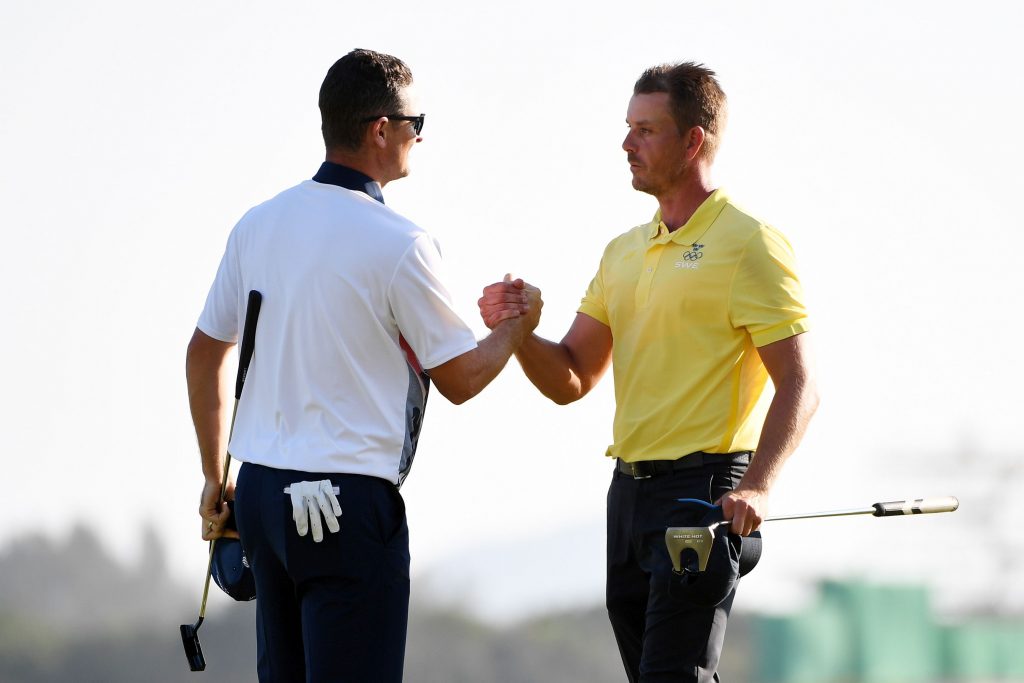
The 2020 edition was one of the most memorable in history with all three of Rio’s 2016 Olympic medalists, Justin Rose, Henrik Stenson and Matt Kuchar in attendance. Kuchar eventually took the title finishing on 18 under par to beat Justin Rose by three.
Ends.
Jeev Milkha Singh has revealed – in the latest My Time, in partnership with Rolex video – one of the biggest decisions of his golf career involved a phone call to his parents in the early 1990s.
While excelling on the golf team at Abilene Christian University in the United States he felt the call of the professional game but needed clearance from family HQ back in his hometown of Chandigarh, in India.
“Had to make a big call; picked up the phone and spoke to my parents,” says the Indian star, who turns 49 today.
“My dad said: ‘you know what, please go ahead, but don’t come back to me after five or 10 years and tell me you want to do something else’. They obviously gave me the right guidance.”
It was a wise move by Singh seeing as his father, Milkha Singh, is arguably India’s greatest sprinter and his mother, Nirmal Kaur, a former captain of the Indian women’s volleyball team.
“Actually we wanted to make him a doctor,” says Milkha Singh.
“He said: ‘no I want to play golf’. [I said] If you want to play golf then you have to work day and night. I want to see you number one in the world!”
While the young Singh didn’t quite reach that target he more than justified his decision to turn professional by winning the Asian Tour Order of Merit title twice, claiming five titles on the Asian Tour, and four on both the European Tour and Japan Golf Tour Organization.

171206-BANGKOK-THAILAND-Jeev Milkha Singh of India poses with his awards on 17 December 2006 at the UBS Asian Tour awards night. Singh won the UBS Asian Tour Order of Merit Award, the Players Player of the Year Award and the UBS Achievement Award, which were presented to him at the Mandarin Oritental Hotel Bangkok, Thailand. Picture by Paul Lakatos/UBS.
Singh was introduced to the game of golf at the age of nine by his father and later earned a golf scholarship in America after representing the Indian national team.
He says: “My inspiration growing up was my father. Lots of people in India said: ‘you come from the Milkha family, you have a lot of pressure’.”
He turned professional in 1993, never looked back and became the flag bearer for Indian golf.
“Everybody asked me: ‘hey, do you guys play golf in India?’. I said: ‘yes we do’, and they said: ‘oh, we didn’t know that’. And I said you know what, let’s show them that there are good golfers out of India,” adds Singh.
“But if I played in Italy I needed an Italian visa, or Spain a Spanish visa. And in France I needed one there. Some weeks I had to miss because I couldn’t get a visa in time. But nothing comes easy, you have to take it in your stride.”
He suffered a loss of form mid-way through his career but bounced back by winning the Volvo China Open in 2006.

Beijing, CHINA: India’s Jeev Mikkha Singh holds his trophy after claiming his maiden European Tour victory 16 April 2006, winning the 1.8-million USD Volvo China Open by one shot over Spain’s Gonzalo Fernandez-Castano. The 34-year-old Indian carded a two-under par 70 around the Nick Faldo-designed course at Beijing’s Honghua International Golf Club, to finish at 10 under par for the tournament. AFP PHOTO/Peter PARKS (Photo credit should read PETER PARKS/AFP via Getty Images)
“I had a fantastic start but then a dip for five or six years. In those five, six years I learned a lot.
I was going through a bad patch. I had not won a tournament from 2000 to 2006, so six years of drought. Golf is a game very close to human life becauase you go through the ups and downs. One week you are the best and the next you don’t even make the cut,” adds Singh.
“Took the plunge in 1993 and loved it ever since!”
Ends.
As Jeev Milkha Singh celebrates his 49th birthday today, let us look back at his illustrious career, highlighted by five Asian Tour wins and two Asian Tour Order of Merit titles, and find out what made him decide to take the plunge and turn professional in 1993.
Christmas came two weeks early for India’s Shiv Kapur in 2005. On this day, December 11, 15 years ago, he recorded a memorable victory in the Volvo Masters of Asia at Thai Country Club, in Bangkok. It was his first win in the professional game and followed a decorated amateur career. We spoke to Kapur about that breakthrough week, in a tournament which was the season-ending Tour Championship on the Asian Tour – for the elite top-60 players from the final Order of Merit.
For Shiv Kapur, simply making the field for the prestigious Volvo Masters of Asia at Thai Country Club at the very end of 2005 was enough of an achievement.
The then 23-year-old rookie had successfully negotiated the Asian Tour Qualifying School in January and after a slow start to the first half of year he found some momentum, nearly winning the Double A International in Thailand in November.
Another rising star at the time Thailand’s Chinnarat Phadungsil – a 17-year-old amateur – defeated him on the second hole of extra time, but it was an encouraging performance by the young Kapur.
Much was expected of the Indian star-in-the-making who had claimed the gold medal in the Asian Games in 2002 in Busan – amongst a plethora of amateur game achievements.

INDIA – JANUARY 05: Shiv Kapur, Golfer and the winner of the Volvo Masters of Asia 2005, poses and holds the Volvo Masters Trophy / Award at Delhi Golf Club, in Delhi, India. Potrait (Photo by Kalyan Chakravorty/The The India Today Group via Getty Images)
“I remember going into the week [at the Volvo Masters of Asia] being so pleased to make the Tour Championship in my opening season,” said Kapur, from his home in Dubai last week.
“Retaining my card was my primary goal. I remember I was locked in a race for Rookie of the Year with Andrew Buckle at the time. But I was just happy because back then the Volvo Masters of Asia was the Tour Championship and a goal for all of us to play in.
“I had watched it on TV and seen all my compatriots and friends play in it. I just thought if I can get into that field it would be a great way to end the season. And low and behold I put myself in contention.”
He started well in the event because as he says: “You know honestly, I was like a kid in a candy store, just happy to be there.”
Kapur fired a six-under-par 66 to share the lead on day one with Australia’s Buckle.
Then a 67 saw him hold the halfway lead by a shot from the defending champion Jyoti Randhawa, also from India.
And by the third round Kapur, after a 68, he found himself sharing the lead with Randhawa and Australian Marcus Both: on an impressive 15 under for the tournament.
Kapur was paired in the penultimate group with Thailand’s Chawalit Plaphol – as two balls were the order of the week.
“I remember the front nine on Sunday was steady stuff but nothing flash. Thoughts of victory were not really going through my head. I was a couple under through the front nine.
“From what I remember, standing on the 10th tee, I said to myself: “Now look, you have nothing to lose, you have had a great year and a great run, let’s just go for it, have some fun and play more aggressively and see if that is good enough. I wasn’t going to die wondering, I wasn’t playing for second place”.
He started to attack a few more flags, things started to go his way, and he holed a couple of putts.
Said Kapur: “I remember, very vividly, standing on the 18th tee, with a one-shot lead. The only thing I was thinking was good rhythm, good rhythm, on my tee shot. I was just trying to find the fairway. To me it felt like I made a really slow swing but it just came out perfectly up the left side of the fairway with a bit of cut in the middle.

“I was so pumped up on my second shot; I had 170 or 175 yards and back then for me that would have been a six iron and I just told my caddie just give me the seven iron because I could feel the adrenaline pumping through me. I hit the absolute perfect shot 15 feet right of the flag, because it was a back left pin. But I hit it so good, I hit it through the back of the green. And when I got up there I said just two putt this and when I stood over the putt, just as I was about to putt, I thought it will be pretty cool to hole this, but to be fair I was trying to two putt, but it went in!”
He followed that up with a big fist pump, and gave his caddie a massive hug.
“The rest I don’t remember, I remember I had to wait for Jyoti to finish. I remember it showing 20 under on the leaderboard and at the start of the week when we walked into the clubhouse and we saw Tiger Wood’s scoring record [20 under] when he played the Asian Honda Classic in 1997 I thought wow if I can match Tiger on this course then you have done alright.”
Kapur said that although being stress free that week the only thing on his mind was the Rookie of the Year title.
“I knew the only way for me to win that, was to win the tournament. It is just one of those things when it is your week and a lot of things go your way,” added the Indian star.
The victory also opened up many doors for him. It got him into a World Golf Championship (WGC) event, and the Sony Open in Hawaii.
“It was the perfect spring board. In golf, one week can change your life, and literally that was the one week for me I think. And I started to get good pairings after that and in the co sanction events I was paired with the best players in the world. This is what I dreamed of as an amateur.”
Last year Kapur nearly pulled off another victory at Thai Country Club at the Thailand Open but lost to American John Catlin in a play-off.

“Thai Country Club has been my happy hunting ground. If I could pick a course to play every single year it would have to be that,” added Kapur.
There was, however, one blemish to his Volvo Masters of Asia week all those years ago.
He “mislaid” the Rookie of the Year Award on the Sunday night after the end of year Awards ceremony. The champagne was flowing and the celebrations lasted long into the night, so it was an understandable mishap for a young player who had just broken through into the big time – on his way to becoming one of his country’s greatest golfers.
Ends.

Sentosa, Singapore, December 9: Four of Asia’s most-exceptional golfing venues – Horizon Hills Golf & Country Club in Malaysia, Laguna Golf Lăng Cô in Vietnam, Sapporo Country Club and The North Country Golf Club, both in Japan – have become part of Asian Tour Destinations.
All four are award-winning venues, with a history of hosting world-class tournaments, and join a select group of members at Asian Tour Destinations – which is an exclusive network of elite golf clubs with direct ties to the Asian Tour.
Earlier this year Black Mountain Golf Club in Hua Hin, Thailand; Classic Golf & Country Club in New Delhi, India; and Kota Permai Golf & Country Club in Kuala Lumpur, Malaysia, became part of the emerging network.
They joined Sentosa Golf Club in Singapore – which was the first golf club to sign-up in 2015.
Cho Minn Thant, Commissioner and CEO of the Asian Tour, said: “Asian Tour Destinations is flourishing and now boasts eight of the finest golf clubs in the Asia-Pacific region. The Asian Tour is delighted to welcome the latest additions to this exclusive membership body.
“The main objective of Asian Tour Destinations is to provide an affiliate membership programme between the associated venues and the Asian Tour – which will drive sustainable growth and development for the betterment of golf in our region as a whole.”

Johor Bahru, Malaysia:January 23: Pictured during the HORIZON HILLS MEDIA GOLF 2019 at Horizon Hills Golf & Country Club,Johor Bahru, Malaysia. (Photo by Mike Casper / MYPHOTO2U )
Horizon Hills is one of the great golfing facilities in southern Malaysia and has hosted three Iskandar Johor Opens: Ireland’s Padraig Harrington won the event in 2010, Dutchman Joost Luiten was the winner in 2011, while Spaniard Sergio Garcia triumphed the following year.
“Within a short space of time, since our opening in 2008, Horizon Hills Golf & Country Club has become a household name in the regional golf industry,” said Tang Meng Loon, Director, Club, Townships & Property Management, Horizon Hills.
“It was therefore a logical step for us to become part of Asian Tour Destinations – which is a platform that will allow us to further build our brand in the region and beyond.”
Laguna Lăng Cô Resort boasts the distinction of having Sir Nick Faldo’s first Signature Design open for play and it is the home of the Faldo Series Asia Grand Final – which is hosted by Sir Nick himself every year. The Asian Tour has been a long-time supporter of the Faldo Series, which has helped to grow the game of golf globally. Laguna Lăng Cô is an integrated golf and beach resort and is part of the Banyan Tree Group. It is the first golf course in Vietnam to be Earth Check Gold Certified.

Laguna Golf Lăng Cô
Said Adam Calver, Director of Golf, Laguna Golf Lăng Cô: “Vietnam continues to be at the forefront of golf expansion and development in the region and we are very proud that Laguna Golf Lăng Cô is a contributor in this evolution. We appreciate the work the Asian Tour continues to do to grow the game here and Asian Tour Destinations is a perfect fit for us and supports our resorts future plans and ambitions.”
Sapporo Country Club and The North Country Golf Club, in Hokkaido, are the first golf clubs from Japan to join the Asian Tour Destinations fold.
“This is an exciting development for Sapporo Country Club: to align ourselves with the Asian Tour Destination programme. And to have the opportunity to network and exchange ideas with some of the other premier golfing venues in Asia will prove invaluable,” said Yamazaki Shigeki, President, Sapporo Country Club.

Sapporo Golf Club – Takino Country Club
The North Country Golf Club has been the home of The Shigeo Nagashima Invitational Sega Sammy Cup on the Japan Golf Tour Organization (JGTO) since 2005.
And their championship course was designed by Japan legend Isao Aoki – the winner of 51 titles on the JGTO and the first player from Japan to win on the PGA Tour, at the Hawaiian Open in 1983
Said Yasuhiro Ota from The North Country Golf Club: “The North Country Golf Club is proud of its long association with The Shigeo Nagashima Invitational Sega Sammy Cup – which demonstrates the club’s desire to connect with the game of golf at the highest level. Our involvement with Asian Tour Destinations provides us with a similar pathway for us to improve and reach the highest standards, operationally and commercially.”

The North Country Golf Club
Being a part of the Asian Tour Destinations network means that each venue is certified Tour calibre and operates a comprehensive range of facilities and services to their members and guests under tournament-ready conditions all-year round.
Among the core benefits, Asian Tour members will be able to play and practice at each venue, allowing for the members at each club to enjoy direct engagement with the region’s best golfers.
Ends.
The R&A confirmed that The 151st Open will be played at Royal Liverpool from July 16-23, 2023 and The 152nd Open will be played at Royal Troon from July 14-21,2024.
The Championships have been rescheduled following the cancellation of The 149th Open at Royal St George’s this year due to the COVID-19 pandemic. The Open will be played at the famous Kent links from 11-18 July 2021.
Martin Slumbers, Chief Executive of The R&A, said, “We have been working closely with Royal Liverpool and Royal Troon and the relevant local agencies to reschedule the Championships.
“We are grateful to everyone involved at the clubs and at our partner organisations for supporting our plans and showing flexibility to adapt their own schedules. We can now look forward to seeing the world’s best players competing at these outstanding links courses in 2023 and 2024.”
Michael Johnson, Captain of Royal Liverpool Golf Club, said, “Without doubt the golfing world greatly anticipates the return of The Open after the hiatus of 2020 and Royal Liverpool Golf Club is delighted to fit into the revised schedule alongside our friends at Royal Troon. We must thank The R&A for its continued support and look forward to welcoming competitors and spectators alike to Hoylake in 2023.”
Desmond Bancewicz, Captain of Royal Troon Golf Club, said, “Following the most unusual circumstances this year, affecting all our lives, Royal Troon Golf Club looks forward with eager anticipation in hosting The Open in 2024 for a 10th time and sends their very best wishes to The R&A and Royal St George’s Golf Club for 2021.”
This will be the 13th time the Championship has been staged at Royal Liverpool and the first since Rory McIlroy lifted the Claret Jug there in 2014.
The Open will return to Royal Troon for the 10th time following Henrik Stenson’s memorable final round duel with Phil Mickelson before claiming victory in 2016.
Future venues:

You just know a Q&A with Hong Kong’s Dominique Boulet is going to be a great read. The popular and affable golfer played on the Asian Tour for over a decade; and he was an amateur star, earning a golf scholarship at the prestigious Northwestern University having also represented Hong Kong in the Eisenhower Trophy. Now a highly respected golf commentator and key figure on the Board of the Asian Tour, we spoke to Dom in Hong Kong and opened his treasure trove of stories.
1. It has been a difficult year. How has it been for you? What have you been up to?
Yes, like everybody it has been a difficult year. Certainly work wise: I have not worked since January, my last event was the SMBC Singapore Open. And my mother passed away very suddenly in February in the UK, so I was back there for a few weeks – which is why I missed the Bandar Malaysian Open.
But it’s also been nice because I have been at home most of the time – I can’t remember the last time I was at home for such an extended period, it must be 30 or 40 years since that happened. So I am spending time with my wife and son. We went to the UK for two months because my son turned 18 and he finished high school. He was starting university in London at Queen Mary University. So we went back to the UK at the beginning of August to get him ready but of course it’s all online now so he ended up flying back with us to Hong Kong and he is studying from here – which is a bit tragic for him.
I have also been playing a bit of golf with my mates at the Hong Kong Golf Club, so it’s all been a mixed blessing. I also went to Scotland for a week and we played Carnoustie, Western Gailes, Gleneagles and had a tee-time on the Old Course but we got rained off that day. And a couple of rounds at Blairgowrie. I just love Scotland.
2. You have enjoyed a highly-successful career in broadcast for nearly two decades. What do you enjoy about it the most?
I just feel I am really lucky. I watch golf and talk about it for a living, and I would be doing that anyway. I am lucky to have landed a job that is my passion. And the people I work with have been great. I have met a lot of guys I never thought I would get a chance to work with. Guys like Alan Wilkins, Julian Tutt, Dougie Donnelly, Tony Johnstone and Dale Hayes. These are people I used to listen to and enjoy listening to and now I get to work with so many of them. And I have enjoyed working with Richard Kaufman, Anthony Kang and many others. Also, I get to watch world class golf. It’s been great.
I have never been nervous about it; I was a lot more nervous playing golf than commentating. I know the game, I study it, I am passionate about it, I read about it all the time, so I am prepared in the sense that nothing will really surprise me.

Dominique Boulet (left) with fellow commentator Richard Kaufman.
3. How did you get into broadcast and what was the first event you commentated on?
It was back in 2005. Derek Fung was doing commentary but could not make it to one of them. It was the BMW Asian Open at Tomson Shanghai Pudong. I think that was the first one and I worked with Alan Wilkins who was an absolute delight to work with. He was the best guy I could have learned from. He was fantastic and did not take it too seriously. And then I just went on from there, I have done it for 15 years now. I haven’t counted how many events I have done but it must be 200 or 300.
4. Which have been the most memorable events you have commentated on? Any stand out moments in history?
Obviously the Hong Kong Open is close to my heart and there have been some fantastic moments there. The Rory McIlroy and Lin Wen-tang playoff in 2008 and when Rory won in 2011 I was actually on course following him. I love being on course, I don’t do it very often but for some reason I was on course that week and there’s Rory playing beautifully and I am calling the shots, up close and personal, that was a highlight. And I always love it when our Asian Tour players do well, like when Angelo Que and Scott Hend were in the play-off in 2014, and when Prom [Meesawat] played well in 2013.
And when Anthony [Kang] won in Malaysia [Malaysian Open] in 2009 that was so exciting. When our members from the Asian Tour are in contention, in the big tournaments, and playing great, they are the ones I enjoy the most.
5. You played on the Asian Tour for many years. Do you miss those days and what did you enjoy the most?
Playing on the Asian Tour was fantastic. The camaraderie was amazing – you hear that from so many players, and it’s true. The guys who have gone onto bigger Tours, in Europe or the PGA Tour, they all say their playing days in Asia were fantastic.
I remember those bus rides back from the course and you had 30 players on the bus, you had the Indians, the Americans, the Taiwanese, everyone was there and they were all chatting, all telling stories of their rounds
And sitting around a table at night in a remote place where everyone is staying, like Sunrise Golf & Country Club in Taiwan for instance. The stories that were flying around, the incidents that occurred, it was just a memorable time.
It was our career and we took it seriously, but we had our moments when we relaxed, like on Sunday nights and travel days on Monday, and even Tuesday’s sometimes …
I miss those days but I certainly don’t miss playing poorly. Those runs when you are playing poorly and you felt bad about yourself. You question yourself, even your self-esteem because you feel like your golf is defining you. I don’t miss those days but when you were playing well there was nothing better. And we really weren’t playing for that much money back then; we were just covering costs but it was a great way to live a life.

27 Sep 2001: Dominique Boulet of Hong Kong in action during the first day of the Davidoff Nations Cup held at the Royal Selangor Golf Club, Kuala Lumpur, Malaysia. DIGITAL IMAGE Mandatory Credit: Stanley Chou/ALLSPORT
6. Best ever funny story about life on Tour?
My funniest ever moment was actually in college. I was playing with an Italian-American guy called Marty Caifano. Marty was deaf, he had to wear hearing aids, he was pretty hearing impaired. We were playing a practice round, and this road was running beside the hole and there was an ambulance driving by with the siren on and Marty is standing on the green tapping his hearing aid – as he thinks the battery is out and it’s beeping. I said: “Marty it’s not your hearing aid, it’s the ambulance mate, it’s the siren”. Well he starts laughing so hard that he starts stumbling backwards and falls back into a bunker! Unbelievable. So many things have happened on the golf course but that was one of the funniest.
7. You had your chances to win. Which were the ones that got away?
My best finish was fourth; six or seven times I finished fourth. I had chances coming into the back nine on Sunday but did I feel I was right in it with a hole or two to play? Maybe in Dubai one year, when I was fourth. I had the 36-hole lead there. At Hong Kong Open I finished fourth in 1996 but I shot 65 on the last day. I had some good finishes in Taiwan and Korea. What I have really learned in commentary is how fragile and undisciplined I was on the golf course. I had no patience. I just didn’t have the mental capacity to play this game and it’s still the same to this day. We had a tournament at the Hong Kong Golf Club – a two-day event for some professionals and amateurs and juniors. And even then, the amount of shots I gave away through bad discipline and no patience. I am 55 years old and I still can’t control my emotions on the course!
I observe these top guys now and you can see their patience and discipline is at an extraordinary level. They don’t fire at the pins all the time. Tiger Woods for examples fires at the fewest pins and yet he has the most game. It takes something I don’t have, I don’t possess.

DOMINIQUE BOULET, HK GOLF PLAYER, AT THE TRAINING SESSION OF THE PGA CHAMPIONSHIP. 10 JAN 96 (Photo by MARTIN CHAN/South China Morning Post via Getty Images)
8. What are the biggest changes you have seen on the Asian Tour over the years?
I think how disciplined the players are. They have taken it up another level professionally. Guys are working out and training really hard. I am talking about the Asian Tour in particular. They have very few off days when on the road. In general 98% of the players are doing everything they can to try and get to the next level.
From a tournament perspective, there is a lot more live television than when we played. We had highlight shows and a few live events but now we have 10 to 15 live events per year.
And tournaments are just better run, courses are in better shape.
9. You are on the Board of the Asian Tour. What are your hopes for the Tour in the future?
In the immediate future I hope we get back playing again. Hopefully at the start of next year. That is the plan. So much is out of our control. Cho [Cho Minn Thant, Commissioner and Chief Executive Officer, Asian Tour] and his team are doing a great job, working really hard to try and get the Tour up and running. Ours it probably the most international Tour, along with Europe, so it’s hard with the travel restrictions. It is a shame because before lockdown, we were getting a lot of momentum.
I would just like to see a healthy, 30 to 35 event schedule. I think that is ideal. Playing for minimum purses of at least US$500,000 – so guys have a good opportunity to make a living to develop their games. And we were not far away from 30 events before the pandemic.
10. You enjoyed a great amateur career and played at Northwestern University. What was that experience like?
It was fantastic. The first time I stepped foot on American soil was September 1985 when I was starting college. I went there with one suitcase and a set of golf clubs.
Before that, in Hong Kong, I had been working for a fella called Peter Stevenson – a very successful businessman, who also handled Ram Golf there. He went to Chicago on business and he passed my resume to Ram and Wally Goodwin, the coach at Northwestern at the time (Goodwin later became coach at Stanford when Tiger Woods was there). Wally called me, we had a one-hour chat on the phone in early 1985, and he asked me a bunch of questions. By then I had won the Hong Kong closed and open amateur titles. And he asked me how far I hit my three iron and I think I said about 190 yards, I still remember parts of that conversation. I had to send in my O and A Level results from England, and he wrote a few weeks later and said: “if you want to come, I have a scholarship for you”.

Dominique Boulet (middle) with his team mates at the Northwestern University back in the 1980s.
It was very exciting to be in America, I couldn’t believe how cold Chicago is. It’s brutal. I thought England was cold but it’s not even close. It was artic. So there was not much golf in the winter. But people mistakenly think all you do is play golf on a golf scholarship but you have to go and take classes and get your degree, like every other student there. There was a lot of work to be done and Northwestern is a very good school. I made a lot of good friends, Fran Quinn [two-time Asian Tour winner] being one of them. Fran was on the team with me. And I used to spend the summers with him and his family. It was great, it is an experience I cherish.
Thailand’s Prom Meesawat, a two-time winner on the Asian Tour, says he is “happy to be alive” after having to endure a nightmare few weeks last month suffering from a ruptured appendix.
A video of him on social media a few days ago walking tentatively and gingerly in a swimming pool tells part of the story, fortunately the tail end of it.

CHACHOENGSAO -THAILAND – Prom Meesawat of Thailand pictured on Friday November 8, 2019 during round two of the Thailand Open at the Thai Country Club, Chachoengsao, Thailand. The USD$ 300.000 event is an Asian Tour event, November 7-10, 2019. Picture by Paul Lakatos/Asian Tour.
On October 15, he had a surgery to fix the problem, but it was by no means routine.
“I was playing golf with all the boys last month. And in the afternoon I was going to the gym but my stomach started feeling uncomfortable,” says Prom – whose famous father Suthep was the first Thai to win the Thailand Open in 1991.
“And then I went to the hospital in the evening on Sunday, just to see the doctor and he gave me some medicine to try and help the pain. The next day I am still going to play golf but I could only play six holes because it was so painful and I lost my energy.
“I almost could not drive back. So I rested in the locker room. Then I drove to Synphaet Hospital in Bangkok. The same doctor gave me ultrasound and gave me a thorough check up. I was admitted for two days but they could not see anything unusual from the ultrasound result.”
He stayed for another two nights, went home for two days but it was still painful, so he went back to the hospital again on Thursday. The doctor suggested a CT scan which revealed a rupture appendix.
“Then I had surgery on that night on October 15. I haven’t touched the golf club in over a month now as I need to recover first. It has been a month and half and Tuesday was my first day walking in the pool. I am alright now, no pain. It’s just the core muscle where I felt a little bit of pinching on that spot,” he added.

PORTRUSH, NORTHERN IRELAND – JULY 16: Prom Meesawat of Thailand plays a shot during a practice round prior to the 148th Open Championship held on the Dunluce Links at Royal Portrush Golf Club on July 16, 2019 in Portrush, United Kingdom. (Photo by Stuart Franklin/Getty Images)
The 36-year-old explained it was very painful and after reading about it he didn’t realize it was life threatening because it was ruptured.
Next month he is going to start work on strength condition with his trainer but not work on the core area.
“What made this difficult was that it just felt uncomfortable in front of my stomach. It was not right at the spot where the appendix is. So that is why the doctor could not tell what happened with me. Even when they touched or pushed on the appendix spot there was no pain. It was a very difficult case.”
It took almost a week to find out it was appendicitis. And they did not know it was ruptured, which could have cost his life.
“I didn’t expect it was going to be an appendix problem. The doctor said we can do surgery tonight or tomorrow, I said no! Do it straight away. No, don’t wait! I am glad I am still alive,” added the Thai star.
He says the plan right now is to start walking in the pool and see if he can do some short game work.
“I have to get my body flexible to help the wound. We don’t know how the wound is inside. I am going to start slowly and not try to force it. I am a professional and I need to take care of my body really well. If the Tour starts in January, I might have to miss the first couple.”
Prom won the Singha Pattaya Open earlier in August for a record fourth time on the All Thailand Golf Tour and was in fine form before he fell ill.
“It all happened very quickly. We weren’t prepared for that. My wife took very good care of me despite having to take care of two kids. It is good that the hospital was close to my house – only five mins away. That was perfect,” Prom added.

Prom with his kids.
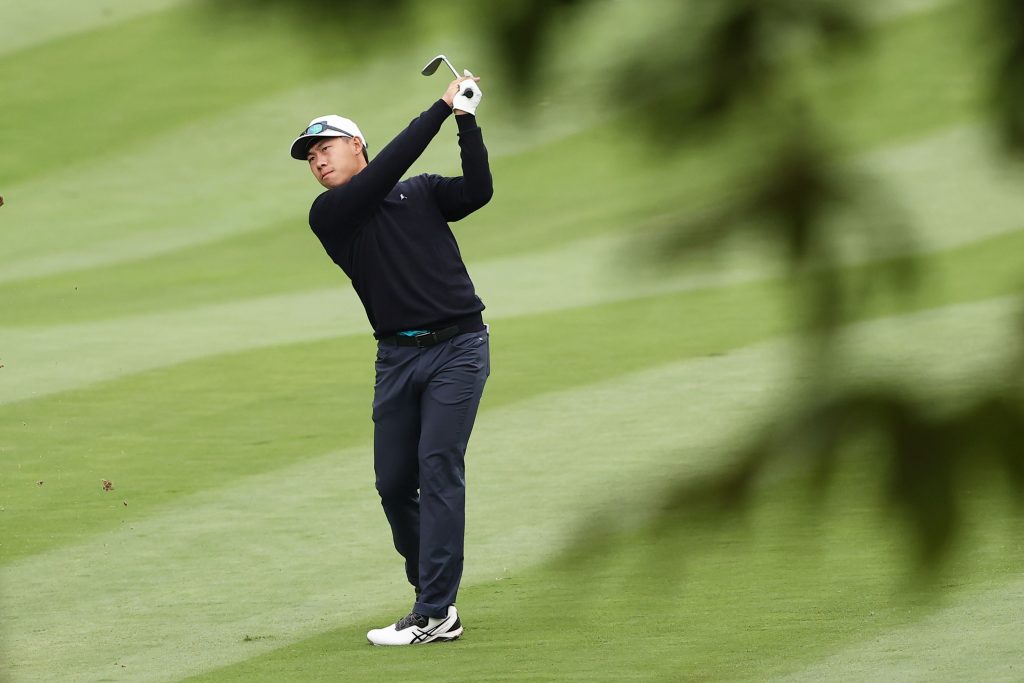
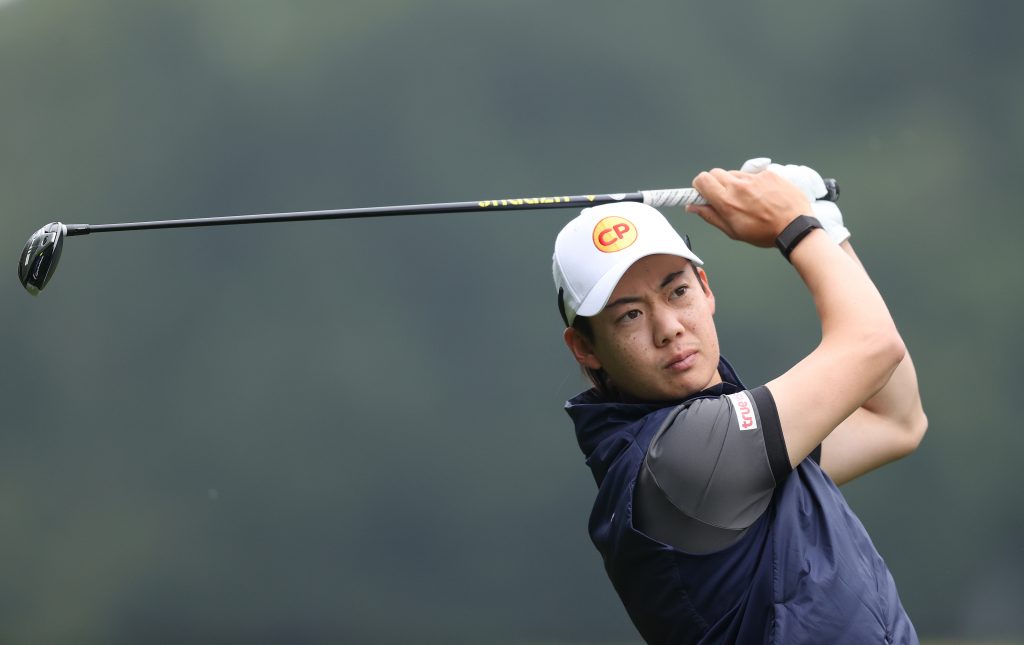
The Asian Development Tour is a strong and emerging secondary Tour, with its own identity and an impressive schedule, rich with events. It has also become a conveyor belt of stars-in-the-making, and of course it’s a circuit that the Tour’s membership cannot wait to play once the ‘new normal’ is resumed post COVID-19. We spoke to some of its best-known graduates about how important the Tour has been for their careers.

Joohyung Kim of Korea
When Korean Joohyung Kim earned a remarkable ‘battlefield promotion’ to the Asian Tour last year thanks to three brilliant victories on the Asian Development Tour (ADT) it meant the region was excited and proud to have discovered another young and prodigious talent.
But, perhaps, more important than that was the fact that the ADT had once again served its purpose and met its objectives.
Launched in 2010, the ADT is the region’s secondary circuit that runs parallel and in unison with the Asian Tour – providing opportunities for up-and-coming players, not just from Asia but from all over the world.
It is a feeder tour, a supporting tour, a stepping stone tour that gives even the most talented golfers the one thing they are not born with: that all important element called experience.
The top-seven players on the ADT Order of Merit at the end of the season earn their Asian Tour cards plus all events receive Official World Golf Ranking points – both magnet-like attractions for players just starting out.
And, last year the ADT boasted 19 events with a total purse of US$1.74 million while it was in 2015 that the Tour enjoyed its finest year-to-date with a record 28 tournaments boasting overall prizemoney of US$2.2 million.
Kim, now aged 18 but 17 when he completed his hat-trick, is the most recent high-profile graduate who this year went on to play in his maiden Major – the US PGA Championship – and his first PGA Tour event.
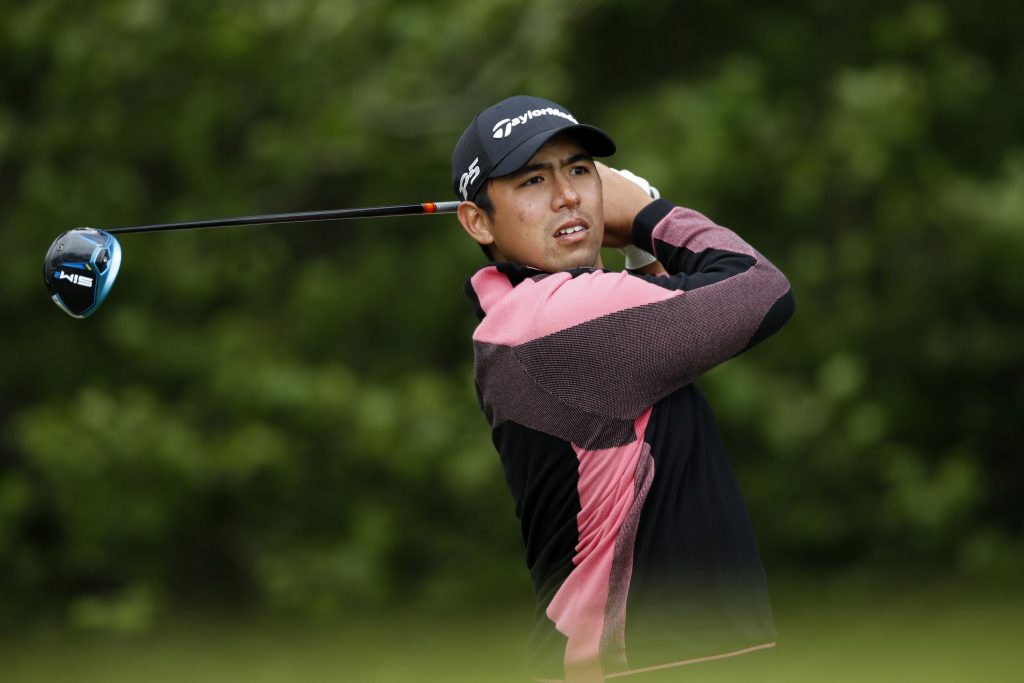
But there have been many players who have successfully emerged from the ADT and perhaps the best known is American John Catlin – who sensationally claimed two titles on the European Tour in September this year: the Estrella Damm N.A. Andalucía Masters and the Dubai Duty Free Irish Open.

John Catlin of USA
“The year I played [2016], I played 22 events, they were all four rounds, they are Official World Golf Ranking events, and you are playing against good golfers and you have to go out and shoot good numbers to win tournaments,” says Catlin.
The Californian did just that, winning the Combiphar Golf Invitational in Indonesia on the ADT in 2016 – his first Tour title. And, he also claimed the PGM EurAsia Perak Championship in Malaysia, on the same tour, the following year.
At that time the top-five on the ADT Order of Merit earned their Asian Tour card.
Says Catlin: “I think playing that many tournaments and having to finish top five, when I was playing, to earn my Asian Tour card, it was a great experience for me and gave me confidence. It was top-five on ADT, then top-60 on Asian Tour and then top-110 on the European Tour – it was all stepping stones. But to have accomplished that first stepping stone gave me a lot of confidence to accomplish the second one and so on and so forth.”
He says it also taught him how to win.
“Winning is not easy, any Tour you play on you have to play very good golf. Winning those two events on the ADT was a huge boost and gave me the confidence to win on the main Tour, especially that first win [on the Asian Tour] at the Asian Pacific Classic in China. I was able to draw on those previous wins,” added the American.
“The opportunity that the ADT gave me was very, very big.”
Catlin explains that it was his coach Noah Montgomery who first suggested he play in Asia.
“It wasn’t an avenue I had considered,” he explains.
“As I looked into it and saw the opportunities and saw some of the success stories and guys like Cameron Smith, Kiradech [Aphibarnrat], Anirban [Lahiri], the list goes on and on. There are so many success stories about Asian Tour players who have moved onto the European Tour and PGA Tour. I saw it as a great opportunity and I saw the cost effectiveness of it.”
He went on to win four times on the Asian Tour, including three in 2018 – when he was voted the Asian Tour’s Players’ Player of the Year.
But he is quick to acknowledge that life was difficult in the early days, as it is for all rookies.
“The hardest part, if you don’t have unlimited funds, is to find a place to play where you can develop your game in order to become a better golfer and not break your budget.
“And that is what is great about the ADT, they make it affordable for guys, entry fees are US$50, caddie fees aren’t outrageous, you can find a reasonably priced hotel, food is reasonably cheap, and with the same amount of money you can play one year in America, you can play two or three on the ADT.”
Catlin, who based himself in Hua Hin, Thailand, while playing in Asia, finished second in the Boonchu Ruangkit Championship in January – which was the only ADT event played this year before the coronavirus pandemic.
The main who beat him was Thailand’s Pavit Tangkamolprasert – who, thanks to the victory, became the most successful player in ADT history with seven wins.

Pavit Tangkamolprasert of Thailand
Pavit is a two-time winner on the Asian Tour but he mastered his craft on the ADT – particularly in 2014, when he triumphed four times and lifted the Order of Merit title.
“I respect the ADT very much, it is a Tour that is only getting stronger. I got into the Asian Tour through this tour and will always recognize that,” said Pavit.
“The ADT gave me an opportunity to develop my game to this level. I had so much experience during the journey and I appreciate being part of both the development tour and main tour. The experience of the development tour helps me to keep my game at a high level. It [the ADT] is an experience that everyone needs to try, it is a quality tour.”
Rising Indonesian star Danny Masrin was starting to play some of the finest golf of his career at the end last year and beginning of this season and says his time on the ADT has played a big part in his development.
“When I first came out I remember when the cut line was typically over par, but as I spent my time there it quickly became that if you weren’t under par you probably were not going to make the cut. I definitely think that the quality of players has significantly gotten better every year. I mean we are seeing ADT players winning AT events which is great and says a lot about the ADT,” says Masrin.
“I think also especially starting out as a professional the key is trying to get as many four round events as you can by playing the weekend. The ADT was a good developing ground to feel comfortable with four days of tournament golf. I would say a lot of the courses were very scoreable which gave us confidence when it was time to play Asian Tour events when we got the opportunity.”

Danny Masrin of Indonesia
Another crucial part of the success of the ADT is the relationships it has built with the domestic circuits that it jointly-sanctions events with, as well as local promoters.
The ADT hosts regular events with The PGM in Malaysia, the Professional Golf Tour of Indonesia, the All Thailand Golf Tour and Taiwan PGA and has also held events in Bangladesh, Brunei and Pakistan in the past.
It is a coming together of the major stakeholders of golf in Asia that will serve the ADT well long into the future.
Ends.
Myanmar’s Kyi Hla Han and Zaw Moe, past winners of Singapore’s National Open, enjoyed the privilege of playing the newly-renovated Serapong course at Sentosa Golf Club last week and as expected, they were full of praise for the famous layout.
Han, a former Asian Tour number one and winner of the Singapore Open in 1994, and Moe – the 1997 Singapore Open champion – were invited by the club to play the course during its soft opening.
They were joined in their group by Cho Minn Thant, Commissioner & Chief Executive Officer of the Asian Tour, and Australian Unho Park – a 20-year veteran of the Tour, who is now a key part of its’ administrative team.

From left: Zaw Moe, Unho Park, Cho Minn Thant and Kyi Hla Han.
The Serapong, voted by the players on the Asian Tour as the ‘Best Golf Course on Tour’ last year, had been closed since March as it underwent extensive renovations.
The soft opening was held on Friday and saw all the members of staff who worked on the course get to play it for the first time before the official opening on Saturday.
Changes have been made to the bunkers – which now have creative, artistic serrated edges – fairways, and tee boxes.
“The renovations are great!” said Han, a former Commissioner of the Asian Tour.
“The fairways and greens are fantastic, and the bunkers are also excellent. There was a course I was working on in Mandalay, in Myanmar, which has classic bunkers with rough edges which give the course a more classic look. So the changes to the bunkers here at Sentosa are similar – I think it is a wonderful design element, and something that appeals to me as a course designer, the more classic, older look.
“The Serapong has always stood up so well to the players in the Singapore Open – the scores are not too low. It is a tough course from the back tees. It is playing too long for me now! I need to play a shorter course.”
![]()
Zaw was equally impressed.
“The course looks fantastic. The fairways are really good, they have just one type of grass, as opposed to different types,” said Zaw, who played with great success on both the Asian Tour and Japan Golf Tour Organization.
“For me the course looks the same but it is the condition that is really noticeable. The course looks neat and extremely well presented as always. And of course you can really see the new shaping around the bunkers – very distinctive.”
The Asian Tour is headquartered at Sentosa Golf Club, so Cho was also delighted to have the chance to play the course.
“The Serapong has always been one of the highest acclaimed courses on the Asian Tour. They [Sentosa] have really outdone themselves in what they have done to the course over the last nine months,” said Cho.
“The condition of the golf course is excellent. They have made the bunkers a bit trickier, the sand is great, the fairways are looking immaculate, and the greens are rolling great so there’s not much more we can ask for.
“There is no real one thing that stands out. I feel it’s one of those courses that doesn’t have a signature hole because the whole golf course is memorable, and the finer details have been done really well.
“It is remarkable for the members to give up their golf course during this pandemic period where a lot of people were actually playing golf, it’s incredible they could have the patience and the foresight to do that. It is going to pay dividends in the long run.”
Ends.
Singapore’s finest has officially reopened having been closed since March for renovation works.
Sentosa Golf Club has today officially reopened its world-class state-of-the-art championship course, The Serapong, after it underwent an extensive renovation in March to maintain its immaculate conditioning and playing standards.
The renovations are headlined by a new bunkering style with creative, artistic serrated edges to enhance The Serapong’s character and overall strategy, whilst elevating the course to a new level on the world stage. The club used 6,000 tonnes of new sand during the renovations to reinstate consistency, texture and tournament ready compaction for improved playability.
Modifications have also helped to enhance and preserve the personality of many of The Serapong’s iconic holes, including the signature 5th hole, which overlooks metropolitan Singapore and its bustling port.
The Serapong’s iconic 5th hole has seen extensive renovations to its bunkers.
Masterminded by Andrew Johnston, the club’s General Manager, Director of Agronomy and resident Golf Course Designer, The Serapong has been closed since March and, alongside the new bunkering, a number of other key course upgrades were implemented during that time.
These included the re-grassing of fairways, rejuvenating them with minor grading adjustments and improved drainage strategies, as well as modifying the greens soil profile by introducing new carbon technology to boost soil chemistry and profile structure.
Enhancements to the greens are set to make The Serapong’s putting surfaces even better, which is hard to believe given the wide acclaim they already receive from its members, guests and visiting Tour Professionals.
Finally, the renovations also paid close attention to the re-levelling of all tee boxes, reinstating them with the historic tabletop flat finish The Serapong is renowned for. It will enable the club to continue to maintain the tees at a super low mowing height of 3mm, improving the quality of the playing experience for members and guests.

The 14th hole on The Serapong.
Speaking ahead of The Serapong’s reopening, which is a soft launch ahead of a grand reopening next March, Andrew Johnston said: “The last time The Serapong was renovated was nearly 14 years ago and since then the course has grown to become one of the world’s best, picking up multiple accolades in the process. Despite the challenges presented by the worldwide pandemic, we have found a way to pull the Sentosa family together within the safe working restrictions to complete the works. This has been a very exciting project that was well overdue, and we are confident the changes implemented will only enhance the golfing experience for our members and guests.
“Being located in a sub-tropical climate means the golf course ages faster than an ordinary one, and these renovations are crucial to maintaining the quality of the playing surfaces, as well as the conditions and high-standards that we pride ourselves on here at Sentosa, 365 days of the year.”
Dominic Wall – Director – Asia-Pacific at The R&A, commented: “The newly renovated Serapong looks great, and continues to showcase why Sentosa Golf Club is one of the world’s leading golfing venues. It is fantastic to see that, throughout the entire process of the renovations, the project continued to align with the club’s ground-breaking sustainability agenda. With our Asia-Pacific headquarters located at the club, we look forward to seeing Sentosa’s members and guests back out on the fairways taking on The Serapong’s unique challenge.”
Cho Minn Thant, Commissioner & Chief Executive Officer at The Asian Tour, added: “The renovations undertaken on The Serapong by the team at Sentosa have been nothing short of breath-taking. The renovations have enabled The Serapong to retain its unique personality and characteristics that made it one of the world’s top golf courses, as well as the best golf course in Singapore. With the course now reopening to members, we are looking forward to welcoming back Asia’s best players next year to battle it out at the SMBC Singapore Open.”
The Serapong was originally designed by the world-famous golf course design firm Golf Plan and Ronald Fream, opening in 1982. The course was further renovated in 2006 by the Bates Golf Design Group, who were led at the time by their VP of Design and Construction, Andrew Johnston, and whose designs have seen the course’s trademark contours, extended stone-lined lakes and breath-taking Singapore harbour backdrop become renowned across the world.
It was recently voted ‘Singapore’s Best Golf Course’ for the second year in a row at the World Golf Awards back in October and finds itself regularly listed as one of the world’s greatest golf courses.

SINGAPORE- Jazz Janewattanananond of Thailand pictured with the winner’s trophy on Sunday January 19, 2019 after the final round of the SMBC Singapore Open at the Sentosa Golf Club, Singapore. The USD$ 1 Million event is co- sanctioned with the Asian Tour and Japan Tour. Picture by Paul Lakatos/Lagardére Sports.
The Serapong has played host to the Singapore Open since 2005 (initially Barclays Singapore Open, then SMBC Singapore Open from 2015), welcoming some of the world’s finest players such as 2005, 2006 and 2010 winner Adam Scott, 2018 winner Sergio Garcia and rising Asian star Jazz Janewattananond, who captured the title in 2019.
The 2020 edition was one of the most memorable in history with all three of Rio’s 2016 Olympic medalists, Justin Rose, Henrik Stenson and Matt Kuchar in attendance. Kuchar eventually took the title finishing on 18 under par to beat Justin Rose by three.
Ends.
Jeev Milkha Singh reveals that one of the biggest decisions of his golf career involved a phone call to his parents in the early 1990s.
Jeev Milkha Singh has revealed – in the latest My Time, in partnership with Rolex video – one of the biggest decisions of his golf career involved a phone call to his parents in the early 1990s.
While excelling on the golf team at Abilene Christian University in the United States he felt the call of the professional game but needed clearance from family HQ back in his hometown of Chandigarh, in India.
“Had to make a big call; picked up the phone and spoke to my parents,” says the Indian star, who turns 49 today.
“My dad said: ‘you know what, please go ahead, but don’t come back to me after five or 10 years and tell me you want to do something else’. They obviously gave me the right guidance.”
It was a wise move by Singh seeing as his father, Milkha Singh, is arguably India’s greatest sprinter and his mother, Nirmal Kaur, a former captain of the Indian women’s volleyball team.
“Actually we wanted to make him a doctor,” says Milkha Singh.
“He said: ‘no I want to play golf’. [I said] If you want to play golf then you have to work day and night. I want to see you number one in the world!”
While the young Singh didn’t quite reach that target he more than justified his decision to turn professional by winning the Asian Tour Order of Merit title twice, claiming five titles on the Asian Tour, and four on both the European Tour and Japan Golf Tour Organization.

171206-BANGKOK-THAILAND-Jeev Milkha Singh of India poses with his awards on 17 December 2006 at the UBS Asian Tour awards night. Singh won the UBS Asian Tour Order of Merit Award, the Players Player of the Year Award and the UBS Achievement Award, which were presented to him at the Mandarin Oritental Hotel Bangkok, Thailand. Picture by Paul Lakatos/UBS.
Singh was introduced to the game of golf at the age of nine by his father and later earned a golf scholarship in America after representing the Indian national team.
He says: “My inspiration growing up was my father. Lots of people in India said: ‘you come from the Milkha family, you have a lot of pressure’.”
He turned professional in 1993, never looked back and became the flag bearer for Indian golf.
“Everybody asked me: ‘hey, do you guys play golf in India?’. I said: ‘yes we do’, and they said: ‘oh, we didn’t know that’. And I said you know what, let’s show them that there are good golfers out of India,” adds Singh.
“But if I played in Italy I needed an Italian visa, or Spain a Spanish visa. And in France I needed one there. Some weeks I had to miss because I couldn’t get a visa in time. But nothing comes easy, you have to take it in your stride.”
He suffered a loss of form mid-way through his career but bounced back by winning the Volvo China Open in 2006.

Beijing, CHINA: India’s Jeev Mikkha Singh holds his trophy after claiming his maiden European Tour victory 16 April 2006, winning the 1.8-million USD Volvo China Open by one shot over Spain’s Gonzalo Fernandez-Castano. The 34-year-old Indian carded a two-under par 70 around the Nick Faldo-designed course at Beijing’s Honghua International Golf Club, to finish at 10 under par for the tournament. AFP PHOTO/Peter PARKS (Photo credit should read PETER PARKS/AFP via Getty Images)
“I had a fantastic start but then a dip for five or six years. In those five, six years I learned a lot.
I was going through a bad patch. I had not won a tournament from 2000 to 2006, so six years of drought. Golf is a game very close to human life becauase you go through the ups and downs. One week you are the best and the next you don’t even make the cut,” adds Singh.
“Took the plunge in 1993 and loved it ever since!”
Ends.
As Jeev turns 49 today, let us look back at his illustrious career and find out what made him decide to take the plunge and turn professional in 1993.
As Jeev Milkha Singh celebrates his 49th birthday today, let us look back at his illustrious career, highlighted by five Asian Tour wins and two Asian Tour Order of Merit titles, and find out what made him decide to take the plunge and turn professional in 1993.
On this day 15 years ago, Shiv Kapur recorded his maiden professional victory at the Volvo Masters of Asia held at Thai Country Club in Bangkok.
Christmas came two weeks early for India’s Shiv Kapur in 2005. On this day, December 11, 15 years ago, he recorded a memorable victory in the Volvo Masters of Asia at Thai Country Club, in Bangkok. It was his first win in the professional game and followed a decorated amateur career. We spoke to Kapur about that breakthrough week, in a tournament which was the season-ending Tour Championship on the Asian Tour – for the elite top-60 players from the final Order of Merit.
For Shiv Kapur, simply making the field for the prestigious Volvo Masters of Asia at Thai Country Club at the very end of 2005 was enough of an achievement.
The then 23-year-old rookie had successfully negotiated the Asian Tour Qualifying School in January and after a slow start to the first half of year he found some momentum, nearly winning the Double A International in Thailand in November.
Another rising star at the time Thailand’s Chinnarat Phadungsil – a 17-year-old amateur – defeated him on the second hole of extra time, but it was an encouraging performance by the young Kapur.
Much was expected of the Indian star-in-the-making who had claimed the gold medal in the Asian Games in 2002 in Busan – amongst a plethora of amateur game achievements.

INDIA – JANUARY 05: Shiv Kapur, Golfer and the winner of the Volvo Masters of Asia 2005, poses and holds the Volvo Masters Trophy / Award at Delhi Golf Club, in Delhi, India. Potrait (Photo by Kalyan Chakravorty/The The India Today Group via Getty Images)
“I remember going into the week [at the Volvo Masters of Asia] being so pleased to make the Tour Championship in my opening season,” said Kapur, from his home in Dubai last week.
“Retaining my card was my primary goal. I remember I was locked in a race for Rookie of the Year with Andrew Buckle at the time. But I was just happy because back then the Volvo Masters of Asia was the Tour Championship and a goal for all of us to play in.
“I had watched it on TV and seen all my compatriots and friends play in it. I just thought if I can get into that field it would be a great way to end the season. And low and behold I put myself in contention.”
He started well in the event because as he says: “You know honestly, I was like a kid in a candy store, just happy to be there.”
Kapur fired a six-under-par 66 to share the lead on day one with Australia’s Buckle.
Then a 67 saw him hold the halfway lead by a shot from the defending champion Jyoti Randhawa, also from India.
And by the third round Kapur, after a 68, he found himself sharing the lead with Randhawa and Australian Marcus Both: on an impressive 15 under for the tournament.
Kapur was paired in the penultimate group with Thailand’s Chawalit Plaphol – as two balls were the order of the week.
“I remember the front nine on Sunday was steady stuff but nothing flash. Thoughts of victory were not really going through my head. I was a couple under through the front nine.
“From what I remember, standing on the 10th tee, I said to myself: “Now look, you have nothing to lose, you have had a great year and a great run, let’s just go for it, have some fun and play more aggressively and see if that is good enough. I wasn’t going to die wondering, I wasn’t playing for second place”.
He started to attack a few more flags, things started to go his way, and he holed a couple of putts.
Said Kapur: “I remember, very vividly, standing on the 18th tee, with a one-shot lead. The only thing I was thinking was good rhythm, good rhythm, on my tee shot. I was just trying to find the fairway. To me it felt like I made a really slow swing but it just came out perfectly up the left side of the fairway with a bit of cut in the middle.

“I was so pumped up on my second shot; I had 170 or 175 yards and back then for me that would have been a six iron and I just told my caddie just give me the seven iron because I could feel the adrenaline pumping through me. I hit the absolute perfect shot 15 feet right of the flag, because it was a back left pin. But I hit it so good, I hit it through the back of the green. And when I got up there I said just two putt this and when I stood over the putt, just as I was about to putt, I thought it will be pretty cool to hole this, but to be fair I was trying to two putt, but it went in!”
He followed that up with a big fist pump, and gave his caddie a massive hug.
“The rest I don’t remember, I remember I had to wait for Jyoti to finish. I remember it showing 20 under on the leaderboard and at the start of the week when we walked into the clubhouse and we saw Tiger Wood’s scoring record [20 under] when he played the Asian Honda Classic in 1997 I thought wow if I can match Tiger on this course then you have done alright.”
Kapur said that although being stress free that week the only thing on his mind was the Rookie of the Year title.
“I knew the only way for me to win that, was to win the tournament. It is just one of those things when it is your week and a lot of things go your way,” added the Indian star.
The victory also opened up many doors for him. It got him into a World Golf Championship (WGC) event, and the Sony Open in Hawaii.
“It was the perfect spring board. In golf, one week can change your life, and literally that was the one week for me I think. And I started to get good pairings after that and in the co sanction events I was paired with the best players in the world. This is what I dreamed of as an amateur.”
Last year Kapur nearly pulled off another victory at Thai Country Club at the Thailand Open but lost to American John Catlin in a play-off.

“Thai Country Club has been my happy hunting ground. If I could pick a course to play every single year it would have to be that,” added Kapur.
There was, however, one blemish to his Volvo Masters of Asia week all those years ago.
He “mislaid” the Rookie of the Year Award on the Sunday night after the end of year Awards ceremony. The champagne was flowing and the celebrations lasted long into the night, so it was an understandable mishap for a young player who had just broken through into the big time – on his way to becoming one of his country’s greatest golfers.
Ends.
Four of Asia’s most-exceptional golfing venues have become part of the burgeoning Asian Tour Destinations today.

Sentosa, Singapore, December 9: Four of Asia’s most-exceptional golfing venues – Horizon Hills Golf & Country Club in Malaysia, Laguna Golf Lăng Cô in Vietnam, Sapporo Country Club and The North Country Golf Club, both in Japan – have become part of Asian Tour Destinations.
All four are award-winning venues, with a history of hosting world-class tournaments, and join a select group of members at Asian Tour Destinations – which is an exclusive network of elite golf clubs with direct ties to the Asian Tour.
Earlier this year Black Mountain Golf Club in Hua Hin, Thailand; Classic Golf & Country Club in New Delhi, India; and Kota Permai Golf & Country Club in Kuala Lumpur, Malaysia, became part of the emerging network.
They joined Sentosa Golf Club in Singapore – which was the first golf club to sign-up in 2015.
Cho Minn Thant, Commissioner and CEO of the Asian Tour, said: “Asian Tour Destinations is flourishing and now boasts eight of the finest golf clubs in the Asia-Pacific region. The Asian Tour is delighted to welcome the latest additions to this exclusive membership body.
“The main objective of Asian Tour Destinations is to provide an affiliate membership programme between the associated venues and the Asian Tour – which will drive sustainable growth and development for the betterment of golf in our region as a whole.”

Johor Bahru, Malaysia:January 23: Pictured during the HORIZON HILLS MEDIA GOLF 2019 at Horizon Hills Golf & Country Club,Johor Bahru, Malaysia. (Photo by Mike Casper / MYPHOTO2U )
Horizon Hills is one of the great golfing facilities in southern Malaysia and has hosted three Iskandar Johor Opens: Ireland’s Padraig Harrington won the event in 2010, Dutchman Joost Luiten was the winner in 2011, while Spaniard Sergio Garcia triumphed the following year.
“Within a short space of time, since our opening in 2008, Horizon Hills Golf & Country Club has become a household name in the regional golf industry,” said Tang Meng Loon, Director, Club, Townships & Property Management, Horizon Hills.
“It was therefore a logical step for us to become part of Asian Tour Destinations – which is a platform that will allow us to further build our brand in the region and beyond.”
Laguna Lăng Cô Resort boasts the distinction of having Sir Nick Faldo’s first Signature Design open for play and it is the home of the Faldo Series Asia Grand Final – which is hosted by Sir Nick himself every year. The Asian Tour has been a long-time supporter of the Faldo Series, which has helped to grow the game of golf globally. Laguna Lăng Cô is an integrated golf and beach resort and is part of the Banyan Tree Group. It is the first golf course in Vietnam to be Earth Check Gold Certified.

Laguna Golf Lăng Cô
Said Adam Calver, Director of Golf, Laguna Golf Lăng Cô: “Vietnam continues to be at the forefront of golf expansion and development in the region and we are very proud that Laguna Golf Lăng Cô is a contributor in this evolution. We appreciate the work the Asian Tour continues to do to grow the game here and Asian Tour Destinations is a perfect fit for us and supports our resorts future plans and ambitions.”
Sapporo Country Club and The North Country Golf Club, in Hokkaido, are the first golf clubs from Japan to join the Asian Tour Destinations fold.
“This is an exciting development for Sapporo Country Club: to align ourselves with the Asian Tour Destination programme. And to have the opportunity to network and exchange ideas with some of the other premier golfing venues in Asia will prove invaluable,” said Yamazaki Shigeki, President, Sapporo Country Club.

Sapporo Golf Club – Takino Country Club
The North Country Golf Club has been the home of The Shigeo Nagashima Invitational Sega Sammy Cup on the Japan Golf Tour Organization (JGTO) since 2005.
And their championship course was designed by Japan legend Isao Aoki – the winner of 51 titles on the JGTO and the first player from Japan to win on the PGA Tour, at the Hawaiian Open in 1983
Said Yasuhiro Ota from The North Country Golf Club: “The North Country Golf Club is proud of its long association with The Shigeo Nagashima Invitational Sega Sammy Cup – which demonstrates the club’s desire to connect with the game of golf at the highest level. Our involvement with Asian Tour Destinations provides us with a similar pathway for us to improve and reach the highest standards, operationally and commercially.”

The North Country Golf Club
Being a part of the Asian Tour Destinations network means that each venue is certified Tour calibre and operates a comprehensive range of facilities and services to their members and guests under tournament-ready conditions all-year round.
Among the core benefits, Asian Tour members will be able to play and practice at each venue, allowing for the members at each club to enjoy direct engagement with the region’s best golfers.
Ends.
The R&A today confirmed that The 151st Open will be played at Royal Liverpool from July 16-23, 2023 and The 152nd Open will be played at Royal Troon from July 14-21,2024.
The R&A confirmed that The 151st Open will be played at Royal Liverpool from July 16-23, 2023 and The 152nd Open will be played at Royal Troon from July 14-21,2024.
The Championships have been rescheduled following the cancellation of The 149th Open at Royal St George’s this year due to the COVID-19 pandemic. The Open will be played at the famous Kent links from 11-18 July 2021.
Martin Slumbers, Chief Executive of The R&A, said, “We have been working closely with Royal Liverpool and Royal Troon and the relevant local agencies to reschedule the Championships.
“We are grateful to everyone involved at the clubs and at our partner organisations for supporting our plans and showing flexibility to adapt their own schedules. We can now look forward to seeing the world’s best players competing at these outstanding links courses in 2023 and 2024.”
Michael Johnson, Captain of Royal Liverpool Golf Club, said, “Without doubt the golfing world greatly anticipates the return of The Open after the hiatus of 2020 and Royal Liverpool Golf Club is delighted to fit into the revised schedule alongside our friends at Royal Troon. We must thank The R&A for its continued support and look forward to welcoming competitors and spectators alike to Hoylake in 2023.”
Desmond Bancewicz, Captain of Royal Troon Golf Club, said, “Following the most unusual circumstances this year, affecting all our lives, Royal Troon Golf Club looks forward with eager anticipation in hosting The Open in 2024 for a 10th time and sends their very best wishes to The R&A and Royal St George’s Golf Club for 2021.”
This will be the 13th time the Championship has been staged at Royal Liverpool and the first since Rory McIlroy lifted the Claret Jug there in 2014.
The Open will return to Royal Troon for the 10th time following Henrik Stenson’s memorable final round duel with Phil Mickelson before claiming victory in 2016.
Future venues:
We speak to Asian Tour Board Member Dominique Boulet, a former Hong Kong golf professional and a recognised personality who lends his voice to the Asian Tour Media.

You just know a Q&A with Hong Kong’s Dominique Boulet is going to be a great read. The popular and affable golfer played on the Asian Tour for over a decade; and he was an amateur star, earning a golf scholarship at the prestigious Northwestern University having also represented Hong Kong in the Eisenhower Trophy. Now a highly respected golf commentator and key figure on the Board of the Asian Tour, we spoke to Dom in Hong Kong and opened his treasure trove of stories.
1. It has been a difficult year. How has it been for you? What have you been up to?
Yes, like everybody it has been a difficult year. Certainly work wise: I have not worked since January, my last event was the SMBC Singapore Open. And my mother passed away very suddenly in February in the UK, so I was back there for a few weeks – which is why I missed the Bandar Malaysian Open.
But it’s also been nice because I have been at home most of the time – I can’t remember the last time I was at home for such an extended period, it must be 30 or 40 years since that happened. So I am spending time with my wife and son. We went to the UK for two months because my son turned 18 and he finished high school. He was starting university in London at Queen Mary University. So we went back to the UK at the beginning of August to get him ready but of course it’s all online now so he ended up flying back with us to Hong Kong and he is studying from here – which is a bit tragic for him.
I have also been playing a bit of golf with my mates at the Hong Kong Golf Club, so it’s all been a mixed blessing. I also went to Scotland for a week and we played Carnoustie, Western Gailes, Gleneagles and had a tee-time on the Old Course but we got rained off that day. And a couple of rounds at Blairgowrie. I just love Scotland.
2. You have enjoyed a highly-successful career in broadcast for nearly two decades. What do you enjoy about it the most?
I just feel I am really lucky. I watch golf and talk about it for a living, and I would be doing that anyway. I am lucky to have landed a job that is my passion. And the people I work with have been great. I have met a lot of guys I never thought I would get a chance to work with. Guys like Alan Wilkins, Julian Tutt, Dougie Donnelly, Tony Johnstone and Dale Hayes. These are people I used to listen to and enjoy listening to and now I get to work with so many of them. And I have enjoyed working with Richard Kaufman, Anthony Kang and many others. Also, I get to watch world class golf. It’s been great.
I have never been nervous about it; I was a lot more nervous playing golf than commentating. I know the game, I study it, I am passionate about it, I read about it all the time, so I am prepared in the sense that nothing will really surprise me.

Dominique Boulet (left) with fellow commentator Richard Kaufman.
3. How did you get into broadcast and what was the first event you commentated on?
It was back in 2005. Derek Fung was doing commentary but could not make it to one of them. It was the BMW Asian Open at Tomson Shanghai Pudong. I think that was the first one and I worked with Alan Wilkins who was an absolute delight to work with. He was the best guy I could have learned from. He was fantastic and did not take it too seriously. And then I just went on from there, I have done it for 15 years now. I haven’t counted how many events I have done but it must be 200 or 300.
4. Which have been the most memorable events you have commentated on? Any stand out moments in history?
Obviously the Hong Kong Open is close to my heart and there have been some fantastic moments there. The Rory McIlroy and Lin Wen-tang playoff in 2008 and when Rory won in 2011 I was actually on course following him. I love being on course, I don’t do it very often but for some reason I was on course that week and there’s Rory playing beautifully and I am calling the shots, up close and personal, that was a highlight. And I always love it when our Asian Tour players do well, like when Angelo Que and Scott Hend were in the play-off in 2014, and when Prom [Meesawat] played well in 2013.
And when Anthony [Kang] won in Malaysia [Malaysian Open] in 2009 that was so exciting. When our members from the Asian Tour are in contention, in the big tournaments, and playing great, they are the ones I enjoy the most.
5. You played on the Asian Tour for many years. Do you miss those days and what did you enjoy the most?
Playing on the Asian Tour was fantastic. The camaraderie was amazing – you hear that from so many players, and it’s true. The guys who have gone onto bigger Tours, in Europe or the PGA Tour, they all say their playing days in Asia were fantastic.
I remember those bus rides back from the course and you had 30 players on the bus, you had the Indians, the Americans, the Taiwanese, everyone was there and they were all chatting, all telling stories of their rounds
And sitting around a table at night in a remote place where everyone is staying, like Sunrise Golf & Country Club in Taiwan for instance. The stories that were flying around, the incidents that occurred, it was just a memorable time.
It was our career and we took it seriously, but we had our moments when we relaxed, like on Sunday nights and travel days on Monday, and even Tuesday’s sometimes …
I miss those days but I certainly don’t miss playing poorly. Those runs when you are playing poorly and you felt bad about yourself. You question yourself, even your self-esteem because you feel like your golf is defining you. I don’t miss those days but when you were playing well there was nothing better. And we really weren’t playing for that much money back then; we were just covering costs but it was a great way to live a life.

27 Sep 2001: Dominique Boulet of Hong Kong in action during the first day of the Davidoff Nations Cup held at the Royal Selangor Golf Club, Kuala Lumpur, Malaysia. DIGITAL IMAGE Mandatory Credit: Stanley Chou/ALLSPORT
6. Best ever funny story about life on Tour?
My funniest ever moment was actually in college. I was playing with an Italian-American guy called Marty Caifano. Marty was deaf, he had to wear hearing aids, he was pretty hearing impaired. We were playing a practice round, and this road was running beside the hole and there was an ambulance driving by with the siren on and Marty is standing on the green tapping his hearing aid – as he thinks the battery is out and it’s beeping. I said: “Marty it’s not your hearing aid, it’s the ambulance mate, it’s the siren”. Well he starts laughing so hard that he starts stumbling backwards and falls back into a bunker! Unbelievable. So many things have happened on the golf course but that was one of the funniest.
7. You had your chances to win. Which were the ones that got away?
My best finish was fourth; six or seven times I finished fourth. I had chances coming into the back nine on Sunday but did I feel I was right in it with a hole or two to play? Maybe in Dubai one year, when I was fourth. I had the 36-hole lead there. At Hong Kong Open I finished fourth in 1996 but I shot 65 on the last day. I had some good finishes in Taiwan and Korea. What I have really learned in commentary is how fragile and undisciplined I was on the golf course. I had no patience. I just didn’t have the mental capacity to play this game and it’s still the same to this day. We had a tournament at the Hong Kong Golf Club – a two-day event for some professionals and amateurs and juniors. And even then, the amount of shots I gave away through bad discipline and no patience. I am 55 years old and I still can’t control my emotions on the course!
I observe these top guys now and you can see their patience and discipline is at an extraordinary level. They don’t fire at the pins all the time. Tiger Woods for examples fires at the fewest pins and yet he has the most game. It takes something I don’t have, I don’t possess.

DOMINIQUE BOULET, HK GOLF PLAYER, AT THE TRAINING SESSION OF THE PGA CHAMPIONSHIP. 10 JAN 96 (Photo by MARTIN CHAN/South China Morning Post via Getty Images)
8. What are the biggest changes you have seen on the Asian Tour over the years?
I think how disciplined the players are. They have taken it up another level professionally. Guys are working out and training really hard. I am talking about the Asian Tour in particular. They have very few off days when on the road. In general 98% of the players are doing everything they can to try and get to the next level.
From a tournament perspective, there is a lot more live television than when we played. We had highlight shows and a few live events but now we have 10 to 15 live events per year.
And tournaments are just better run, courses are in better shape.
9. You are on the Board of the Asian Tour. What are your hopes for the Tour in the future?
In the immediate future I hope we get back playing again. Hopefully at the start of next year. That is the plan. So much is out of our control. Cho [Cho Minn Thant, Commissioner and Chief Executive Officer, Asian Tour] and his team are doing a great job, working really hard to try and get the Tour up and running. Ours it probably the most international Tour, along with Europe, so it’s hard with the travel restrictions. It is a shame because before lockdown, we were getting a lot of momentum.
I would just like to see a healthy, 30 to 35 event schedule. I think that is ideal. Playing for minimum purses of at least US$500,000 – so guys have a good opportunity to make a living to develop their games. And we were not far away from 30 events before the pandemic.
10. You enjoyed a great amateur career and played at Northwestern University. What was that experience like?
It was fantastic. The first time I stepped foot on American soil was September 1985 when I was starting college. I went there with one suitcase and a set of golf clubs.
Before that, in Hong Kong, I had been working for a fella called Peter Stevenson – a very successful businessman, who also handled Ram Golf there. He went to Chicago on business and he passed my resume to Ram and Wally Goodwin, the coach at Northwestern at the time (Goodwin later became coach at Stanford when Tiger Woods was there). Wally called me, we had a one-hour chat on the phone in early 1985, and he asked me a bunch of questions. By then I had won the Hong Kong closed and open amateur titles. And he asked me how far I hit my three iron and I think I said about 190 yards, I still remember parts of that conversation. I had to send in my O and A Level results from England, and he wrote a few weeks later and said: “if you want to come, I have a scholarship for you”.

Dominique Boulet (middle) with his team mates at the Northwestern University back in the 1980s.
It was very exciting to be in America, I couldn’t believe how cold Chicago is. It’s brutal. I thought England was cold but it’s not even close. It was artic. So there was not much golf in the winter. But people mistakenly think all you do is play golf on a golf scholarship but you have to go and take classes and get your degree, like every other student there. There was a lot of work to be done and Northwestern is a very good school. I made a lot of good friends, Fran Quinn [two-time Asian Tour winner] being one of them. Fran was on the team with me. And I used to spend the summers with him and his family. It was great, it is an experience I cherish.
Thailand’s Prom Meesawat, a two-time winner on the Asian Tour, says he is “happy to be alive” after having to endure a nightmare few weeks last month suffering from a ruptured appendix.
A video of him on social media a few days ago walking tentatively and gingerly in a swimming pool tells part of the story, fortunately the tail end of it.

CHACHOENGSAO -THAILAND – Prom Meesawat of Thailand pictured on Friday November 8, 2019 during round two of the Thailand Open at the Thai Country Club, Chachoengsao, Thailand. The USD$ 300.000 event is an Asian Tour event, November 7-10, 2019. Picture by Paul Lakatos/Asian Tour.
On October 15, he had a surgery to fix the problem, but it was by no means routine.
“I was playing golf with all the boys last month. And in the afternoon I was going to the gym but my stomach started feeling uncomfortable,” says Prom – whose famous father Suthep was the first Thai to win the Thailand Open in 1991.
“And then I went to the hospital in the evening on Sunday, just to see the doctor and he gave me some medicine to try and help the pain. The next day I am still going to play golf but I could only play six holes because it was so painful and I lost my energy.
“I almost could not drive back. So I rested in the locker room. Then I drove to Synphaet Hospital in Bangkok. The same doctor gave me ultrasound and gave me a thorough check up. I was admitted for two days but they could not see anything unusual from the ultrasound result.”
He stayed for another two nights, went home for two days but it was still painful, so he went back to the hospital again on Thursday. The doctor suggested a CT scan which revealed a rupture appendix.
“Then I had surgery on that night on October 15. I haven’t touched the golf club in over a month now as I need to recover first. It has been a month and half and Tuesday was my first day walking in the pool. I am alright now, no pain. It’s just the core muscle where I felt a little bit of pinching on that spot,” he added.

PORTRUSH, NORTHERN IRELAND – JULY 16: Prom Meesawat of Thailand plays a shot during a practice round prior to the 148th Open Championship held on the Dunluce Links at Royal Portrush Golf Club on July 16, 2019 in Portrush, United Kingdom. (Photo by Stuart Franklin/Getty Images)
The 36-year-old explained it was very painful and after reading about it he didn’t realize it was life threatening because it was ruptured.
Next month he is going to start work on strength condition with his trainer but not work on the core area.
“What made this difficult was that it just felt uncomfortable in front of my stomach. It was not right at the spot where the appendix is. So that is why the doctor could not tell what happened with me. Even when they touched or pushed on the appendix spot there was no pain. It was a very difficult case.”
It took almost a week to find out it was appendicitis. And they did not know it was ruptured, which could have cost his life.
“I didn’t expect it was going to be an appendix problem. The doctor said we can do surgery tonight or tomorrow, I said no! Do it straight away. No, don’t wait! I am glad I am still alive,” added the Thai star.
He says the plan right now is to start walking in the pool and see if he can do some short game work.
“I have to get my body flexible to help the wound. We don’t know how the wound is inside. I am going to start slowly and not try to force it. I am a professional and I need to take care of my body really well. If the Tour starts in January, I might have to miss the first couple.”
Prom won the Singha Pattaya Open earlier in August for a record fourth time on the All Thailand Golf Tour and was in fine form before he fell ill.
“It all happened very quickly. We weren’t prepared for that. My wife took very good care of me despite having to take care of two kids. It is good that the hospital was close to my house – only five mins away. That was perfect,” Prom added.

Prom with his kids.
We spoke to some of our best-known graduates about how important the Asian Development Tour has been for their careers.
The Asian Development Tour is a strong and emerging secondary Tour, with its own identity and an impressive schedule, rich with events. It has also become a conveyor belt of stars-in-the-making, and of course it’s a circuit that the Tour’s membership cannot wait to play once the ‘new normal’ is resumed post COVID-19. We spoke to some of its best-known graduates about how important the Tour has been for their careers.

Joohyung Kim of Korea
When Korean Joohyung Kim earned a remarkable ‘battlefield promotion’ to the Asian Tour last year thanks to three brilliant victories on the Asian Development Tour (ADT) it meant the region was excited and proud to have discovered another young and prodigious talent.
But, perhaps, more important than that was the fact that the ADT had once again served its purpose and met its objectives.
Launched in 2010, the ADT is the region’s secondary circuit that runs parallel and in unison with the Asian Tour – providing opportunities for up-and-coming players, not just from Asia but from all over the world.
It is a feeder tour, a supporting tour, a stepping stone tour that gives even the most talented golfers the one thing they are not born with: that all important element called experience.
The top-seven players on the ADT Order of Merit at the end of the season earn their Asian Tour cards plus all events receive Official World Golf Ranking points – both magnet-like attractions for players just starting out.
And, last year the ADT boasted 19 events with a total purse of US$1.74 million while it was in 2015 that the Tour enjoyed its finest year-to-date with a record 28 tournaments boasting overall prizemoney of US$2.2 million.
Kim, now aged 18 but 17 when he completed his hat-trick, is the most recent high-profile graduate who this year went on to play in his maiden Major – the US PGA Championship – and his first PGA Tour event.
But there have been many players who have successfully emerged from the ADT and perhaps the best known is American John Catlin – who sensationally claimed two titles on the European Tour in September this year: the Estrella Damm N.A. Andalucía Masters and the Dubai Duty Free Irish Open.

John Catlin of USA
“The year I played [2016], I played 22 events, they were all four rounds, they are Official World Golf Ranking events, and you are playing against good golfers and you have to go out and shoot good numbers to win tournaments,” says Catlin.
The Californian did just that, winning the Combiphar Golf Invitational in Indonesia on the ADT in 2016 – his first Tour title. And, he also claimed the PGM EurAsia Perak Championship in Malaysia, on the same tour, the following year.
At that time the top-five on the ADT Order of Merit earned their Asian Tour card.
Says Catlin: “I think playing that many tournaments and having to finish top five, when I was playing, to earn my Asian Tour card, it was a great experience for me and gave me confidence. It was top-five on ADT, then top-60 on Asian Tour and then top-110 on the European Tour – it was all stepping stones. But to have accomplished that first stepping stone gave me a lot of confidence to accomplish the second one and so on and so forth.”
He says it also taught him how to win.
“Winning is not easy, any Tour you play on you have to play very good golf. Winning those two events on the ADT was a huge boost and gave me the confidence to win on the main Tour, especially that first win [on the Asian Tour] at the Asian Pacific Classic in China. I was able to draw on those previous wins,” added the American.
“The opportunity that the ADT gave me was very, very big.”
Catlin explains that it was his coach Noah Montgomery who first suggested he play in Asia.
“It wasn’t an avenue I had considered,” he explains.
“As I looked into it and saw the opportunities and saw some of the success stories and guys like Cameron Smith, Kiradech [Aphibarnrat], Anirban [Lahiri], the list goes on and on. There are so many success stories about Asian Tour players who have moved onto the European Tour and PGA Tour. I saw it as a great opportunity and I saw the cost effectiveness of it.”
He went on to win four times on the Asian Tour, including three in 2018 – when he was voted the Asian Tour’s Players’ Player of the Year.
But he is quick to acknowledge that life was difficult in the early days, as it is for all rookies.
“The hardest part, if you don’t have unlimited funds, is to find a place to play where you can develop your game in order to become a better golfer and not break your budget.
“And that is what is great about the ADT, they make it affordable for guys, entry fees are US$50, caddie fees aren’t outrageous, you can find a reasonably priced hotel, food is reasonably cheap, and with the same amount of money you can play one year in America, you can play two or three on the ADT.”
Catlin, who based himself in Hua Hin, Thailand, while playing in Asia, finished second in the Boonchu Ruangkit Championship in January – which was the only ADT event played this year before the coronavirus pandemic.
The main who beat him was Thailand’s Pavit Tangkamolprasert – who, thanks to the victory, became the most successful player in ADT history with seven wins.

Pavit Tangkamolprasert of Thailand
Pavit is a two-time winner on the Asian Tour but he mastered his craft on the ADT – particularly in 2014, when he triumphed four times and lifted the Order of Merit title.
“I respect the ADT very much, it is a Tour that is only getting stronger. I got into the Asian Tour through this tour and will always recognize that,” said Pavit.
“The ADT gave me an opportunity to develop my game to this level. I had so much experience during the journey and I appreciate being part of both the development tour and main tour. The experience of the development tour helps me to keep my game at a high level. It [the ADT] is an experience that everyone needs to try, it is a quality tour.”
Rising Indonesian star Danny Masrin was starting to play some of the finest golf of his career at the end last year and beginning of this season and says his time on the ADT has played a big part in his development.
“When I first came out I remember when the cut line was typically over par, but as I spent my time there it quickly became that if you weren’t under par you probably were not going to make the cut. I definitely think that the quality of players has significantly gotten better every year. I mean we are seeing ADT players winning AT events which is great and says a lot about the ADT,” says Masrin.
“I think also especially starting out as a professional the key is trying to get as many four round events as you can by playing the weekend. The ADT was a good developing ground to feel comfortable with four days of tournament golf. I would say a lot of the courses were very scoreable which gave us confidence when it was time to play Asian Tour events when we got the opportunity.”

Danny Masrin of Indonesia
Another crucial part of the success of the ADT is the relationships it has built with the domestic circuits that it jointly-sanctions events with, as well as local promoters.
The ADT hosts regular events with The PGM in Malaysia, the Professional Golf Tour of Indonesia, the All Thailand Golf Tour and Taiwan PGA and has also held events in Bangladesh, Brunei and Pakistan in the past.
It is a coming together of the major stakeholders of golf in Asia that will serve the ADT well long into the future.
Ends.


Recent Comments